


C172 stall warning test

Thread Starter
Joined: Jul 2002
Posts: 174
Likes: 1
From: Netherlands
C172 stall warning test
We recently "discovered" that there are bellows type of small bottles that can be used to test the C172 stall wrng horn. In stead of that dreadful.......Its looks easier as finding a step-up to get to the leading edge, and then forgetting about it. Plus in these corona days, kissing a leading edge can be dangerous  Anybody experience with these thingies?
Or another solution?
Richard
Anybody experience with these thingies?Or another solution?
Richard


Joined: Mar 2002
Aviation Qualifications: CPL
Posts: 3,395
Likes: 327
From: near an aeroplane
Never kissed a Cessna leading edge myself.... but my students tended to use their ties as a 'barrier' so that they could apply some suction to the relevant location without direct contact. Only works with properly dressed students of course...

Fleet Manager


Joined: Aug 2006
Aviation Qualifications: CPL
Posts: 7,089
Likes: 2,952
From: Ontario, Canada
Check stall warning unobstructed. No need to kiss it.
If I were responsible for a pneumatic stall warning Cessna, which was being flown by multiple pilots, I would: Have the "kiss" test done as a maintenance activity before the first flight of the day, and recorded for the day. The person performing this test, a maintenance person, or instructor, could clean the area to their personal satisfaction. Thereafter, for later flights in the day, I would encourage instructors to slow the plane to the point of stall warning at a suitable point in the flight if possible, to confirm the function of the system, and record that it was functioning, when this was confirmed.
A bellows type of device could be made to work, though could be a fussy nuisance, so maybe easier to do the "kiss" way which is familiar to everyone - just one person, once a day only....
Joined: Apr 2004
Posts: 3,157
Likes: 97
From: Up The 116E, Stbd Turn at 32S...:-)

I guess that you could try installing the 'flip-up-via-airflow' mechanical type stall warning horn switch.
You simply 'flick it' up with the 'master' on...and...voila.
I dunno what it would cost, but, have a look at a 'more modern' 172 and see the difference.
Other than that - 'suck it & see'........
Cheers
You simply 'flick it' up with the 'master' on...and...voila.
I dunno what it would cost, but, have a look at a 'more modern' 172 and see the difference.
Other than that - 'suck it & see'........
Cheers
Thread Starter
Joined: Jul 2002
Posts: 174
Likes: 1
From: Netherlands
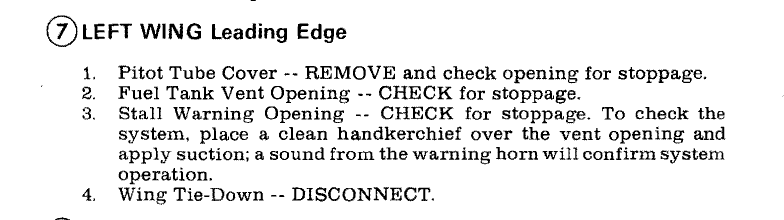
If I read the POH correctly, it should(or COULD) be tested, when in case You read the testing is an option/extension of the "check for stoppage". Working with those age-old POHs can be a challenge. Strange decision at that time, high wingers with those high placed, not so easy to reach openings, low wingers with lip-switches...
Joined: Apr 2008
Aviation Qualifications: ATPL
Posts: 1,122
Likes: 183
From: cowtown
When all else fails read the POH/ AFM
The fun way to check it is to get in slow flight and play a tune on it .
I flew with an inspector of twenty five years experience, who had never played a tune on the stall horn . We had some fun doing that . I can still see his face light up as he played a tune . I think the lesson was how to help someone having difficulty landing and I find that most students that have difficulty landing have not had enough practice or confidence in slow flight regime of flight .
The fun way to check it is to get in slow flight and play a tune on it .
I flew with an inspector of twenty five years experience, who had never played a tune on the stall horn . We had some fun doing that . I can still see his face light up as he played a tune . I think the lesson was how to help someone having difficulty landing and I find that most students that have difficulty landing have not had enough practice or confidence in slow flight regime of flight .
Joined: Jul 2010
Posts: 2,807
Likes: 10
From: Ansião (PT)
Two side-thoughts that might shock some people:
* I once saw a cartoon drawing of a Cessna undergoing this operation from a short-skirted lady student - and with a broad grin drawn on the engine cowling
* a properly trained pilot does not need this kind of gimmick at all. An approaching stall is felt in the seat of the pants (or skirt) and should trigger a warning automatically and instinctively.
[later addition, @below: admittedly, I can only speak for benign low-performance planes. Things may indeed be different on more demanding planes]
* I once saw a cartoon drawing of a Cessna undergoing this operation from a short-skirted lady student - and with a broad grin drawn on the engine cowling
* a properly trained pilot does not need this kind of gimmick at all. An approaching stall is felt in the seat of the pants (or skirt) and should trigger a warning automatically and instinctively.
[later addition, @below: admittedly, I can only speak for benign low-performance planes. Things may indeed be different on more demanding planes]
Last edited by Jan Olieslagers; 18th March 2021 at 17:54.
Joined: Nov 2014
Posts: 10
Likes: 0
From: Hungary
There are aircraft types where you would like to know that the stall approaches way before the shaking starts. Low wing symmetric wing profile during a turn won't give you too much time before a stall and a spin developed from it. An AOA indicator is the best for those cases in my opinion.
Joined: Dec 2001
Aviation Qualifications: ATPL
Posts: 3,765
Likes: 424
From: GA, USA
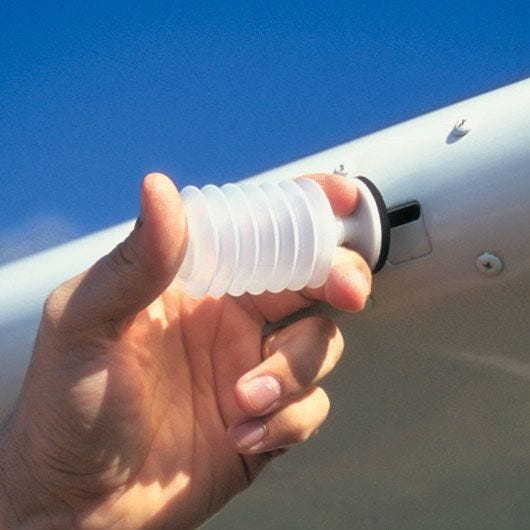
$10 from Sporty’s or Ebay.
Why test it? Because it’s required equipment that’s why.
By certification requirements so the aircraft is not airworthy if it’s found to be inoperative.
Joined: Feb 2008
Posts: 134
Likes: 103
From: Apple Maggot Quarantine Area
https://www.safeflight.com/products/...lift-detector/
https://www.aircraftspruce.com/catal...s/prestall.php
Fleet Manager
Joined: Aug 2006
Aviation Qualifications: CPL
Posts: 7,089
Likes: 2,952
From: Ontario, Canada
I guess that you could try installing the 'flip-up-via-airflow' mechanical type stall warning horn switch.
It is permissible to approve a certified plane with "buffet" being the only stall warning - no stall warning system. I have flown a certified single engine turbine plane which had no stall warning system, just buffet, as well as various "Cubs", Tiger Moths, and other vintage planes. But, I agree, if equipped, it should work- If it doesn't work, the plane is not "airworthy", and should not be flown.
Yes, the switches are astoundingly expensive, but they're not a regular microswitch, they are specially made for that application, yes, I'm sure, with high product liability costs.....

Joined: Jan 2004
Posts: 5,658
Likes: 501
From: Canada
A friend had to replace his heated stall warning vane on a deiced twin Cessna. It was 7000 USD 

Yes the heating pad added a bit to the cost but they are still stupid expensive
The reed system works fine and a first flight of the day check is plenty
Yes the heating pad added a bit to the cost but they are still stupid expensive
The reed system works fine and a first flight of the day check is plenty

Joined: Nov 2005
Aviation Qualifications: PPL
Posts: 12,458
Likes: 368
From: Wildest Surrey
If I read the POH correctly, it should(or COULD) be tested, when in case You read the testing is an option/extension of the "check for stoppage". Working with those age-old POHs can be a challenge. Strange decision at that time, high wingers with those high placed, not so easy to reach openings, low wingers with lip-switches...
Entered the snag in the tech log and of course, pointed it out to the person on the desk; 2 weeks later, that same aircraft spun in with 2 fatalities.
Interviewed by AAIB, they told me there was no record of the snag being rectified even though it was clearly in the tech log.
Next time I flew at Denham, the club owner interviewed me and bollocked me for carrying out a stall without an instructor on board.
Last edited by chevvron; 23rd March 2021 at 17:17.

Joined: Aug 2000
Aviation Qualifications: ATPL
Posts: 1,221
Likes: 129
From: Near Stuttgart, Germany
The high price must be mainly due to liability issues and paperwork because these things cost around 150$/Euros/GBP for homebuilt aircraft. Which is still 100 times the cost of the parts... But otherwise I fully agree with you, keep it as simple as possible. The pneumatic stall warner of the Cessnas is very realiable - in my experience a lot more than the electric ones in Pipers for example. And really, whats the big deal in putting a piece of cloth over it and just testing it?
Joined: Nov 2014
Posts: 10
Likes: 0
From: Hungary
The high price must be mainly due to liability issues and paperwork because these things cost around 150$/Euros/GBP for homebuilt aircraft. Which is still 100 times the cost of the parts... But otherwise I fully agree with you, keep it as simple as possible. The pneumatic stall warner of the Cessnas is very realiable - in my experience a lot more than the electric ones in Pipers for example. And really, whats the big deal in putting a piece of cloth over it and just testing it?
Joined: Mar 2014
Posts: 497
Likes: 0
From: Way north
If I read the POH correctly, it should(or COULD) be tested, when in case You read the testing is an option/extension of the "check for stoppage". Working with those age-old POHs can be a challenge. Strange decision at that time, high wingers with those high placed, not so easy to reach openings, low wingers with lip-switches...
Last edited by jmmoric; 22nd March 2021 at 08:26.

