


Old ADF

Thread Starter
Joined: Apr 2016
Posts: 221
Likes: 0
From: localhost
Old ADF
Wondering if I can get some help here!
A Cessna aircraft I'm now flying has a very old ADF (1969) - it's one with a big dial in the middle. I've seen one in a PA-28 too.
Being used to a "normal" ADF with a digital output I'm a little perplexed by this device and wondering if anyone knows how to translate frequencies in the chart onto the ADF? It seems to have various subscales and a selector for decimal point position.
A Cessna aircraft I'm now flying has a very old ADF (1969) - it's one with a big dial in the middle. I've seen one in a PA-28 too.
Being used to a "normal" ADF with a digital output I'm a little perplexed by this device and wondering if anyone knows how to translate frequencies in the chart onto the ADF? It seems to have various subscales and a selector for decimal point position.

Joined: Sep 2015
Posts: 442
Likes: 0
From: London
Twiddle them till you figure it out?
A picture might help, but generally speaking - the old ones I have flown have a single knob per digit (hence 3 knobs below each digit). When you turn them you should see one of the 3 digits change, and hence get your frequency dialled in.
Sorry if this is a little vague!
A picture might help, but generally speaking - the old ones I have flown have a single knob per digit (hence 3 knobs below each digit). When you turn them you should see one of the 3 digits change, and hence get your frequency dialled in.
Sorry if this is a little vague!

Joined: Jun 2003
Posts: 748
Likes: 9
From: LFMD
These old ADFs are very easy to use.
1. Cover it up with a suitable sized piece of card saying "INOP" in large friendly letters.
2. Use something invented since WW2 for navigation - an iPad works very well.
1. Cover it up with a suitable sized piece of card saying "INOP" in large friendly letters.
2. Use something invented since WW2 for navigation - an iPad works very well.
Joined: Sep 2015
Posts: 442
Likes: 0
From: London
These old ADFs are very easy to use.
1. Cover it up with a suitable sized piece of card saying "INOP" in large friendly letters.
2. Use something invented since WW2 for navigation - an iPad works very well.
1. Cover it up with a suitable sized piece of card saying "INOP" in large friendly letters.
2. Use something invented since WW2 for navigation - an iPad works very well.

Joined: Dec 1998
Posts: 4,282
Likes: 6
From: Escapee from Ultima Thule
Not sure about what you described. Is it an analog tuner? If so, from memory:
Controls/switches:
* Just like a digitally tuned ADF, it will have a selector, or a couple of selectors, for OFF, ANT, ADF, and BFO.
* It will also have a band/frequency range selector. Use it to tune what frequency range on the analogue scale you wish to tune.
* Frequency scale
* A signal strength meter.
* A tuning knob
To tune a station:
1. Determine the frequency you wish to receive
2. Select the frequency range selector to cover the particular frequency you wish to receive
3. Switch to ANT
4. Select ADF audio 'on' on the aircraft's audio panel
5. Rotate the tuning knob until the needle on the frequency scale is close to the frequency you want.
6. Slowly turn the tuning knob so that the needle continues to move towards the desired frequency.
7. Watch the signal strength meter until it peaks. You may have to slowly rotate the tuning knob back & forth to be satisfied you have the best signal.
8. Listen to the morse ident to confirm the correct station. If it's not correct then you've tuned the wrong station. Check each of the steps above. If you can't hear anything, and are tuning a French NDB, select BFO to add sound to the signal.
9. Select 'ADF' to activate the DF function.
Controls/switches:
* Just like a digitally tuned ADF, it will have a selector, or a couple of selectors, for OFF, ANT, ADF, and BFO.
* It will also have a band/frequency range selector. Use it to tune what frequency range on the analogue scale you wish to tune.
* Frequency scale
* A signal strength meter.
* A tuning knob
To tune a station:
1. Determine the frequency you wish to receive
2. Select the frequency range selector to cover the particular frequency you wish to receive
3. Switch to ANT
4. Select ADF audio 'on' on the aircraft's audio panel
5. Rotate the tuning knob until the needle on the frequency scale is close to the frequency you want.
6. Slowly turn the tuning knob so that the needle continues to move towards the desired frequency.
7. Watch the signal strength meter until it peaks. You may have to slowly rotate the tuning knob back & forth to be satisfied you have the best signal.
8. Listen to the morse ident to confirm the correct station. If it's not correct then you've tuned the wrong station. Check each of the steps above. If you can't hear anything, and are tuning a French NDB, select BFO to add sound to the signal.
9. Select 'ADF' to activate the DF function.

Joined: Feb 2003
Posts: 2,042
Likes: 0
From: Oxford
I miss the one I used to use. It came with a massive aerial running from the tip of the fin to above the cockpit, and made me feel like I was in a DC3. Plus it had excellent gain - it dated from when ADFs were new and exciting.
The digital one may be half the size and a tenth of the weight but somehow it's a bit anodyne.
The digital one may be half the size and a tenth of the weight but somehow it's a bit anodyne.
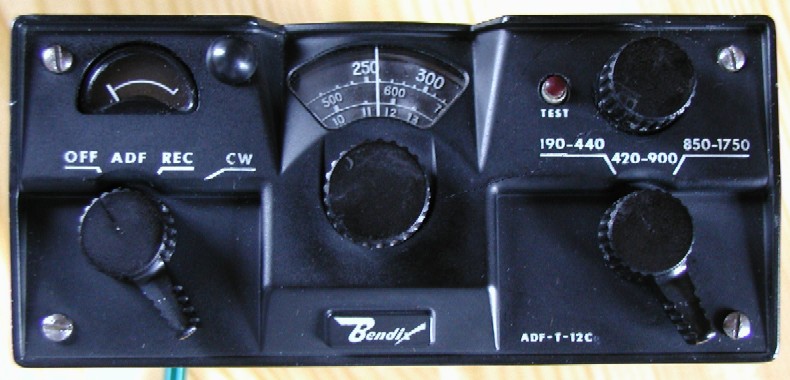


Joined: Jul 2001
Posts: 486
Likes: 0
From: Belgium
They don't make em like this anymore.
1. Select the frequency band you need on the right
2. turn the middle knob until you have the approximate frequency shown on the dial
3. fine tune for maximum strength on the left hand meter
4. listen and identify the morsecode.
1. Select the frequency band you need on the right
2. turn the middle knob until you have the approximate frequency shown on the dial
3. fine tune for maximum strength on the left hand meter
4. listen and identify the morsecode.
Joined: Sep 2004
Posts: 1,684
Likes: 3
From: Down at the sharp pointy end, where all the weather is made.
The big plus with these tuneable receivers is that if you're getting interference, you can very slightly de-tune to improve reception - the signal strength meter might be picking up interference. Harks back to the days of trying to tune in Radio Luxemburg - '208, your station of the stars!' Maybe you'll be able to get the Light Programme, or if you're a serious wireless listener, the Home Service. We still get that, locally, on 756 kHz, very handy for practice holds.
If you have such an ADF and it still works, then I'd hang on to it, for as long as there are NDBs about, of course, which might be quite some time.
TOO
If you have such an ADF and it still works, then I'd hang on to it, for as long as there are NDBs about, of course, which might be quite some time.
TOO
Joined: Oct 2004
Posts: 6,626
Likes: 12
From: UK
BFO- Beat frequency oscillator. Not required in the UK but I am told it was required to ident NDB's in France.
Being used to a "normal" ADF with a digital output
Thread Starter
Joined: Apr 2016
Posts: 221
Likes: 0
From: localhost
Jay Sata - Yes it is!!
Tinny - thanks for the guide. I'm trying to understand how the three scales shown on the dial actually relate to the frequencies displayed on a map - would you have any idea?
Tinny - thanks for the guide. I'm trying to understand how the three scales shown on the dial actually relate to the frequencies displayed on a map - would you have any idea?
Thread Starter
Joined: Apr 2016
Posts: 221
Likes: 0
From: localhost
That's as maybe but some of use grew up after slide rules and analogue radios and consequently have no idea how on earth these old bits of kit work!
Joined: Sep 2011
Posts: 639
Likes: 4
From: Mare Imbrium
The one in Jay's picture is tuned to 258kHz. The selector switch on the right selects which range of frequencies is tuned and you rotate the dial referring to the appropriate scale to a position that equates to the frequency you want. All NDBs are low frequency around the bottom of the medium wave broadcast band so their frequencies are in a few hundreds of kHz.
Just to make it a bit more fun, the scale might be inaccurate by a few kHz, which is why you need the Morse identifier to confirm you are tuned to the right beacon.
Most NDBs are amplitude modulated with a tone so you don't need a bfo. Bfo would be needed to hear the tone (so you can read the Morse) if it is carrier wave only (A1 modulation: that means the Morse is sent by turning the signal itself, or 'carrier wave' on and off.
1940's technology but good stuff nonetheless.
Just to make it a bit more fun, the scale might be inaccurate by a few kHz, which is why you need the Morse identifier to confirm you are tuned to the right beacon.
Most NDBs are amplitude modulated with a tone so you don't need a bfo. Bfo would be needed to hear the tone (so you can read the Morse) if it is carrier wave only (A1 modulation: that means the Morse is sent by turning the signal itself, or 'carrier wave' on and off.
1940's technology but good stuff nonetheless.
Last edited by Heston; 11th January 2017 at 11:08. Reason: Added a bit

Joined: Feb 2016
Aviation Qualifications: CPL
Posts: 2,037
Likes: 85
From: S.E.Asia
I agree with you Heston. I was based near the Bristol Channel decades ago and could navigate direct back from France using the 75 killowatt BBC Wales transmitter at Washford. I could pick it up on the ground at Schipol.
They were wonderfull bits of kit in Australia where a MW radio station could be used as a homing beacon and provide in cockpit entertainment.
They were wonderfull bits of kit in Australia where a MW radio station could be used as a homing beacon and provide in cockpit entertainment.