


Hot, hot, hot!

Thread Starter
Joined: Jan 2009
Posts: 1,546
Likes: 2
From: Oxford, UK
Hot, hot, hot!
Been working out your density altitude any time this week?
In weather like we've been having lately, one is grateful for high wing types with wide open doors....Reminds me of flying in Florida and getting sunbaked in a poorly fenestrated Piper....all that money and no air conditioning.
In weather like we've been having lately, one is grateful for high wing types with wide open doors....Reminds me of flying in Florida and getting sunbaked in a poorly fenestrated Piper....all that money and no air conditioning.



Joined: Jun 2002
Aviation Qualifications: PPL
Posts: 7,177
Likes: 297
From: Nanaimo (CAC8)
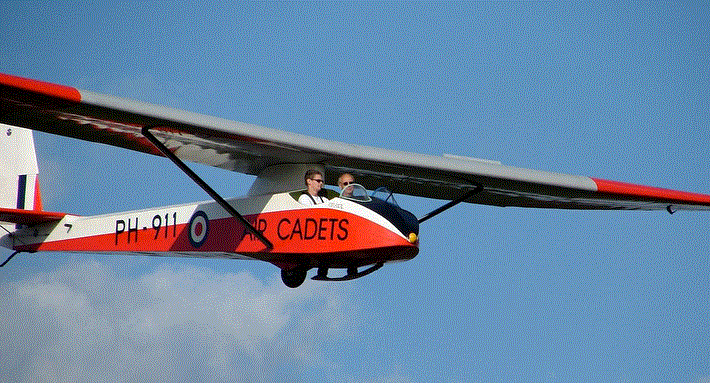
It's been been hot in Western Canada too. At my gliding club's airfield in Alberta (Black Diamond CEH2), the elevation is 3700'. Once the temperature exceeds 30° C, we implement a progressively decreasing gross weight limit for the club's two-seaters.
We've recently had density altitudes in excess of 7000'. I know that's not high by Colorado standards, but it's high enough to make our 180 HP Scout run out of steam.
We've recently had density altitudes in excess of 7000'. I know that's not high by Colorado standards, but it's high enough to make our 180 HP Scout run out of steam.

Joined: May 2010
Posts: 246
Likes: 0
From: Hampshire
Funnily enough I have been working out density altitudes this week. I'm involved with the F1 air racing crowd and we had two races last month, one in Tunisia and one in Spain. It was very hot in Spain, about 40 degrees, so when giving out the results, I calculated the density altitude for the Spanish race this year vs the Spanish race last year. It was 4100 feet this year vs 2000 feet the year before.
There has long been a debate about whether the guys at Reno fly faster because they are in thinner air, or slower because their engines don't get as much. The results for Spain showed a 3 mph gain per 1000' increase in altitude. This only seemed to apply to the cleaner airframes, with little to be gained by the stock slab wing Cassutts.
This would put the gold race winner at Reno at about 264 mph total race speed(average speed over 8 laps). I'm looking forward to finding out if this prediction is accurate. The current single lap course record is 267 mph.
There has long been a debate about whether the guys at Reno fly faster because they are in thinner air, or slower because their engines don't get as much. The results for Spain showed a 3 mph gain per 1000' increase in altitude. This only seemed to apply to the cleaner airframes, with little to be gained by the stock slab wing Cassutts.
This would put the gold race winner at Reno at about 264 mph total race speed(average speed over 8 laps). I'm looking forward to finding out if this prediction is accurate. The current single lap course record is 267 mph.


Joined: Nov 2007
Aviation Qualifications: ATPL
Posts: 1,954
Likes: 30
From: Texas
There has long been a debate about whether the guys at Reno fly faster because they are in thinner air, or slower because their engines don't get as much.


Joined: Jan 2001
Posts: 5,982
Likes: 1
From: In the boot of my car!
Hottest I ever saw and the limits on a Citation was 52 C in Seville.
Luckily I wasn't flying but on holiday. Leaving the air-conditioned Hotel was like stepping into an oven and took your breath away
Pace
Luckily I wasn't flying but on holiday. Leaving the air-conditioned Hotel was like stepping into an oven and took your breath away
Pace
Joined: May 2010
Posts: 246
Likes: 0
From: Hampshire
MI, I think you might be confusing the F1 aeroplanes at Reno with the Unlimiteds. The big difference being that the F1 class runs unsupercharged 0-200s rather than supercharged WW2 fighter engines.
Some of the F1 planes are achieving positive manifold pressure via very clever intake design, but there is still no way a non-supercharged engine will make as much power at 5000' as it does at sea level.
Some of the F1 planes are achieving positive manifold pressure via very clever intake design, but there is still no way a non-supercharged engine will make as much power at 5000' as it does at sea level.
