


Wow! Engine failure after takeoff in Bonanza.

Thread Starter
Joined: Sep 2006
Posts: 1,631
Likes: 0
From: Los Angeles, USA
Wow! Engine failure after takeoff in Bonanza.
Everyone lived, thankfully. Great footage from 3 different angles. The most well documented EFATO ever, probably.
As you can see, the earth comes up to meet you a lot faster than you think when you're carrying a lot of drag in the T/O config. I initially thought he'd get to the green field a lot further in, but as you can see he barely makes it. Glad everyone is fine.
Airplane Crash at Fairbanks Shown from 3 Onboard Cameras N334DH - YouTube
As you can see, the earth comes up to meet you a lot faster than you think when you're carrying a lot of drag in the T/O config. I initially thought he'd get to the green field a lot further in, but as you can see he barely makes it. Glad everyone is fine.
Airplane Crash at Fairbanks Shown from 3 Onboard Cameras N334DH - YouTube
Last edited by AdamFrisch; 24th May 2013 at 21:38.

Joined: Aug 2000
Posts: 1,214
Likes: 0
From: S Warwickshire
I was 1 minute behind Dale in the Bonanza on that group take off. It was actually nearer 200' than 400' so not enough time to put the gear down.
Here's the official NTSB narrative.
He ended up with a bruise in the chest the exact shape of a Bonanza yoke!
We were guessing that it might have been something like a sheared camshaft to switch off the power that quickly, so still mystified.
This was the view I had from my cockpit window:
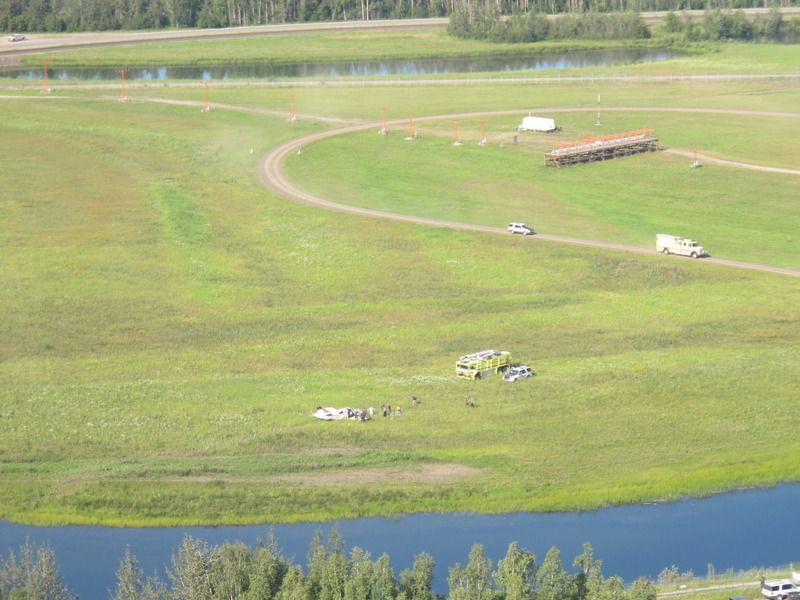 [/URL]
He's now bought a twin!
Here's the official NTSB narrative.
He ended up with a bruise in the chest the exact shape of a Bonanza yoke!
We were guessing that it might have been something like a sheared camshaft to switch off the power that quickly, so still mystified.
This was the view I had from my cockpit window:
[/URL]He's now bought a twin!
Last edited by Mark 1; 25th May 2013 at 07:11.

Joined: Jul 2001
Posts: 486
Likes: 0
From: Belgium
A friend of mine had almost the same experience, engine failure after take-off at about 100ft above the runway; The engine was running fine on post-crash examination. Prop and airframe severely bent, total loss, occupants to hospital.
Sequence of events:
On the previous flight Left tank had been run dry in the air. No big deal, switch tanks and continue. Both tanks filled before next take-off. Runup and taxi done on Right tank. On the runway, aligned for take-off, SWITCHED TO THE LEFT TANK, followed printed checklist that said 'fullest tank'.
NOTE: Left tank or fuel selector has not been drained or used in any way since the refuelling.
Pocket of air between fuel tank and fuel selector valve now travels towards the engine. There is just enough fuel in the line to bring the aircraft to about 100ft and then SILENCE. Engines don't run on air.
Very preventable. Start and taxi on one tank, switch to the other tank for runup and stay on that proven tank until at safe altitude.
Don't change tanks after run-up.
On this particular aircraft, I had previously experienced that it could take from 10-20 seconds before the engine would run again after switching from an empty tank (at altitude).
Sequence of events:
On the previous flight Left tank had been run dry in the air. No big deal, switch tanks and continue. Both tanks filled before next take-off. Runup and taxi done on Right tank. On the runway, aligned for take-off, SWITCHED TO THE LEFT TANK, followed printed checklist that said 'fullest tank'.
NOTE: Left tank or fuel selector has not been drained or used in any way since the refuelling.
Pocket of air between fuel tank and fuel selector valve now travels towards the engine. There is just enough fuel in the line to bring the aircraft to about 100ft and then SILENCE. Engines don't run on air.
Very preventable. Start and taxi on one tank, switch to the other tank for runup and stay on that proven tank until at safe altitude.
Don't change tanks after run-up.
On this particular aircraft, I had previously experienced that it could take from 10-20 seconds before the engine would run again after switching from an empty tank (at altitude).
Joined: Apr 2006
Aviation Qualifications: PPL
Posts: 240
Likes: 9
From: Lestah
Why would you knowingly run a tank dry? and given your explanation of events and outcome, running a tank dry is a tad more than 'no big deal'.
Seems poor airmanship to me to run a tank down to empty before switching.
Having also suffered an EFATO at 500 feet directly over the M1 motorway, time is indeed very short.
Seems poor airmanship to me to run a tank down to empty before switching.
Having also suffered an EFATO at 500 feet directly over the M1 motorway, time is indeed very short.
Joined: Jan 2001
Posts: 5,982
Likes: 1
From: In the boot of my car!
Amazing footage! He only just made it over the water onto hard ground and what really surprised was the really short distance the aircraft stopped in.
Very pleased no one was seriously injured as it could have turned out far worse.
We should practice EFAT more in different configs and mentally selecting possible landing sites should the big shock occur
Pace
Very pleased no one was seriously injured as it could have turned out far worse.
We should practice EFAT more in different configs and mentally selecting possible landing sites should the big shock occur
Pace
Joined: Jul 2005
Posts: 1,929
Likes: 0
From: SoCal
On the runway, aligned for take-off, SWITCHED TO THE LEFT TANK, followed printed checklist that said 'fullest tank'
I have always considered this advice / technique idiotic and downright dangerous. After all, you KNOW the plumbing of the tank you have done your taxi out and runup on is working ok and the fuel flows. Why then change to what essentially is an untested tank & plumbing at the most critical phase of flight ?

If you absolutely feel you have to test both tanks, than taxi out on one and do the runup on the other. Prevents nasty surprises.
Other than that, well done the guy in the Bonanza.
 He also had a spot of luck there - just a tiny bit earlier and he would have hit the embankment. Glad he walked away, albeit 'Bonanza branded'
Last edited by 172driver; 25th May 2013 at 09:29. Reason: typo

Joined: Aug 2005
Posts: 2,525
Likes: 0
From: fl
We were waiting for our passengers to arrive for our Learjet flight at Burbank and watched a Bonanza with 4 people lose an engine about 200 ft. He tried to turn back but stalled and spun in killing all. Very sad but we never said a word about the smoke when we took off to our two pax. We were always taught at low altitude don't look back because it isn't going to work.
Joined: Feb 2003
Posts: 2,042
Likes: 0
From: Oxford
Indeed. Some people say never turn back; others have tried to establish a suitable altitude to make that decision. For example the pre-takeoff brief in the RAF Tutor ac was (last time I was in one, which is 3-4 years ago) that they would consider a turnback above 800ft AGL if the terrain ahead looked unsuitable. That's a lot more than 200ft!
Tim
Tim
Joined: Aug 2005
Posts: 2,525
Likes: 0
From: fl
Sometimes with terrain you have no alternative but to turn back if you have the altitude. I practiced on my flight sim 2000 turning back trying to land downwind at TGU in Honduras at 1500 ft because turkey buzzards were in flocks everywhere and it worked half the time in the sim. Guess a better chance than landing on houses or into terrain. If you stand the 757 on it's wingtip and get it around there you stand the best chance.
Kind of like the chances of Sully making it back from the Hudson to LGA. Might have worked but probably wouldn't. He did the right thing to save everybody.
Kind of like the chances of Sully making it back from the Hudson to LGA. Might have worked but probably wouldn't. He did the right thing to save everybody.
Joined: May 2001
Posts: 10,804
Likes: 1
If you stand the 757 on it's wingtip and get it around there you stand the best chance.
Whats your Vmca when you stick it on its wing tip then.
Stick to MFS please for gods sake.
Joined: Aug 2005
Posts: 2,525
Likes: 0
From: fl
OK Lord let me explain it more simply, obviously I wouldn't turn back unless I lost both engines. Turkey buzzards can cause that to happen you know just like Canadian geese that Sully dealt with. At 1500 feet could you make a standard 30 degree bank and make it back? No. You could do a steeper bank to maybe 45 to 50 degrees and maybe make it back. If you go straight ahead you crash into the side of a mountain because there is no where else to go. Now do you understand? I can diagram the terrain around TGU if you need it or you can just look it up. That small river isn't going to hack it because it isn't straight and wide like the Hudson.
Joined: Aug 2005
Posts: 2,525
Likes: 0
From: fl
Lord, we avoided 98 % of them but my FO took off one day and approaching 500 ft we turned away from one opposite our clearance, the buzzard turned with us so we reversed our bank as the bird did. They always dive so we pulled up and he climbed and hit right over our cockpit window. You can avoid 98% of them but then you get one like this. We flew at a lower altitude back to Miami in case that big bird split a seam. Standing it on a wingtip was a figure of speach, of course the plane is not designed for that but if you let the nose drop during a steep turn you can get turned around and try for the only survivable touchdown spot or you can just fly straight ahead into the terrain, your choice.
Joined: Aug 2005
Posts: 2,525
Likes: 0
From: fl
Make that 99.9% of them because in 600 flights there we hit one with no damage we found out. Just a big blood spot. At take off flaps at low altitude the 757 isn't that maneuverable. I called the bird out and he made all the maneuvers as I would have but the buzzard was on a death mission I guess. My chief pilot took two aircraft out of commision hitting birds and he didn't fly there that much.