


Fuel Circles

Moderator


Joined: Feb 2000
Aviation Qualifications: CPL
Posts: 14,480
Likes: 178
From: UK
all the proprietrary plogs are woeful as fuel planners
So, I designed my own, and tweak it periodically to meet my slightly changing perception of the "perfect PLOG".
Since I've become an instructor, I've just been giving that PLOG as a word file to my students, the good ones have used it, the very good ones have adapted it to suit their own preferences.
G

Joined: Jan 1999
Posts: 6,209
Likes: 2
From: north of barlu
Fuel planning
The computer flight plan that I have will give you the minimum fuel required to do the flight, it then has the minimum fuel on board at each waypoint.
So it is all quite simple, if you don't have the correct fuel quantity at a waypoint then you are going to have to divert.
I can see how this is a problem using the average fuel gauge so for most American aircraft a fuel flow meter is essential.
Fortunately the Robin I fly has four fuel tanks and by running them almost dry (a very accurate tank almost empty light is fitted) you can get a very accurate fuel plot going based on the conditioned for the day rather than filght manual numbers. I have had fuel flow numbers within a ltr after four hours flying in this aircraft however I would not run any aircraft that I did not know well without a much larger margin for error.
So it is all quite simple, if you don't have the correct fuel quantity at a waypoint then you are going to have to divert.
I can see how this is a problem using the average fuel gauge so for most American aircraft a fuel flow meter is essential.
Fortunately the Robin I fly has four fuel tanks and by running them almost dry (a very accurate tank almost empty light is fitted) you can get a very accurate fuel plot going based on the conditioned for the day rather than filght manual numbers. I have had fuel flow numbers within a ltr after four hours flying in this aircraft however I would not run any aircraft that I did not know well without a much larger margin for error.
Joined: Dec 2011
Posts: 2,460
Likes: 0
Problem with using it in light aircraft is that you need an accurate enough fuel gauge
a) is easy.
b) is not so easy, but can be established by e.g. doing two identical flights which have different length cruise sections. Fill up before and after each flight and then you can work out your fuel flow in cruise. Assuming of course you lean equally in both cases.
The fuel gauges are actually irrelevant. Mine happen to be very accurate (expensive capacitive type) but I use them only for switching tanks. When flying solo I run down the LHS tank by about 1/4" on the gauge, to keep the plane flying straight.
It is critical to know the progress of the flight in terms of fuel.
Thread Starter
Joined: Sep 2011
Posts: 280
Likes: 0
From: Lincolnshire
All my contacts with other PPLs suggest that fuel management is poorly addressed in PPL training, and my own experience confirms this. .....PPL training practices err on the safe side and most flying is done with the mixture set to fully-rich and few pilots are taught about leaning. Much reliance is placed on using ground based logs of flight times to determine the remaining fuel on board (FOB); this generally works because conservative fuel consumption figures are used and most training flights are short. The downside of this system is that a large part of the aeroplane's real range is not available and a pilot wishing to embark on a long flight is venturing into unfamiliar territory, and quite spectacular fuel planning related incidents do
happen.
happen.
Am I not correct in thinking the aircraft's real range is in the POH? Talking of the POH, yes, fuel consumption is in there, yes, in our case certainly they are about 30 years old, but that is at least a guide. The wise pilot surely also checks the fuel gauge en route...
but using time rather than fuel state.
Are pilots who use GPS so aware of how much fuel they are using? Would you know that you should not do that extra leg because you would not get back to base?
Agree with A&C re fuel planning. I was trained as an FI with fuel circles and that's what I teach my students as all the proprietrary plogs are woeful as fuel planners.
 How do other FI's instruct their students wrt Fuel planning?
Joined: Dec 2011
Posts: 2,460
Likes: 0
Most people use a portable GPS, and I don't know how you would best use a portable GPS to assist with fuel planning.
I suppose the biggest contribution is that you know where you are and aren't going to get lost. Getting lost does have a tendency to affect one's fuel plans
But you also know your GS and your ETA, and assuming you know the fuel burn you can work out the LFOB (landing fuel on board) from that, manually. If you have 2hrs to run and your burn is 10GPH then you know you will burn another 20 gallons before you get there.
As regards extra legs, my feeling is that the best way is to plan the flight as best as one can, and execute it to the plan. Then (assuming you know the fuel burn) the fuel ought to work out.
I did some (somewhat artificial but required by the FTO) detailed fuel plans in the JAA IR training. One is supposed to maintain a fuel column in the plog. Accounting for every approach, every missed approach, every time around the hold, I managed to get the error down to 1 USG, which was about 3%. The plog form didn't have anywhere enough room so I used a spreadsheet. But paradoxically this is unworkable in "common GA" because the fuel burn is not known anywhere near that accurately. It is know to within about 20%. I was able to make it add up because I know the fuel flow to 1%, but if you know the fuel flow to 1%, and it is GPS linked to compute the LFOB, you don't need to maintain a fuel column in the plog In fact you just look at the current FOB reading and decide if another 5 holds or whatever will deplete it too much.
I suppose the biggest contribution is that you know where you are and aren't going to get lost. Getting lost does have a tendency to affect one's fuel plans
But you also know your GS and your ETA, and assuming you know the fuel burn you can work out the LFOB (landing fuel on board) from that, manually. If you have 2hrs to run and your burn is 10GPH then you know you will burn another 20 gallons before you get there.
As regards extra legs, my feeling is that the best way is to plan the flight as best as one can, and execute it to the plan. Then (assuming you know the fuel burn) the fuel ought to work out.
I did some (somewhat artificial but required by the FTO) detailed fuel plans in the JAA IR training. One is supposed to maintain a fuel column in the plog. Accounting for every approach, every missed approach, every time around the hold, I managed to get the error down to 1 USG, which was about 3%. The plog form didn't have anywhere enough room so I used a spreadsheet. But paradoxically this is unworkable in "common GA" because the fuel burn is not known anywhere near that accurately. It is know to within about 20%. I was able to make it add up because I know the fuel flow to 1%, but if you know the fuel flow to 1%, and it is GPS linked to compute the LFOB, you don't need to maintain a fuel column in the plog
In fact you just look at the current FOB reading and decide if another 5 holds or whatever will deplete it too much.
Thread Starter
Joined: Sep 2011
Posts: 280
Likes: 0
From: Lincolnshire
As regards extra legs, my feeling is that the best way is to plan the flight as best as one can, and execute it to the plan. Then (assuming you know the fuel burn) the fuel ought to work out.
I did some (somewhat artificial but required by the FTO) detailed fuel plans in the JAA IR training. One is supposed to maintain a fuel column in the plog.....The plog form didn't have anywhere enough room so I used a spreadsheet.
But paradoxically this is unworkable in "common GA" because the fuel burn is not known anywhere near that accurately. It is know to within about 20%.

Joined: Dec 2011
Posts: 2,460
Likes: 0
and did you find this useful? Wouldn't it have been much better on your chart though instead of a spreadsheet?!
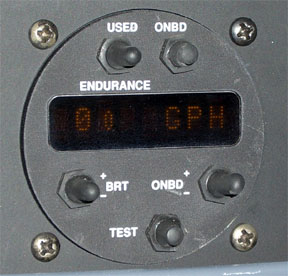
and I get the "exact" fuel in the tanks, and I know the flow rate because it is on the display. I don't need range circles on the map, and anyway they are not circles if there is any wind ..... and at 90kt IAS the wind could be awfully relevant
when flying at 90kts, one does not have to be quite so accurate
Joined: Apr 2009
Posts: 2,817
Likes: 1
From: Hotel Gypsy
Doesn't anyone read the POH any more? For example, the Cessna 172 has a fine (and accurate) cruise performance table. Set an RPM and lean in accordance with the guidance in Normal Operating Prcedrues and you'll get a pretty accurate fuel burn. Add 10% and 45 mins if, like me, you like to adopt IFR criteria and you will never need to stare longingly at notoriously inaccurate fuel gauges.
PS. I agree about the poor standard of training on this during PPL; we appear to have resorted to filling the tanks and assuming a pilot will be bored, out of cash or in need of a pee before the tanks run dry.
PS. I agree about the poor standard of training on this during PPL; we appear to have resorted to filling the tanks and assuming a pilot will be bored, out of cash or in need of a pee before the tanks run dry.
Joined: Nov 2001
Posts: 939
Likes: 1
From: UK
Set an RPM and lean in accordance with the guidance in Normal Operating Prcedrues and you'll get a pretty accurate fuel burn. Add 10% and 45 mins if, like me, you like to adopt IFR criteria and you will never need to stare longingly at notoriously inaccurate fuel gauges.
Joined: May 2008
Posts: 1,366
Likes: 0
From: UK
in need of a pee before the tanks run dry.

Also, I've flown a few vintage aircraft where the oil consumption is more limiting that the fuel - you can carry 5 hours of fuel but only perhaps 3-4 hours oil.
Pilots should always be aware of their remaining endurance and/or range, but most civvie schools air an awful lot on the cautious side. One school I visited offered students a fuel planning sheet with a fuel burn stated of 35 litres/hr for a PA28, when the POH would state something more around 28 for a normal cruise level/leaned, and less if you got higher.
Most training flights don't last much more than an hour, and you would usually have at least 3 hours fuel when you taxi out, so it's not really part of the normal flying training to fly right down to minimum fuel.
Thread Starter
Joined: Sep 2011
Posts: 280
Likes: 0
From: Lincolnshire
I see Peter...I don't recognise that gadget so we obviously don't have one But I can see now, why you always know your exact fuel and the flow rate!
True. But we only fill our tanks with enough fuel plus a bit for the Sortie. Hence most training trips will only use about 20 litres, leaving 40 in the tank. But if we are flying navexes out of the local area, or the qualified club pilots are taking a club aircraft out, we will fuel up with more. So training with planning using fuel circles ensures that we fill up with enough fuel and that we don't fly down to minimum fuel. This system also ensures that we know (ok, I know as the student) the minimum fuel required to land with.
As it happens, I am planning a trip of 93 miles at the moment, with the aforementioned fuel circles, and I know that I can fuel up with 75 litres and be fine...
But I can see now, why you always know your exact fuel and the flow rate!
Most training flights don't last much more than an hour, and you would usually have at least 3 hours fuel when you taxi out, so it's not really part of the normal flying training to fly right down to minimum fuel.
As it happens, I am planning a trip of 93 miles at the moment, with the aforementioned fuel circles, and I know that I can fuel up with 75 litres and be fine...
Joined: Apr 2010
Posts: 1,320
Likes: 102
From: IRS NAV ONLY
I know the fuel gauges are notoriously unreliable, but you could always do a simple calibration test here and then - very simple, especially if aircraft flies a lot.
You drain the tanks, put in the unusable fuel - the fuel gauges should read zero. Then you start filling up, let's say in 5 USgal increments - and check what the gauges read and note it down. You end up with a full tank and a nice table showing actual fuel in tanks vs. fuel shown by the fuel gagues. Quite simple or am I missing something here?
Obviously you don't need a fuel totalizer if you're doing one-hour trips, although it's quite handy to have one - or at least an accurate fuel flow gauge.
Spot on! If only people weren't afraid of the red knob and follow the leaning procedure in the POH exactly, the fuel flow probably wouldn't be more than 5% off the book value. I think one of the problems is that people who rent aircraft just listen to the owner, who says "this aircraft burns xx USgal/h" and use it for fuel planning. It all depends on the mission profile you have - full throttle/full rich at sea level will definitely burn a bit more than a nice economy full throttle/peak EGT at FL100. It's like saying a car has the same mileage/fuel consumption for driving in a city or on the highway.
You drain the tanks, put in the unusable fuel - the fuel gauges should read zero. Then you start filling up, let's say in 5 USgal increments - and check what the gauges read and note it down. You end up with a full tank and a nice table showing actual fuel in tanks vs. fuel shown by the fuel gagues. Quite simple or am I missing something here?
Obviously you don't need a fuel totalizer if you're doing one-hour trips, although it's quite handy to have one - or at least an accurate fuel flow gauge.
Originally Posted by Cows getting bigger
Doesn't anyone read the POH any more? For example, the Cessna 172 has a fine (and accurate) cruise performance table. Set an RPM and lean in accordance with the guidance in Normal Operating Prcedrues and you'll get a pretty accurate fuel burn. Add 10% and 45 mins if, like me, you like to adopt IFR criteria and you will never need to stare longingly at notoriously inaccurate fuel gauges.
Joined: Dec 2011
Posts: 2,460
Likes: 0
Quite simple or am I missing something here?
Often the transmitting mechanism (usually a crude potentiometer, working off a float) is intermittent.
Obviously you don't need a fuel totalizer if you're doing one-hour trips
But the typical UK PPL training scenario is that the school works off a "tech log" e.g.
10/1/2011 Filled up full - endurance 3 hrs
11/1/2011 Flown for 1hr 40 mins - endurance is now 1hr 20 mins
12/1/2011 Flown for 50 mins - endurance is now 30 mins
12/1/2011 55 litres put in (some calc...) endurance is now 1hr 30 mins
12/1/2011 Flown for 30mins (but actually flown for 50 mins) - endurance is now 40 mins but is recorded as 1hr
13/1/2011 Flown for 1hr - OOPS
The choice of the final date is intentional
When I started my PPL training, I knew s0d all about flying but I was horrified by this procedure, with the obvious potential for cumulative errors and omissions, and I think the same of it now. Anybody with a technical / engineering education or background would think the same of it.
The basic issue is that poorly equipped spamcans don't have much useful range to start with and they tend to get operated either by shrewd people (who don't go anywhere near the limit) or by less than shrewd people (who rely on a lot of luck).
I know I bang on about the TB20 but on that you can fill up at Lydd and fly to Benbecula, with Lydd as your alternate, and (in zero wind) you will still have enough fuel to fly on to roughly Biarritz.
Joined: May 2006
Posts: 779
Likes: 0
From: Londonish
Are you serious? That's crazy.
Not really done any touring since returning to the UK, but I always dipped tanks before AND after flight. That way I have a pretty good idea of the starting point AND what it turns out flown my way..
Not really done any touring since returning to the UK, but I always dipped tanks before AND after flight. That way I have a pretty good idea of the starting point AND what it turns out flown my way..
Joined: Dec 2011
Posts: 2,460
Likes: 0
Yes; the prang I linked to involved prolonged flying (multiple flights) during which the fuel level remained below the visually inspectable level.
This is a trap for many... due to wing dihedral the fuel level is not visible is many/most GA types when below about 50%. This does not usually cause an operational problem in singles but it is an issue with "6-seater" twins operated for charter work, because you never know how many fat people will turn up for the next job, so you have to keep the tanks as low as possible. It's OK if you know exactly what you are doing...
This is a trap for many... due to wing dihedral the fuel level is not visible is many/most GA types when below about 50%. This does not usually cause an operational problem in singles but it is an issue with "6-seater" twins operated for charter work, because you never know how many fat people will turn up for the next job, so you have to keep the tanks as low as possible. It's OK if you know exactly what you are doing...
Joined: May 1999
Aviation Qualifications: ATP+Mil
Posts: 27,402
Likes: 857
From: Quite near 'An aerodrome somewhere in England'
Using three different units for fuel calculations (litres, Imperial gallons and US gallons) is fraught with risk. Compound this with the useless fuel gauges in most light aircraft and pilots' reluctance to pay for more fuel than is absolutely essential and I'm surprised that there aren't more accidents due to fuel calculation / uplift errors.
When marking Flight Performance and Planning papers for the PPL, I was surprised how many people didn't understand the difference between density and specific gravity, particularly when using US gallons.
We had an aeroplane with a generally accepted 4 hour endurance, but we had an absolute rule concerning minimum in flight fuel indications. A pilot flew it for an hour on an instructional GH flight, then a renter took it on a 90 trip to Wales. He didn't bother refuelling whilst there and despite reaching the minimum indications, pressed on back to base passing a number of available aerdromes en route. At 1+(2 x 1½) = 4 hours, some miles short, it all went quiet and he had to land it in a field.... Fortunately without damage.
When marking Flight Performance and Planning papers for the PPL, I was surprised how many people didn't understand the difference between density and specific gravity, particularly when using US gallons.
We had an aeroplane with a generally accepted 4 hour endurance, but we had an absolute rule concerning minimum in flight fuel indications. A pilot flew it for an hour on an instructional GH flight, then a renter took it on a 90 trip to Wales. He didn't bother refuelling whilst there and despite reaching the minimum indications, pressed on back to base passing a number of available aerdromes en route. At 1+(2 x 1½) = 4 hours, some miles short, it all went quiet and he had to land it in a field....
Fortunately without damage.

Joined: Dec 2011
Posts: 2,460
Likes: 0
pilots' reluctance to pay for more fuel than is absolutely essential
This is inevitable. If you fill a Seneca right up, it will be ~prob90 useless for charter.
Joined: May 1999
Aviation Qualifications: ATP+Mil
Posts: 27,402
Likes: 857
From: Quite near 'An aerodrome somewhere in England'
In our case, pilots who uplifted fuel away from base (except where we had an agreement) would only pay the difference between our price and the other price. So uplifting 40 litres, in those days, would have cost him about £4 as he would have been credited the balance from his rental bill.
As for leaning, a private owner with decent CHT, fuel flow and EGT indications should be able to find the best mixture setting. But most of the rental wreckage around at clubs isn't so equipped and excessive leaning (I flew with one pilot who (briefly!) pulled the mixture back to the point of rough running at 1500 ft), can damage engines. We had to change a pot once at the 600 hr point - someone had cooked it through excessive leaning......
With all the advances we've seen in electronics, it surprises me that most of the GA club fleets still rely on ancient carburetted engines with manual mixture controls and the ridiculous need for carburettor heat. Even the cheapest car with a much more complicated engine usually has electronic fuel injection and a reliable EMU these days - but many light aircraft are stuck with some carburettor from a 1950's combine harvester!
As for leaning, a private owner with decent CHT, fuel flow and EGT indications should be able to find the best mixture setting. But most of the rental wreckage around at clubs isn't so equipped and excessive leaning (I flew with one pilot who (briefly!) pulled the mixture back to the point of rough running at 1500 ft), can damage engines. We had to change a pot once at the 600 hr point - someone had cooked it through excessive leaning......
With all the advances we've seen in electronics, it surprises me that most of the GA club fleets still rely on ancient carburetted engines with manual mixture controls and the ridiculous need for carburettor heat. Even the cheapest car with a much more complicated engine usually has electronic fuel injection and a reliable EMU these days - but many light aircraft are stuck with some carburettor from a 1950's combine harvester!
Joined: Dec 2011
Posts: 2,460
Likes: 0
someone had cooked it through excessive leaning
Excessive leaning alone just gives you a rough engine and a loss of power. No damage is caused.
During taxi, maximum possible leaning is the best thing - keeps the plugs clean.
