


inverted flight!

Thread Starter

Joined: Feb 2002
Posts: 375
Likes: 0
From: london uk
inverted flight!
Just explaining to a ppl student(in the club, i am not an instructor) why an aircraft flies and hit with a question to which i was stumped!! I think the aerofoil section makes the air travel further over the top of the wing than the bottom, thus causing a low pressure area on top of the wing. This low pressure area sucks the wing up! I think most would agree this is something like correct So when a plane flies inverted, the low pressure area is on the EARTH side and should, if the previous theory is true, suck the plane into the ground But it doesnt appear to. So for the aerobat types out there, how does it manage to fly either way up?
I think the aerofoil section makes the air travel further over the top of the wing than the bottom, thus causing a low pressure area on top of the wing. This low pressure area sucks the wing up! I think most would agree this is something like correct So when a plane flies inverted, the low pressure area is on the EARTH side and should, if the previous theory is true, suck the plane into the ground But it doesnt appear to. So for the aerobat types out there, how does it manage to fly either way up?

Joined: May 2005
Posts: 526
Likes: 0
From: Aberdeen, UK
There was a recent thread along these lines here: http://www.pprune.org/forums/showthr...incorrect+wing
All to do with incorrect theory, lift with flat plates etc. With some good (but heavy on the theory) links iirc.
All to do with incorrect theory, lift with flat plates etc. With some good (but heavy on the theory) links iirc.
Joined: Dec 2004
Posts: 832
Likes: 0
From: East Anglia
Depends on the angle of attack. The wing isn't level when it is generating lift, it points slightly up and hence the air over the top has to travel further. This happens even if the aircraft is upside down.
Joined: Dec 2001
Aviation Qualifications: ATPL
Posts: 3,766
Likes: 424
From: GA, USA
Angle of attack, officially known as the angle between the relative wind and the chordline of the wing.
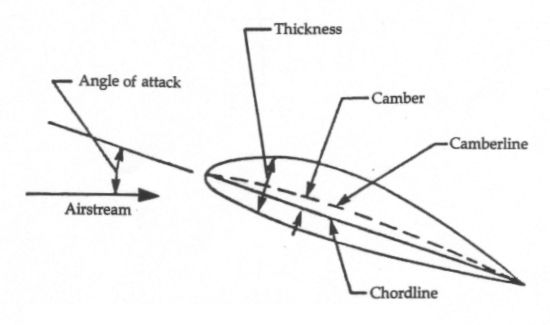
With sufficient angle of attack you can make pretty much anything fly
see this video:
http://www.youtube.com/watch?v=C_3vLmm5tC8
With inverted flight the wing is upside down, therefore it needs a higher angle of attack then in normal flight.
Watching a plane come by in inverted flight, you will see the nose is fairly high up, this is to create sufficient lift by flying with a high angle of attack.
A aerobatic airplane specifically made for the job can have what is a called a symmetrical wing profile, the top and bottom are the same shape. It therefore flies about as good inverted as right side up.

Normal wing;

With sufficient angle of attack you can make pretty much anything fly
see this video:
http://www.youtube.com/watch?v=C_3vLmm5tC8
With inverted flight the wing is upside down, therefore it needs a higher angle of attack then in normal flight.
Watching a plane come by in inverted flight, you will see the nose is fairly high up, this is to create sufficient lift by flying with a high angle of attack.
A aerobatic airplane specifically made for the job can have what is a called a symmetrical wing profile, the top and bottom are the same shape. It therefore flies about as good inverted as right side up.
Normal wing;

Joined: Oct 2005
Posts: 913
Likes: 1
From: somewhere in Oz
Joined: Aug 2000
Posts: 3,648
Likes: 2
From: UK
The vectors are displaying the difference from the ambient atmospheric pressure force. So they don't look far off.
http://www.diam.unige.it/~irro/profilo4_e.html
has some further useful diagrams.
http://www.diam.unige.it/~irro/profilo4_e.html
has some further useful diagrams.
Joined: Aug 2000
Posts: 1,966
Likes: 0
From: Norfolk
Symmetrical wings
Just to be bloody pedantic:-
symmetrical wings in the Pitts family are not truly symmetrical - they are far closer to being symmetrical than the flat bottomed (M6) aerofoil but they are actually designed to fly similarly either way up - the nose attitude S&L inverted is still slightly higher than erect S&L.
Symmetrical ailerons in the same family are to all intents perfectly symmetrical!
I know that this doesn't really help much but it is a fuller picture!
Stik
symmetrical wings in the Pitts family are not truly symmetrical - they are far closer to being symmetrical than the flat bottomed (M6) aerofoil but they are actually designed to fly similarly either way up - the nose attitude S&L inverted is still slightly higher than erect S&L.
Symmetrical ailerons in the same family are to all intents perfectly symmetrical!
I know that this doesn't really help much but it is a fuller picture!
Stik
Joined: Oct 1999
Posts: 874
Likes: 13
From: South East.
....also, apart from a higher nose attitude to maintain S&L inverted, don't forget the effect of the changed aerofoil presentation on the Stalling Speed. It can be 10 - 15 knots greater.
Good thread.
Btw, Andy RR, I'm not very convinced by those pressure diagrams either.......
Good thread.
Btw, Andy RR, I'm not very convinced by those pressure diagrams either.......
Joined: Dec 2003
Posts: 476
Likes: 0
From: Massachusetts Bay Colony
Just to be bloody pedantic:-
symmetrical wings in the Pitts family are not truly symmetrical - they are far closer to being symmetrical than the flat bottomed (M6) aerofoil but they are actually designed to fly similarly either way up - the nose attitude S&L inverted is still slightly higher than erect S&L.
Symmetrical ailerons in the same family are to all intents perfectly symmetrical!
I know that this doesn't really help much but it is a fuller picture!
Stik
symmetrical wings in the Pitts family are not truly symmetrical - they are far closer to being symmetrical than the flat bottomed (M6) aerofoil but they are actually designed to fly similarly either way up - the nose attitude S&L inverted is still slightly higher than erect S&L.
Symmetrical ailerons in the same family are to all intents perfectly symmetrical!
I know that this doesn't really help much but it is a fuller picture!
Stik
Most wings are mounted to an airframe to produce sufficient lift to maintain S&L at a specified aircraft weight, airspeed and altitude but still have the hull of the aircraft level. For most light airplanes, this angle is usually only about 2 or 3 degrees, but that means that, to get the same amount of lift inverted, you have have the aircraft 2 or 3 degrees "wing" above the horizon, which will look like 4 or 8 degrees "nose above the horizon".
An extreme example of this is the B-52. It was designed to fly at 40,000 feet at 500,000 lbs but to be perfectly level and stable at that altitude to drop bombs accurately. Its wing is mounted to the fuselage at 17 degrees which means, when the aircraft attitude is straight and level, the wing is at an angle of attack of 17 degrees.
A few of the photos on this page show the wing mounting angle. You can see that near the leading edge of the wing, it intersects the upper part of the fuselage and they almost meet in the center. But the trailing edge of the wing hits the fuselage about midway down.
http://www.globalsecurity.org/wmd/systems/b-52-pics.htm
This also accounts for the fact that the B-52 climbs out from take-off in a distinct nose-down attitude because, in the denser air of low level, it doesn't need such a high angle of attack to maintain a climb. (couldn't find a good video for that)
Just to add further aerodynamic confusion!

Pitts2112
about the only thing my aero degree is actually useful for...
Last edited by Pitts2112; 3rd November 2006 at 23:18.

Joined: Aug 2006
Posts: 151
Likes: 0
From: UK
Newtons laws of Motion
I'm always puzzled why the change of momentum regarding the airflow under the wing is never considered as part of the lift.
As the wing moves forward at a high angle of attack, the airflow hitting the underside of the wing, which was sitting there quite happily, all of a sudden is forced down, effectively the wing pushing it out of the way. This imparts a vertical force on the wing ( to every action there is an equal an opposite reaction) and hence lift.
This is a completely separate effect to lift produced by lower pressure on the upper surface of the wing.
Why is this lift from a change of momentum of the airflow, never considered, I would imagine this is the predominant lift force when flying inverted for a standard aerofoil.
As the wing moves forward at a high angle of attack, the airflow hitting the underside of the wing, which was sitting there quite happily, all of a sudden is forced down, effectively the wing pushing it out of the way. This imparts a vertical force on the wing ( to every action there is an equal an opposite reaction) and hence lift.
This is a completely separate effect to lift produced by lower pressure on the upper surface of the wing.
Why is this lift from a change of momentum of the airflow, never considered, I would imagine this is the predominant lift force when flying inverted for a standard aerofoil.
Joined: Dec 2003
Posts: 476
Likes: 0
From: Massachusetts Bay Colony
I'm always puzzled why the change of momentum regarding the airflow under the wing is never considered as part of the lift.
As the wing moves forward at a high angle of attack, the airflow hitting the underside of the wing, which was sitting there quite happily, all of a sudden is forced down, effectively the wing pushing it out of the way. This imparts a vertical force on the wing ( to every action there is an equal an opposite reaction) and hence lift.
This is a completely separate effect to lift produced by lower pressure on the upper surface of the wing.
Why is this lift from a change of momentum of the airflow, never considered, I would imagine this is the predominant lift force when flying inverted for a standard aerofoil.
As the wing moves forward at a high angle of attack, the airflow hitting the underside of the wing, which was sitting there quite happily, all of a sudden is forced down, effectively the wing pushing it out of the way. This imparts a vertical force on the wing ( to every action there is an equal an opposite reaction) and hence lift.
This is a completely separate effect to lift produced by lower pressure on the upper surface of the wing.
Why is this lift from a change of momentum of the airflow, never considered, I would imagine this is the predominant lift force when flying inverted for a standard aerofoil.
Or are you trolling??????????
Pitts2112
Joined: Oct 2005
Posts: 913
Likes: 1
From: somewhere in Oz
Circulation Theory?
The vectors are displaying the difference from the ambient atmospheric pressure force. So they don't look far off.
http://www.diam.unige.it/~irro/profilo4_e.html
has some further useful diagrams.
http://www.diam.unige.it/~irro/profilo4_e.html
has some further useful diagrams.
My head is hurting!
A
Joined: Dec 2003
Posts: 476
Likes: 0
From: Massachusetts Bay Colony
That's why I find it easiest for light aviation to think in terms of Bernoulli, realise it's only an approximation, and be done with it. You only need a mental model that explains the behaviour of the aircraft so you understand what it is likely to do in various conditions. And the best way to do that is fly in as many different conditions as possible and add to your experience. Understand the relationships between alpha, lift, drag, parasite drag, adverse yaw, and a few others (which Bernoulli does perfectly adequately) and you're away. Spend more time admiring the sunshine on the ground...
And that's after taking a BSc (H) in aeronautical engineering!
Pitts2112
And that's after taking a BSc (H) in aeronautical engineering!
Pitts2112
Joined: Aug 2006
Posts: 151
Likes: 0
From: UK
Out of touch
Pitts,
No I was serious. All my aviation studies were done 20 years ago, but proffessionally, I moved in another direction. Just starting to get a keen interest in aviation again, although it was never far away.
But, back then, I'm pretty sure Bernoulli was the only principle described (I could be wrong) and I have never seen a description of how a wing works using change of momentum, It always air flow over the top has further to travel... blah... blah..
No I was serious. All my aviation studies were done 20 years ago, but proffessionally, I moved in another direction. Just starting to get a keen interest in aviation again, although it was never far away.
But, back then, I'm pretty sure Bernoulli was the only principle described (I could be wrong) and I have never seen a description of how a wing works using change of momentum, It always air flow over the top has further to travel... blah... blah..
Joined: Dec 2003
Posts: 476
Likes: 0
From: Massachusetts Bay Colony
Pitts,
No I was serious. All my aviation studies were done 20 years ago, but proffessionally, I moved in another direction. Just starting to get a keen interest in aviation again, although it was never far away.
But, back then, I'm pretty sure Bernoulli was the only principle described (I could be wrong) and I have never seen a description of how a wing works using change of momentum, It always air flow over the top has further to travel... blah... blah..
No I was serious. All my aviation studies were done 20 years ago, but proffessionally, I moved in another direction. Just starting to get a keen interest in aviation again, although it was never far away.
But, back then, I'm pretty sure Bernoulli was the only principle described (I could be wrong) and I have never seen a description of how a wing works using change of momentum, It always air flow over the top has further to travel... blah... blah..
Consider yourself lucky to have, for 20 years, escaped being sucked into the most vitriolic, time-wasting, pointless argument in our hobby. It takes on religious proportions on some threads. Stick with Bernoulli if that's what you already know and spend the mental effort on useful stuff in life, like understanding the off-side rule or something...
Pitts2112
Joined: Oct 2005
Posts: 913
Likes: 1
From: somewhere in Oz
A
PS: Pitts, did your BSc (H) (helicopters?) tell you how induced drag is modelled - from a scientific interest, rather than a practical aviation interest?
Joined: Dec 2003
Posts: 476
Likes: 0
From: Massachusetts Bay Colony
From Bookworm's link you can travel to this page (http://www.diam.unige.it/~irro/richiami1_e.html) and it basically takes the Navier-Stokes equation (momentum based) and derives Bernoulli. Don't ask me to explain the derivation, but it proves that they are in essence one and the same thing.
A
PS: Pitts, did your BSc (H) (helicopters?) tell you how induced drag is modelled - from a scientific interest, rather than a practical aviation interest?
A
PS: Pitts, did your BSc (H) (helicopters?) tell you how induced drag is modelled - from a scientific interest, rather than a practical aviation interest?
(H) Honours. Not really the same thing but as close to a British uni equivelant as I've ever been able to find. Basically it was a US standard 4 year degree, whereas, I believe, a British BSc is a three year degree.
Can't remember about the drag model, to be honest. That was 20 years ago and I'm not even sure where the book is any more. I'm sure we did talk about drag quite a bit but I can't remember what models we used for it. Sorry.
Pitts2112

