displaced threshold lighting ?

Thread Starter
Joined: Oct 2004
Posts: 14
Likes: 0
From: chicago
displaced threshold lighting ?
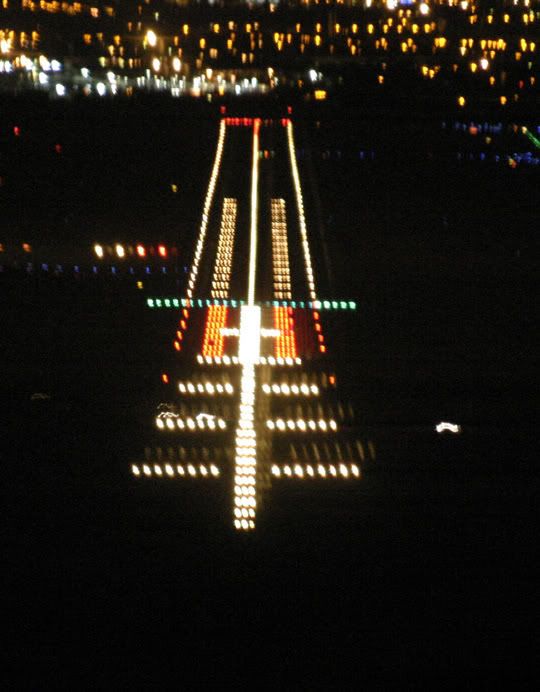
Can anyone describe displaced threshold lighting to me.
My Jeppesen does not show it and I can't find it anywhere.
Also since you at it, what's the procedure to land at night without landing light ????
Thank you in advance for all that information.
I'm trying to learn and it dosn't go easy

My Jeppesen does not show it and I can't find it anywhere.
Also since you at it, what's the procedure to land at night without landing light ????
Thank you in advance for all that information.
I'm trying to learn and it dosn't go easy

Joined: Feb 2003
Posts: 2,042
Likes: 0
From: Oxford
2. is easy - advise ATC if possible (i.e. if you haven't had a total electrical failure) then just get on with it. Beware the black hole effect - look at the runway perspective not the ground in front of you, or you will fly into the runway... You should have practised this for your night qualification anyway.
1. - not sure, someone else will know...
Tim
1. - not sure, someone else will know...
Tim
Joined: Oct 1999
Posts: 2,212
Likes: 0
From: Anywhere
Displaced threshold lighting.
The simple answer is - normally there isn't any. If you think about it there's no real need. During the day you can see the whole paved surface, hence the requirement to mark it with the large arrows that you see pointing towards the threshold. At night however all you can see are the lights, so you start the standard runway lighting (edge lights and green threshold bars) from the start of the displaced threshold and any approach lighting will be flush fitted into the unuseable landing area. (Flush fitted because this area can still be used for take off and sometimes taxying.
There are occasions this area is required to be lit in which case it will be delineated by red edge lighting visual from the direction of the approach. This lighting will be one way - from the other direction it will probably be white lighting with the red 'end' lights at the start of the displaced area because it can still be used as runway if taking off from the other end.
Have a look at the Aeronautical Ground Lighting section of CAP637 - Visual Aids Handbook which will show it much better than can be explained.
The simple answer is - normally there isn't any. If you think about it there's no real need. During the day you can see the whole paved surface, hence the requirement to mark it with the large arrows that you see pointing towards the threshold. At night however all you can see are the lights, so you start the standard runway lighting (edge lights and green threshold bars) from the start of the displaced threshold and any approach lighting will be flush fitted into the unuseable landing area. (Flush fitted because this area can still be used for take off and sometimes taxying.
There are occasions this area is required to be lit in which case it will be delineated by red edge lighting visual from the direction of the approach. This lighting will be one way - from the other direction it will probably be white lighting with the red 'end' lights at the start of the displaced area because it can still be used as runway if taking off from the other end.
Have a look at the Aeronautical Ground Lighting section of CAP637 - Visual Aids Handbook which will show it much better than can be explained.
Last edited by Chilli Monster; 13th October 2004 at 09:54.

Joined: Sep 2004
Posts: 1,684
Likes: 3
From: Down at the sharp pointy end, where all the weather is made.
Displaced Threshold Lighting...
At night, you shouldn't see anything diferent about runway lighting for a displaced threshold.
A displaced threshold means that the start of that part of the runway available for landing is inset or 'displaced' from the beginning of the total surface available. This can be for a variety of reasons, perhaps because the beginning part isn't maintained but more usually because the final part of the approach is obstructed by buildings or electricity pylons etc.
The threshold will be marked by a row of green lights at 90 deg to the direction of travel i.e. across the runway. The white side lights will start at this point. The end of the Landing Distance Available will be marked by a row of red lights across the runway. It may well be that there are side lights before the threshold if it is displaced; these are for the benefit of pilots using the full length for departure and should be coloured red. Lighting provided for glideslope guidance, such as Precision Approach Path Indicators (PAPI) should give guidance to the aiming point of the displaced runway, not the full length. This describes the lighting for a basic 'visual' runway.
Any other runway lighting, in place if it is a precision instrument runway, such as centreline, touchdown zone or stop-end cautionary zone lights, will look the same whether the threshold is displaced or not.
hope this helps - ask again if not
Cheers,
The Odd One
Chilli Monster
Sorry, trod on your reply!!! (if you see what I mean)
Cheers,
TheOddOne
At night, you shouldn't see anything diferent about runway lighting for a displaced threshold.
A displaced threshold means that the start of that part of the runway available for landing is inset or 'displaced' from the beginning of the total surface available. This can be for a variety of reasons, perhaps because the beginning part isn't maintained but more usually because the final part of the approach is obstructed by buildings or electricity pylons etc.
The threshold will be marked by a row of green lights at 90 deg to the direction of travel i.e. across the runway. The white side lights will start at this point. The end of the Landing Distance Available will be marked by a row of red lights across the runway. It may well be that there are side lights before the threshold if it is displaced; these are for the benefit of pilots using the full length for departure and should be coloured red. Lighting provided for glideslope guidance, such as Precision Approach Path Indicators (PAPI) should give guidance to the aiming point of the displaced runway, not the full length. This describes the lighting for a basic 'visual' runway.
Any other runway lighting, in place if it is a precision instrument runway, such as centreline, touchdown zone or stop-end cautionary zone lights, will look the same whether the threshold is displaced or not.
hope this helps - ask again if not
Cheers,
The Odd One
Chilli Monster
Sorry, trod on your reply!!! (if you see what I mean)
Cheers,
TheOddOne
Guest
Posts: n/a
Edge lighting from the start of TORA towards a displaced threshold in the UK is white.
Red is an international standard contained in ICAO Annex 14.
Have a look at Manchester. Plenty of photos on !!!!!!!!!!!!!!. Gatwick and others I'm sure are the same from (hazy) memory.
Its shown in CAP 637
Sir George Cayley
Red is an international standard contained in ICAO Annex 14.
Have a look at Manchester. Plenty of photos on !!!!!!!!!!!!!!. Gatwick and others I'm sure are the same from (hazy) memory.
Its shown in CAP 637
Sir George Cayley
Joined: Oct 1999
Posts: 2,212
Likes: 0
From: Anywhere
Edge lighting from the start of TORA towards a displaced threshold in the UK is white.
Red is an international standard contained in ICAO Annex 14.
Red is an international standard contained in ICAO Annex 14.
 (Always pays to read the posters location).
Joined: Aug 2001
Posts: 1,178
Likes: 0
From: BFS
I always find a night landing better without the light. It forces you to take the whole perspective. With the light on ground rush becomes a factor as does just staring at the bit of tarmac you can see, usually resulting in an arrival. Could just be me though.
Just get the head out, eyes to the end of the runway and it'll be fine. Easier at a field with centre line lights.
Just get the head out, eyes to the end of the runway and it'll be fine. Easier at a field with centre line lights.
Joined: Sep 2003
Posts: 1,034
Likes: 1
From: 59°45'36N 10°27'59E
he threshold will be marked by a row of green lights at 90 deg to the direction of travel i.e. across the runway
(5-6 on each side)
Joined: Sep 2004
Posts: 43
Likes: 0
From: UK
I always find a night landing better without the light. It forces you to take the whole perspective.

Night flying season just around for the corner. Love It!

Joined: Apr 2002
Posts: 84
Likes: 0
From: South East UK
According to CAP168 (ie:UK)
Runway Edge lights should be white except:
b) Where a threshold is displaced, the lights between the beginning of the runway and the displaced threshold should show red in the approach direction.
Runway Edge lights should be white except:
b) Where a threshold is displaced, the lights between the beginning of the runway and the displaced threshold should show red in the approach direction.