


Oxygen masks and safety lifejackets

Thread Starter


Joined: Jan 2000
Aviation Qualifications: SLF
Posts: 1,578
Likes: 312
From: UK and Italy
Oxygen masks and safety lifejackets
Safety lifejackets have never been known to save a life, but have cost a few, The Ethiopian Airways sea-landing after a hijack, when people inflated their lifejackets before exiting the cabin, and drowned.
Have oxygen masks ever saved a life? They only have a capacity of 2l, whereas I carry a 22l cylinder for a long-haul flight. Is 2l enough for the pilots to get the aircraft down below 5000 ft where there is enough oxygen that the atmosphere is breathable? From 45,000 feet?
Would it be too much to ask to have airlines provide oxygen on demand at the press of a button? I'm sure it wouldn't cost much more than having coloured lighting on demand on B777s and the ability to adjust the temperature of your seat's environment, also on 777s
Have oxygen masks ever saved a life? They only have a capacity of 2l, whereas I carry a 22l cylinder for a long-haul flight. Is 2l enough for the pilots to get the aircraft down below 5000 ft where there is enough oxygen that the atmosphere is breathable? From 45,000 feet?
Would it be too much to ask to have airlines provide oxygen on demand at the press of a button? I'm sure it wouldn't cost much more than having coloured lighting on demand on B777s and the ability to adjust the temperature of your seat's environment, also on 777s
Last edited by justapax; 17th April 2025 at 21:47.


Joined: Dec 2012
Posts: 271
Likes: 57
From: UK
Safety lifejackets have never been known to save a life, but have cost a few, The Ethiopian Airways sea-landing after a hijack, when people inflated their lifejackets before exiting the cabin, and drowned.
Have oxygen masks ever saved a life? They only have a capacity of 2l, whereas I carry a 22l cylinder for a long-haul flight. Is 2l enough for the pilots to get the aircraft down below 5000 ft where there is enough oxygen that the atmosphere is breathable? From 45,000 feet?
Would it be too much to ask to have airlines provide oxygen on demand at the press of a button? I'm sure it wouldn't cost much more than having coloured lighting on demand on B777s and the ability to adjust the temperature of your seat's environment, also on 777s
Have oxygen masks ever saved a life? They only have a capacity of 2l, whereas I carry a 22l cylinder for a long-haul flight. Is 2l enough for the pilots to get the aircraft down below 5000 ft where there is enough oxygen that the atmosphere is breathable? From 45,000 feet?
Would it be too much to ask to have airlines provide oxygen on demand at the press of a button? I'm sure it wouldn't cost much more than having coloured lighting on demand on B777s and the ability to adjust the temperature of your seat's environment, also on 777s
The bottles are pressurised to approx 1850 psi and are on a ring-main that supplies the oxygen in an emergency situation. On the Boeing 747 [which also had a ring main system] there was also a connection in the overhead PSU for therapeutic oxygen, in that a mask could be plugged in and the pilot could switch on therapeutic [low pressure] oxygen supply for a passenger if required.
These oxygen cylinders have to be able to provide both the crew and a full compliment of passenger with oxygen for a set period of time [from memory it might be 45 minutes but, that I'm not absolutely sure about it was many years ago when I sat licences] So yes, to answer your question the emergency oxygen system can supply both crew and passengers for more than enough time.
I think you are getting confused with the with the small portable oxygen cylinders that are located at the door stations which are small bottles that can be used by the cabin crew in emergency situations
With regard as to why airlines do not offer therapeutic oxygen ay more, is that a lot of modern aircraft no longer have either the outlets in the PSUs or a 'ring main system' A lot of modern airliners, now rather than the many full size oxygen cylinders in the freight bays and all the associated plumbing around the aircraft actually have gas generator bottles on the overhead PSUs where the oxygen is 'produced' in an overhead bottle in an emergency situation. Again, the amount of time oxygen is available for is governed by law, so has to meet all the required standards.
Last edited by MAC 40612; 18th April 2025 at 00:47.
Joined: Jul 2013
Aviation Qualifications: Non-Aircrew
Posts: 5,677
Likes: 3,334
From: Everett, WA
The cert requirement is for all passengers and crew for 15 minutes - or - for as long as it takes to get from max certified cruise altitude to 10k ft., whichever is longer.
O2 'on demand' is a potential fire hazard (and aircraft fires have killed far more than have died from inflating life vests inside the aircraft).
At least in this part of the world, instructions on use of life vests during the pre-flight passenger briefing include the instruction to not inflate until you're out of the aircraft. People ignoring the pre-flight safety briefing falls into Darwin candidate territory.
O2 'on demand' is a potential fire hazard (and aircraft fires have killed far more than have died from inflating life vests inside the aircraft).
At least in this part of the world, instructions on use of life vests during the pre-flight passenger briefing include the instruction to not inflate until you're out of the aircraft. People ignoring the pre-flight safety briefing falls into Darwin candidate territory.
Thread Starter
Joined: Jan 2000
Aviation Qualifications: SLF
Posts: 1,578
Likes: 312
From: UK and Italy
The Ethiopean Airways example shows that people don't always watch the in-flight safety demonstration or read the safety card. Or, necessarily, understand it properly. I guess that when people are panicking after they have made an on-water landing and they see one person donning and inflating a life-jacket, they followed his or her example.
I got the 2 litres from a tv programme, 'Heathrow - Britain's busiest aeroport', which referred to 'the small portable oxygen cylinders that are located at the door stations which are small bottles that can be used by the cabin crew in emergency situations' only', and I got the impression these were the only sources of oxygen, and comparable to the drop-down masks that are available in the case of emergency. My bad.
I got the 2 litres from a tv programme, 'Heathrow - Britain's busiest aeroport', which referred to 'the small portable oxygen cylinders that are located at the door stations which are small bottles that can be used by the cabin crew in emergency situations' only', and I got the impression these were the only sources of oxygen, and comparable to the drop-down masks that are available in the case of emergency. My bad.
Joined: Oct 2018
Aviation Qualifications: PPL
Posts: 12,221
Likes: 1,649
From: Ferrara
The old trope was that the life-jackets were for the insurance companies so they'd be able to retrieve all the bodies............. apparently "missing persons" are quite expensive administratively

Joined: Aug 2025
Aviation Qualifications: Non-Aircrew
Posts: 5
Likes: 2
From: UK
As far as I understand, small 1 or 2 liter oxygen cylinders are the standard in medical oxygen. They are lightweight and portable, and are kept for emergency use.
A 2 liter cylinder is about 600 liters of oxygen at 300 bar (or 300 liters at 150 bar). If you take it very roughly, then this is half an hour to an hour of breathing.
A 2 liter cylinder is about 600 liters of oxygen at 300 bar (or 300 liters at 150 bar). If you take it very roughly, then this is half an hour to an hour of breathing.
Thread Starter
Joined: Jan 2000
Aviation Qualifications: SLF
Posts: 1,578
Likes: 312
From: UK and Italy
As far as I understand, small 1 or 2 liter oxygen cylinders are the standard in medical oxygen. They are lightweight and portable, and are kept for emergency use.
A 2 liter cylinder is about 600 liters of oxygen at 300 bar (or 300 liters at 150 bar). If you take it very roughly, then this is half an hour to an hour of breathing.
A 2 liter cylinder is about 600 liters of oxygen at 300 bar (or 300 liters at 150 bar). If you take it very roughly, then this is half an hour to an hour of breathing.
When I was in hospital recently, patients requiring oxygen were, if not plumbed into the system, provided with huge cylinders of oxygen as they were wheeled from ward to ward. The kind of size you associate with scuba divers. I guess the idea is that with such a huge supply, there was no risk of patients running out.
I'm thinking of taking a flight from the UK to Australia via DXB in an A380. You obviously are an expert in the subject. Should I take medical oxygen with me and if so how much? Oxygen is a pain to take through customs, as it's a pressurised container of a gas which promotes flames.
justapax

Joined: Feb 2017
Aviation Qualifications: CPL
Posts: 549
Likes: 192
From: Sydney
I know you are really focused on larger airliners but felt a need to comment (as you do on the internet)...
I cannot comment on larger commercial airliners but they sure have saved many people (pilot and crew and pax) in aircraft ditchings of other aircraft.
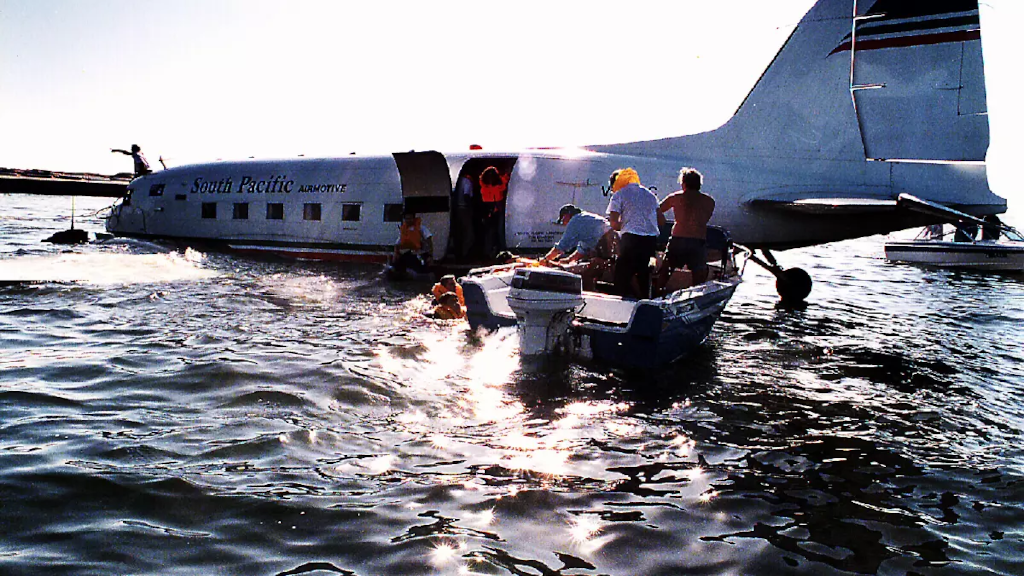
DC-3 1994 Ditched shortly after Take off from YSSY. 21 pax and 4 crew. All survived. I think one serious injury - flight attendant broke her arm.
Again cannot comment on larger commercial airliners but having supplemental oxygen has saved many in other types of aircraft.
I cannot comment on larger commercial airliners but they sure have saved many people (pilot and crew and pax) in aircraft ditchings of other aircraft.
DC-3 1994 Ditched shortly after Take off from YSSY. 21 pax and 4 crew. All survived. I think one serious injury - flight attendant broke her arm.
Again cannot comment on larger commercial airliners but having supplemental oxygen has saved many in other types of aircraft.
Last edited by jonkster; 17th August 2025 at 23:06. Reason: fixed photo
Supercharged PPRuNer

Joined: Nov 2000
Aviation Qualifications: ATPL
Posts: 1,188
Likes: 15
From: Doon the watter, a million miles from the sandpit.
[QUOTE] I carry medical oxygen with me if I expect to have difficulty breathing, e.g., when at 8000 feet equivalent, such as in a 787. [/QUOTE]
Small point, but the 787 is normally pressurised to an altitude of 6,000’ rather than 8,000. One of the reasons the cabin environment is nicer than in other, erm, older Boeings. And in the unlikely event that drop-down masks are required, the supply is good for around an hour. Even I can manage a rapid descent in that time.
You are not going to run short of O2 on a 787 - or indeed any other modern jet.
Small point, but the 787 is normally pressurised to an altitude of 6,000’ rather than 8,000. One of the reasons the cabin environment is nicer than in other, erm, older Boeings. And in the unlikely event that drop-down masks are required, the supply is good for around an hour. Even I can manage a rapid descent in that time.
You are not going to run short of O2 on a 787 - or indeed any other modern jet.
Thread Starter
Joined: Jan 2000
Aviation Qualifications: SLF
Posts: 1,578
Likes: 312
From: UK and Italy
[QUOTE=G SXTY;11940225]
That's depressing. It means my remaining lung isn't giving me sufficient oxygen for me to feel comfortable at 6000', not 8000' as I had previously thought.
At SFC I can walk for about 20 minutes on the flat before I get really breathless and need to sit down and gasp for air. Aloft, as I'm just sitting and being served food and drinks (lots of drinks, especially on EK!) the lower oxygen pressure doesn't seem to matter on an A350, but does on a 787. Can 1000' really make that much difference?
I actually have slightly over 50% lung function, I had half a lung out, but in the process the left lingula became strangulated, so I only have a bit of lung function left from the bottom of what's left of my left lung.
If you have knowledge about lung function vs. effective altitude, I'd be grateful to know about it. The last thing I want to do is board an unpressurised aircraft and find that the little cylinder of oxygen I carry runs out before the flight does. I get enough grief at LHR and EMA taking *any* oxygen on board.
I carry medical oxygen with me if I expect to have difficulty breathing, e.g., when at 8000 feet equivalent, such as in a 787. [/QUOTE]
Small point, but the 787 is normally pressurised to an altitude of 6,000’ rather than 8,000. One of the reasons the cabin environment is nicer than in other, erm, older Boeings. And in the unlikely event that drop-down masks are required, the supply is good for around an hour. Even I can manage a rapid descent in that time.
You are not going to run short of O2 on a 787 - or indeed any other modern jet.
Small point, but the 787 is normally pressurised to an altitude of 6,000’ rather than 8,000. One of the reasons the cabin environment is nicer than in other, erm, older Boeings. And in the unlikely event that drop-down masks are required, the supply is good for around an hour. Even I can manage a rapid descent in that time.
You are not going to run short of O2 on a 787 - or indeed any other modern jet.
At SFC I can walk for about 20 minutes on the flat before I get really breathless and need to sit down and gasp for air. Aloft, as I'm just sitting and being served food and drinks (lots of drinks, especially on EK!) the lower oxygen pressure doesn't seem to matter on an A350, but does on a 787. Can 1000' really make that much difference?
I actually have slightly over 50% lung function, I had half a lung out, but in the process the left lingula became strangulated, so I only have a bit of lung function left from the bottom of what's left of my left lung.
If you have knowledge about lung function vs. effective altitude, I'd be grateful to know about it. The last thing I want to do is board an unpressurised aircraft and find that the little cylinder of oxygen I carry runs out before the flight does. I get enough grief at LHR and EMA taking *any* oxygen on board.
Supercharged PPRuNer
Joined: Nov 2000
Aviation Qualifications: ATPL
Posts: 1,188
Likes: 15
From: Doon the watter, a million miles from the sandpit.
The carbon fuselage permits a higher differential pressure, hence the lower cabin altitude, and unlike the triple, cabin air is not supplied from the engines. The computertronics also regulate recirculated air based on the number of people onboard, and playing with this number can make a very noticeable difference to air quality (think stuffy nose, dry throat, etc). And then there’s my highly scientific bread roll test: they actually remain edible for long enough to eat your meal, whereas on other types within minutes they’re hard enough to be shot out of a cannon.
It all adds up, and getting off after a long sector on the 787, I (and most of my colleagues) generally feel fresher and less tired than if we’d been on a triple.
Paxing All Over The World

Joined: May 2001
Posts: 10,842
Likes: 328
From: Hertfordshire, UK.
To follow the thread drift ... I have done six sectors with VS on their 789 LHR-JNB/CPT. Travelling either in PE or Upper.
I have done this journey in: VC10; 747 (multiple models); A 343; A 346; A 333; B 772. I have been in Y; PE; C at various times over the last 40 years and have never felt any difference when emerging! Even as I get older, I cannot feel any change in the cabin air. So electric or bleed or anything else? Nope!!
I have done this journey in: VC10; 747 (multiple models); A 343; A 346; A 333; B 772. I have been in Y; PE; C at various times over the last 40 years and have never felt any difference when emerging! Even as I get older, I cannot feel any change in the cabin air. So electric or bleed or anything else? Nope!!
N4790P
Joined: Jun 2002
Posts: 2,557
Likes: 231
From: Asia
To follow the thread drift ... I have done six sectors with VS on their 789 LHR-JNB/CPT. Travelling either in PE or Upper.
I have done this journey in: VC10; 747 (multiple models); A 343; A 346; A 333; B 772. I have been in Y; PE; C at various times over the last 40 years and have never felt any difference when emerging! Even as I get older, I cannot feel any change in the cabin air. So electric or bleed or anything else? Nope!!
I have done this journey in: VC10; 747 (multiple models); A 343; A 346; A 333; B 772. I have been in Y; PE; C at various times over the last 40 years and have never felt any difference when emerging! Even as I get older, I cannot feel any change in the cabin air. So electric or bleed or anything else? Nope!!
Feels just as knackered irrespective of aircrsft type with the class of travel being the only doscriminater.


Joined: Oct 2018
Aviation Qualifications: PPL
Posts: 12,221
Likes: 1,649
From: Ferrara
"Maybe smoke hoods for passengers would be useful to be included in FAA-required passenger equipment?"
I seem to remember it was looked at years ago and turned down on the grounds of cost (no surprise) but also the chances of someone putting one on correctly in an emergency were minimal - and you're better off without one and just running than choking with a badly fitted bag over your head.
I carried one for many years but hard to find a replacement
I seem to remember it was looked at years ago and turned down on the grounds of cost (no surprise) but also the chances of someone putting one on correctly in an emergency were minimal - and you're better off without one and just running than choking with a badly fitted bag over your head.
I carried one for many years but hard to find a replacement