


Quick Turn Around Landing Weight

Thread Starter
Joined: Nov 2011
Posts: 11
Likes: 0
From: Tahiti
Quick Turn Around Landing Weight
Hello guys,
Can anyone please explain me the Quick Turn Around Landing Weight procedure ? I know that it has something to do with the brakes being heated after landing but I don't understand the relationship with the weight of the aircraft!
Thanks a lot
Can anyone please explain me the Quick Turn Around Landing Weight procedure ? I know that it has something to do with the brakes being heated after landing but I don't understand the relationship with the weight of the aircraft!
Thanks a lot

Joined: Mar 2002
Aviation Qualifications: ATPL
Posts: 9,192
Likes: 961
From: Seat 1A
Here's the page out of our flight manual that explains the concept pretty well:
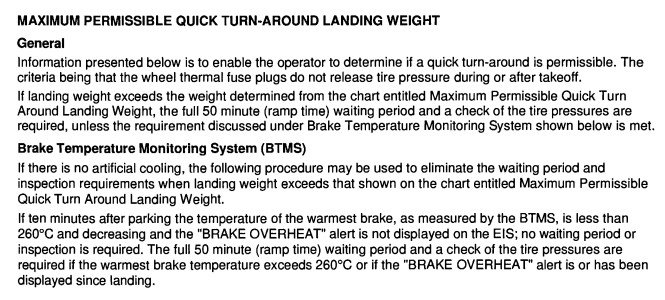
Brakes have to absorb the kinetic (speed) energy of the aircraft (=1/2 mass x velocity x velocity). As weight increases, the energy the brakes have to absorb increases. Brakes have a finite capacity before they "give out", which results in a maximum weight that they can stop the aeroplane. The QTA weight is the weight that, after a landing, will ensure there is enough brake capacity or "energy" to permit a subsequent takeoff with a successful abort. If you used all your brake energy on the previous landing, you wouldn't be able to stop should you need to reject/abort the next takeoff. As brakes cool, their energy capacity returns, and that is why there are time limits on the "quick turnaround". The QTA weight chart assumes you slam on the brakes to maximum to a complete stop, something that very rarely happens.
For each airport we go to, we have a maximum landing weight chart that details the Max QTA weight; but we would only use that chart if the brake temperature indication system was U/S. The QTA weight limit decreases slightly as the outside air temperature goes up due to the true airspeed effect as well as, I assume, reduced efficiency of the brakes as they get hotter.
So practically speaking, we hardly ever use the QTA chart. We regularly land well over the QTA limit, but because we use less than maximum braking (eg on a long runway), our actual brake temperatures (ie brake energy used) are lower, and we can therefore turnaround and takeoff as quick as we like.
Brakes have to absorb the kinetic (speed) energy of the aircraft (=1/2 mass x velocity x velocity). As weight increases, the energy the brakes have to absorb increases. Brakes have a finite capacity before they "give out", which results in a maximum weight that they can stop the aeroplane. The QTA weight is the weight that, after a landing, will ensure there is enough brake capacity or "energy" to permit a subsequent takeoff with a successful abort. If you used all your brake energy on the previous landing, you wouldn't be able to stop should you need to reject/abort the next takeoff. As brakes cool, their energy capacity returns, and that is why there are time limits on the "quick turnaround". The QTA weight chart assumes you slam on the brakes to maximum to a complete stop, something that very rarely happens.
For each airport we go to, we have a maximum landing weight chart that details the Max QTA weight; but we would only use that chart if the brake temperature indication system was U/S. The QTA weight limit decreases slightly as the outside air temperature goes up due to the true airspeed effect as well as, I assume, reduced efficiency of the brakes as they get hotter.
So practically speaking, we hardly ever use the QTA chart. We regularly land well over the QTA limit, but because we use less than maximum braking (eg on a long runway), our actual brake temperatures (ie brake energy used) are lower, and we can therefore turnaround and takeoff as quick as we like.
Last edited by Capn Bloggs; 19th October 2018 at 05:39. Reason: Improved my original goobledegook.


