


AVRO LANCASTER QUESTION

Thread Starter
Joined: Jun 2005
Posts: 58
Likes: 2
From: THE BLUEBIRD CAFE
AVRO LANCASTER QUESTION
Old mate has just picked up a little flat twin 2-stroke engine which he was informed by the seller was used as an auxiliary power unit in Lancs.
The makers plate says - THE E.C.Co.Ltd. TYPE: 250 TWIN ENG.No.: GPS 242
The letter 'G' appears to have been stamped on the plate as though the serial of the unit may have changed post original production; as though it may have been PS 242 originally.
It is 13 inches in height and 22 inches across from head to head.
What have we here?
He has in addition an interesting collection of complete aero engines including a Lycoming R-680 , one that was originally delivered by the factory to Airlines of Australia in 1937.
The R-680 was the power plant for the Stinson A-Model three-engined airliner.
The makers plate says - THE E.C.Co.Ltd. TYPE: 250 TWIN ENG.No.: GPS 242
The letter 'G' appears to have been stamped on the plate as though the serial of the unit may have changed post original production; as though it may have been PS 242 originally.
It is 13 inches in height and 22 inches across from head to head.
What have we here?
He has in addition an interesting collection of complete aero engines including a Lycoming R-680 , one that was originally delivered by the factory to Airlines of Australia in 1937.
The R-680 was the power plant for the Stinson A-Model three-engined airliner.


Joined: Jan 2008
Posts: 17,699
Likes: 2,042
From: Reading, UK
Rather than an airborne APU (which the Lancaster didn't have AFAIK), it's likely to be the engine that drove a generator for a ground power unit.
These were mostly derived from motorcycle engines, and "the E C Co Ltd" is almost certainly the Enfield Cycle Company who (according to Wikipedia) "produced 250 cc and 350 cc flat twin 2-stroke petrol stationary engines during the war which were used for generators and other military uses".
https://en.wikipedia.org/wiki/Flat_twin_engine
These were mostly derived from motorcycle engines, and "the E C Co Ltd" is almost certainly the Enfield Cycle Company who (according to Wikipedia) "produced 250 cc and 350 cc flat twin 2-stroke petrol stationary engines during the war which were used for generators and other military uses".
https://en.wikipedia.org/wiki/Flat_twin_engine

Joined: Mar 2006
Posts: 171
Likes: 0
From: in a hotel
Joined: Mar 2005
Aviation Qualifications: Military
Posts: 6,563
Likes: 952
From: Aus
Not in the Lanc that I'm aware of Wander00, that's 101 Squadron with the "Airborne Cigar" I'm presuming. 100 Group didn't use the Lanc, depending on the squadron they used a mix of Stirling, Mosquito, Halifax, Fortress, Beaufighter, Wellington and B-24 (some of which did have an APU, but don't know if the Group used those particular models).

Joined: Jul 2007
Aviation Qualifications: ATP+Mil
Posts: 1,953
Likes: 172
From: with the ex-CX pond scum (a zoologist was once head of Flight Ops)
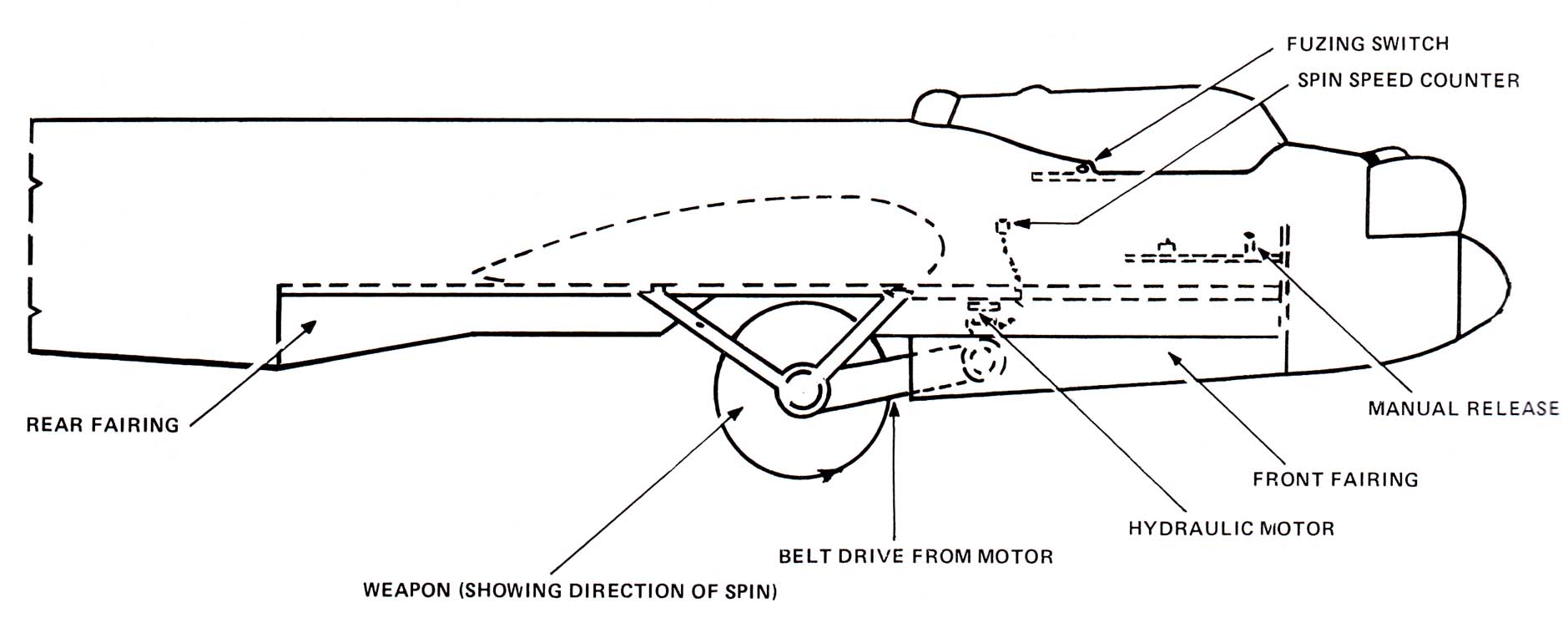
Didn't the 'dam buster' Lancs have some sort of power unit to spin up the 'Highball' weapon before dropping? Apparently the aircraft vibrated severely with the thing spinning before the drop (just one more problem to add to the illuminated belly lights, terrain and flak).
Last edited by Captain Dart; 17th September 2017 at 06:38.
Joined: Jan 2008
Posts: 17,699
Likes: 2,042
From: Reading, UK
Didn't the 'dam buster' Lancs have some sort of power unit to spin up the 'Highball' weapon before dropping? Apparently the aircraft vibrated severely with the thing spinning before the drop (just one more problem to add to the illuminated belly lights, terrain and flak).


Joined: Jan 2008
Posts: 17,699
Likes: 2,042
From: Reading, UK
While the original plan was indeed to fit a Ford V8, the solution eventually adopted was a Vickers Janny variable-speed hydraulic motor (as used for submarines' steering gear).
