The subtle art of gluing wood
Before we start into the artistry let us look at what we need in a glue.
In Australia an aircraft parked on the Tarmac at Alice Springs in summer will heat up.
The outside temperature might be close to 40 degrees celcius, no wind and the sun just beating down. In those situations the aircraft might very end up being over 50 degrees celcius.
In Japan at the moment the place is covered in snow. Daily temperatures can be as low as minus 15 degrees celcius.
neither scenario is very conducive to flying enjoyment but if you own a turbulent there the aircraft sitting parked may well be subjected to those temperatures.
So what we need in a glue is that it will achieve a stable chemical bond between the components over a huge range of temperatures.
Mankind has always been able to create glues stronger than timber, like casein made from milk, but it was only in the last century that glues of the necessary stability were first developed.
Resorcinol Formaldehyde was the first really useful glue for aviation and was developed in the early 1930’s. This is a two part mix of a red syrup and a brown powder. mixed in the correct proportions this produces a glue of amazing stability. The glue requires very tightly conforming surfaces, pressure and heat to correctly set it off.
Acid catalysed Phenolics were once used but have fallen out of favour for aircraft use. The most common example of an acid catalysed phenolic is Selleys 308 marine glue.
this is a brown powder that is mixed with water to produce a watery paste that is applied to one side of the joint. the other side of the joint is brushed with formic acid and the joint assembled and pressed together. It is a truely brilliant glue. the problem that saw it discontinued in aviation use is that if too much formic acid was brushed on there would be some uncatalysed acid left in the joint and this would gradually attack the integrity of the wood, unpredictably weakening the joint.
The wonder child in aircraft glues though would have to be Epoxy. This has proven to be such a useful glue that it is used everywhere. The Laminex and Formica used in kitchen benchtops are paper and epoxy laminates. Entire aircraft have been built from fibreglass and epoxy, kevlar and epoxy, carbon fiber and epoxy.
Epoxy is basically two liquid chemicals that when mixed form a liquid that internally bonds to form a stable inert solid plastic. There are actually a number of different chemical formulations that can create epoxy. To achieve a total transformation to an inert solid the components need to be mixed together in exact proportions. There is a weakness in that if other contaminating liquids are entrained in the mix the reaction that produces the final solid form will not achieve the full strength in the final material. Oil and water are two strength destroying contaminants.
There are basically two epoxy formulations in use in wooden aircraft.
Ciba Geigy make a certified for aviation epoxy. The components are mixed in a 2 to 1 ratio. One of the components has titanium dioxide mixed in it as a water contamination indicator. If the resulting epoxy sets with a shiny surface there is no contamination, if it sets with a matte surface there is moisture contamination and the joint integrity is suspect.
While it is certified for aviation use it has the disadvantage that one of the components is a carcinogenic compound.
The other epoxy in common use is basically the WEST systems epoxy. WEST is the wood epoxy saturation technique used in boatbuilding and pioneered by the Gougeon Brothers.
This epoxy is a 1 to 1 mix by volumes. From memory it is a 4 to 5 mix by weight but I never use the weight method.
The west systems epoxy is what I use.
How much glue do you think you need to mix up at a time when building your Turbulent?
an intriguing question isnt it. you will find that a glue mix is usually just a few grams at a time. each glue mix has an optimal working time before the chemical change to the solid starts to become noticeable. you must get all the work done while the glue is liquid. so you need to do small glue mixes so that you are always be working with the fully liquid glue.
the west system epoxy is very easy to use in small batches and this is why I prefer it.
a story about glue contamination.
the airforce had developed a boron fiber structural patch that could be used to repair difficult to access cracks. while the technique worked it was subject to unpredictable failures. so the airforce hired the local composites expert to watch the process and see if he could determine the cause of the failures. for an entire week he watched patching work. it got to be quite boring and he could see nothing wrong so wanted to call it quits.
no! said the airforce, boring it might be but keep watching. we need to crack this problem.
the next week was even more boring and my friend was not enjoying it at all. come the final hours of the last day and mercifully the weekend and the end of the job. in one of the final ever so boring patches he had to watch the airframe fitter was having a problem getting the patch to sit where he wanted it, so leaning over he reached into his top pocket and took out a little screwdriver to push the patch into final position.
“stop right there” said my bored friend. “what is that thing in your hand??”
“my little screw driver. I use it for instrument changes.”
“where does it live?”
“in my top pocket.”
“yes but your top pocket goes all over the workshop and all around engines.”
“yes I suppose so.”
after further investigation the problem was traced to the ever so slight oil contamination on the screwdriver. it didnt look oily but it was just enough contamination to ruin the joint.
I’m sure people have many different approaches to glue mixes but this is how I did it while making my Turbulent.
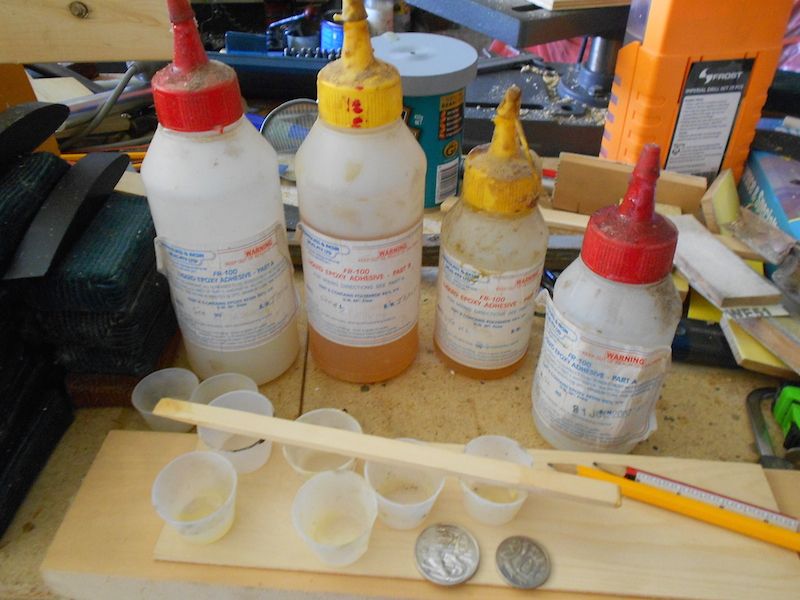
The little pots have proven to be very useful for mixing and seem just the right size.
When nurses dispense tablets to patients in hospital they dont touch the tablets to avoid communicating any bugs they come into contact with. They put the pills into the little containers. After the patient has taken the tablets the little containers get discarded.
On the wife’s visits to hospital she collects quite a few so when they are washed and dried these become my glue pots.
since we are gluing wood I use a wooden stick for the mixing. after each batch I let the glue cure and check that the stick has hard glue on it, then I stick it on the linisher and sand off the old glue. if the stick ever falls on the floor it gets set aside for the glue to set.
I break out a new uncontaminated stick. I make sure that the stick never gets contaminated with oil or water. any contamination and the stick is in the bin.
If you get epoxy all over you enough times you will become so sensitive to the epoxy that you will never be able to work with it again. one of the reasons for the long stick is so that you can work without getting epoxy on your hands.
more after I have a snooze in the afternoon heat.