Ahh yes, the ever present misunderstanding of how an aircraft flies, rears its ugly head again.
Should you actually believe that the airfoil generates lift by the difference in pressures, ie Bernoullian physics, like this, then read no further

IF you believe in Newtonian physics, then you have a chance to understand why Airbus is much further ahead in airfoil design.
So, as the ac moves down the runway, the pressure wave underneath the wing builds as speed increases. Given the angle of the wing, the pressure wave will begin to build in front of the wing, causing the nose to lift, at the same time, the compressed air from the trailing edge, will be forced out at a rapid rate, causing cavitation which will tend to bring the tail down (a downwash suction).
While this illustration is closer, is does touch on the building of the pressure wave in front of the airfoil..think of that effect on takeoff.
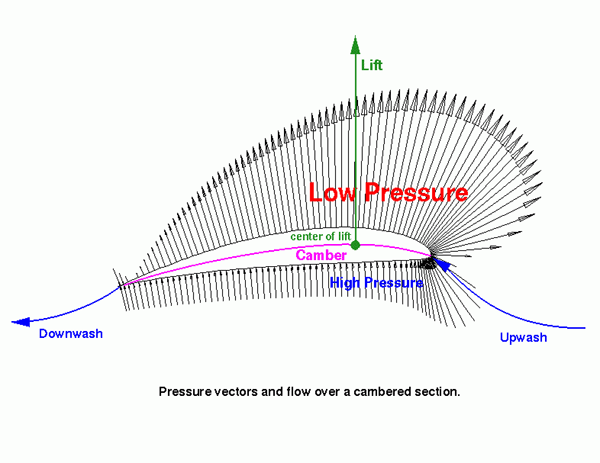 Note the high pressure forward of the airfoil! (ps, high pressure means compressed air, ie, the air had to come from somewhere, hence the 'low pressure' zone above, but still missing a bunch of components)
As you can sortof visualize, the pressure wave building in front of the airfoil has a rotational effect. This rotation effect exceeds the lift component of the ac to lift from the ground, ie the ac will rotate the nose up, before it can lift it from the ground.
That is why you hold the nose down, it is beacuse of the function of a much more effective lift of the wings, and especially the centerwing. Steering feels light way before v1, well, it may not be lift. it is the bird trying to push away from the ground, just in a different way.
Much the same effect on landing, which is why the A380 crosses the threshold at 120kts. (if you do decide to stand under the flightpath, (or measure the winds), you will find that you get blown back, not from the engines, but from the compressed pressure wave, for lack of a better analogy, compressing the air in front of the wing, and shooting it out the back as it moves forward, or a funneling effect)
I am probably not expaining the mechanics very well, but hopefullly, one can visualize what I am trying to illustrate.
EDIT: interesting, that 'ground effects' are understood for flare on landing, but not on takeoff...