Would the 222 family be considered an original idea, in some way?
In post
916 of the Nostalgia Thread I offered a small exposé on Bell Helicopter (you know, the kind of thing one does during a coffee break instead of a crossword

) and here is the extract relating to the 222:
222
For me personally one of the more surprising responses to one of Bell's developments was the 222. In my mind the 222 should have been a resounding success fed by Bell's legion of satisfied single-engine clients but, as we know, this was not to be.
"The first of five prototypes of the Model 222 (described as the first commercial light twin-engined helicopter to be built in the USA) flew for the first time on 13 August 1976. FAA certification for a Model 222 in preproduction configuration was received on 16 August 1979. The production 222 received approval for VFR operation on 20 December, and the first delivery, to Petroleum Helicopters Inc, was made on 16 January 1980. FAA certification for single-pilot IFR operations in Category I weather conditions was granted on 15 May 1980. A Model 222 delivered to Omniflight Helicopters on 18 January 1981 was the 25,000th Bell helicopter built. Another became a flying testbed for Bell's Model 680 rotor system. Production ceased in 1989."
The 222's launch to market (1980) was perfectly timed, intentional or otherwise, in that the progression towards twins in the corporate world was underway and many of those preparing to upgrade were Bell customers. The 222 provided a viable contrast to the Agusta 109 and an alternative for those wanting something smaller than an S76. But, the craft was let down by the initially poor performance its Lycoming engines and by generally high maintenance costs including those relating to the Nodal suspension system.
The failure of the 222 made it easier for Aérospatiale's 355 model to flourish and provided impetus to the ongoing refinement of Agusta's 109 series. In the process Bell lost out on a formidable slice of an important market, a market they had dominated for over a decade.
The above aside, was the 222 an original idea (your question)? Given the generally accepted definition of 'original' within the context of this discussion (new; fresh; inventive; novel) I don't know whether the 222 qualifies.
Light twins were already on the scene (105/109) with the AS355 and S76 being developed at the same time as the 222 so 'twin power' in a light frame wasn't exactly innovative. Neither was one of the 222's primary 'technical' features the smooth-ride Nodal Suspension System (ripped from the LongRanger and which ended-up becoming the bane of the aircraft's cost-effectiveness along with its engines).
In terms of styling the 222 wasn't bad, perhaps the rear wheel sponsons could have been a little smaller and or further back (they sometimes made access to the cabin slightly awkward) but she was a quick ship and .. (perhaps something which could only be appreciated by enthusiastic drivers) she produced this amazing Bell 'whop' which was just wonderful!
My godfather got to fly the Bell demonstrator N2221W for one week in the summer of '81 (after Heathrow grounded Bell's 222 chief test pilot at Battersea for non-compliance with London's helicopter routes

) and he reported that it was a 'dream' to fly. (Perhaps members such as
Longbox could offer their views).
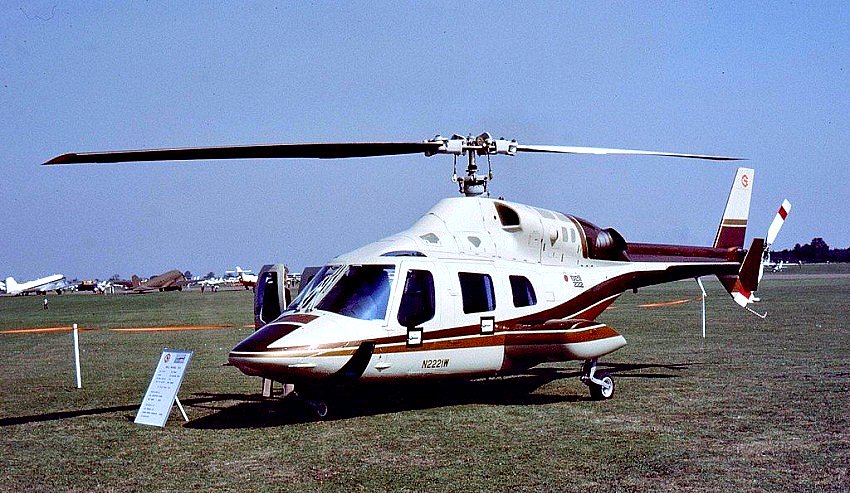 The Bell 222 (N2221W) which my godfather flew in 1981