Flyingmam,
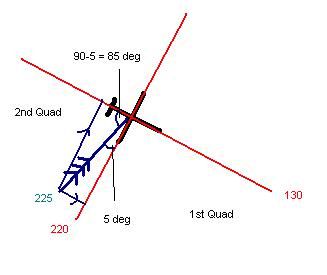
The book is right. You see the wind vector falls below aircraft's 90 degree line.
This is an important question because its needed when you go flying and want to quickly calculate drift angles in your mind, for example in flying holds.
Immagine four quadrants on the aircraft, each 90 degrees. The origin of the quadrants is the aircraft's heading If the aircraft heads 130, the first quadrant is up to 220. The wind vector falls in 225. This means its in the second quadrant.
Now look at the angles subtended in the second quadrant, disregard the first, and its all there. The angle opposite the tailwind component is 5 degrees and the angle opposite the crosswind component is 85 degrees. I made a quick on sketch on paint to make it clearer: