HarryMann;
Where would the c.g. be at that point of the cruise, if left to it's own devices?
What is the effect on pitch controllability when reverting to Alt2 or Direct mode of the above c.g. - from the pilot's perspective?
Representative cg fore-aft limits would be 17% to 39% MAC. At 210k kg, the cg would nominally be 29% to 33%...slightly aft; the tail would have about 4500kg of fuel at that point.
Pitch control in alternate law 2 (which is what they would have been in) is load factor demand law similar to normal law. Yaw remains in alternate law. They would have been in Roll direct law, which can achieve a roll rate of about 25deg/sec. In smooth air, the aircraft would be very controllable, in other words.
In very turbulent air and certainly in any inadvertent entry into a cell, my sense is, one would have to mindful of large control inputs, above all trying to maintain a level pitch attitude, letting the altitude and even the speed wander rather than chasing it with power (and certainly not pitch) but respecting the stall speed. In extreme conditions, an overspeed is not as serious as a stall - even a 50kt+ overspeed when the choices are really limited.
The weight of the fuel in the wings is actually a slight bonus, helping to reduce the bending moment. The outboard tanks are burnt at the end of the flight.
Settling the rudder limiter question:
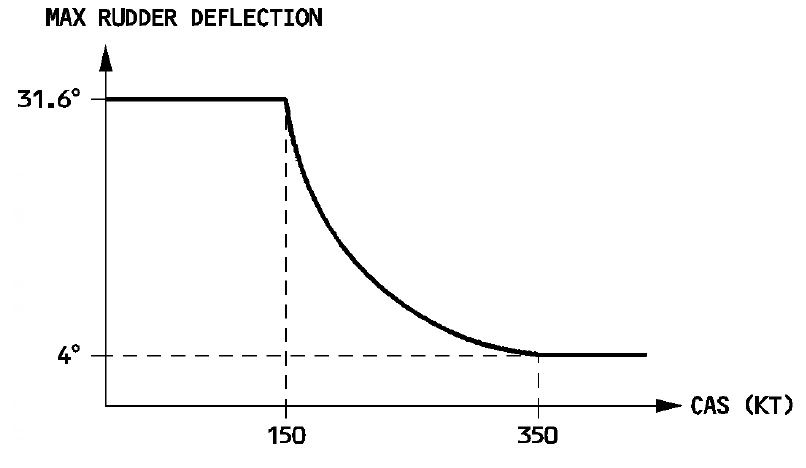
RUDDER TRAVEL LIMIT AND PTLU
Rudder and pedal deflection is limited as a function of the speed.
Each channel of the limiter is controlled and monitored by its associated SEC.
In case of double SEC failure the max rudder deflection remains at the value reached before failure then max deflection is available when the slats are extended.
Will;
Rudder at discovery and recovery is not the deflection that caused the separation, iow, full deflection to starboard. It took massive hydraulic power to put it there, and at sever, with no hydraulics or command to return it to neutral (or other), it may be there just as it was.
Help me out - trying to understand the two statements - "
Rudder at discovery and recovery is not the deflection that caused the separation" and then, "
it took massive hydraulic power to put it there" - put it where?..at the position we see it in now or at the moment of failure?
Right now, the rudder would be free to move and it's position is a function of the recovery operation. I suspect the damage on the bottom of the elevator is mechanical, not high-speed air-induced.