Not sure if this will work:
3.4.1 Density altitudeWith the initial data from ISA you can define a density which corresponds to the density at sea level, - density altitude 0ft. Now suppose that the actual air pressure decreases and/or the temperature increases. The result will be that density decreases. The new value of density corresponds to a higher altitude in the standard case (i.e. in ISA) and we refer to this as a higher density altitude.Decreasing density implies higher density altitude
Increasing density implies lower density altitudeOn a warm summer day an airport at sea level can have the same density altitude as that of an airport at an higher altitude at normal temperature.Density altitude is the altitude in the standard atmosphere where the density has the same value as the one that actually prevails around the aircraftA 1°C change in the ISA temperature will modify the density altitude by 120'.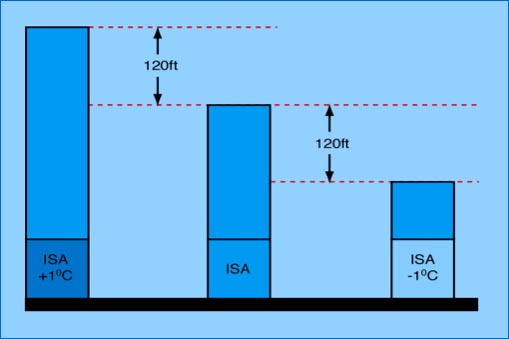 Figure 3.3
Density altitude changes by 120 feet per 1oC deviation from ISA at the actual levelProblems arise at extremely high-density altitudes, since much of the performance characteristics of an aeroplane depend on the dynamic pressure of the air. This in turn is a function of 1/2 ρV2. The lower density will give less lift to the wing. The thrust decreases since the engines consume less air (density = kg / m3). A propeller gets less grip in the thinner air. The effects of the thinner air on the airspeed indicator are not apparent since the aircraft behaves as it should, i.e. it takes off at the normal indicated speed etc. But the actual speed relative to the air (true airspeed) must increase when density decreases to give the same indicated airspeed. The result is that a higher density altitude extends the take-off run and gives a more shallow climbing profile. It will also require an extension of the landing run as the true landing speed will be higher in order to give the same IAS.
Figure 3.3
Density altitude changes by 120 feet per 1oC deviation from ISA at the actual levelProblems arise at extremely high-density altitudes, since much of the performance characteristics of an aeroplane depend on the dynamic pressure of the air. This in turn is a function of 1/2 ρV2. The lower density will give less lift to the wing. The thrust decreases since the engines consume less air (density = kg / m3). A propeller gets less grip in the thinner air. The effects of the thinner air on the airspeed indicator are not apparent since the aircraft behaves as it should, i.e. it takes off at the normal indicated speed etc. But the actual speed relative to the air (true airspeed) must increase when density decreases to give the same indicated airspeed. The result is that a higher density altitude extends the take-off run and gives a more shallow climbing profile. It will also require an extension of the landing run as the true landing speed will be higher in order to give the same IAS.