See from your Woodchurch thread, some very nice pics. It seems that you are a prop man, so that opens up another can of worms, but read on - it gets better.
For those not familiar with DSLRs the majority feature a rather convenient plus called the crop factor. Because the sensor is smaller, the image is projected onto this smaller surface and gives the appearance of greater magnification. In fact, it is just the reduced field of view - so your lens get instantly pumped by around 1.5/1.6 times on Nikon and most Canon: by 2 times on the Olympus and other "Four thirds" cameras and by bugger all on the full frame, but wonderful (sensor is the same size as film) Canon EOS 5D.
So. where is this leading? To ensure that you don't get visible camera shake and wobbly pictures with a film SLR, you aim as a rule of thumb to use a minimum shutter speed, the same as the focal length you are using. If you were to shoot at 200mm Zoom, then you would aim for a min shutter of 1/200th of a second. With the above "Crop Factor" of most DSLRs, you need to multiply this by 1.5 for Nikon and Canon, 2.0 for the Olympus, etc. etc. So for the Nikon, you would get 300mm out of a 200 zoom, but your min shutter speed would be in the case of a D70 say, 1/300th of a second. There is a catch. If you are using a long zoom, it follows that you need a fairly high shutter speed. If you do this, you will get a great picture of the aircraft, but with a frozen prop.
I reckon that the max shutter speed to get a half way decent prop disk, is 1/250th of a second, so for anyone keen on props, this does begin to pose a problem. The answer lies in adaptive optics, Vibration Reduction or Image stabilisation. What this does, is to sense camera shake, vibration, etc and add an opposite phase to one of the optical elements and Voila! you can take at lower shutter speeds. This technology is usully applied at the lens in DSLRs though the new Sony Alpha, has it built into the body, which means that you don't have to buy it for each lens. (Not used the camera, so a few reviews might be in order.) For an airshow lens with VR or IS the Sigma 80-400VR comes into mind. (Around £850) So does the Nikon 80-400VR. (Tad over a grand) Canon have many IS lenses in their own range, but I am not familiar with them, though prices again, are not cheap..
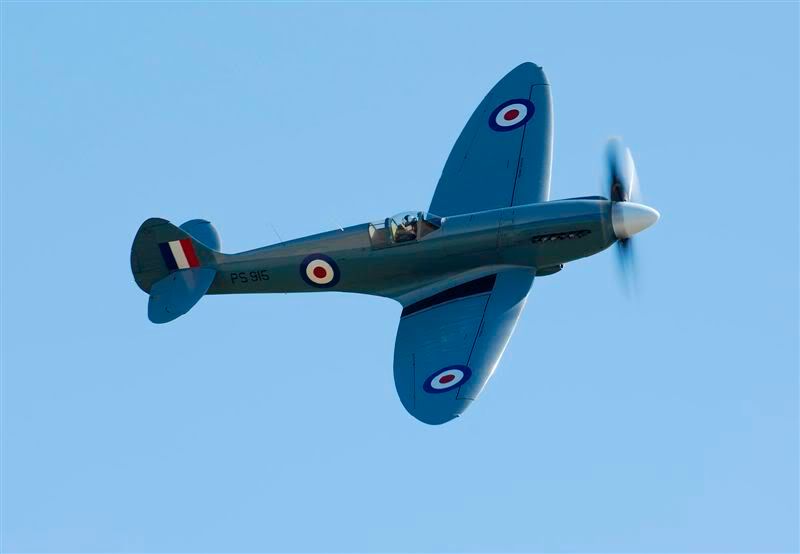
Beneath is a picture taken at RIAT of the Spitfire PR19 and it was (mistakenly) taken at a ridiculously low shutter speed for me, of 1/125th of a second, at F11 and with 200mm of zoom. (Nikon 70-200VR F2.8) Normally, with the D200 I wouldn't have dreamed of going beneath 1/450th to 1/500th let alone 1/300th - but look at the propdisk.
There we have it. Conan's top tip for helicopter displays, is to forget it unless you have a VR lens, or are right on top of it.
Conan