If on the ground two people both lift the ailerons with a force of 40 pounds each, then the half inch droop should go to zero, and the ailerons become in line with the trailing edge.
If two people each apply a lifting force of 40 pounds to the trailing edge of a 172's ailerons, something's probably going to be damaged (I've had to repair them for this). The "40 pounds" is the Cessna specified cable tension for the aileron control circuit. It's a closed cable circuit, so that cable tension can be measured anywhere the cable can be accessed easily. Excluding the control wheel chain part of the aileron control circuit, and the two aileron pushrods and their connections, there is no place where any freeplay could safely exist, the entire aileron control circuit is under 40 pounds tension.
For 172 aileron rigging, Cessna states: "Stop bushings should be centered in slots of aileron bellcranks in each wing when the control wheels are neutral, with correct tension on the aileron carry-thru cable. Pushrods are then adjusted to rig the ailerons neutral."
"Neutral" for Cessna ailerons is that the aileron trailing edges neatly meet the trailing edges of both the wing tips, and the outboard trailing edges of the flaps. Cessna does not describe any [permissible] "droop" in the aileron position. If it were to exist, it would be the result of horribly worn aileron pushrods/connections, or a broken pushrod connection in the aileron (which I had to repair on my Cessna). So if the 172 you're referring to has "droop" in the ailerons, which two people can easily reposition, it should be inspected for aileron control circuit damage.
This photo:
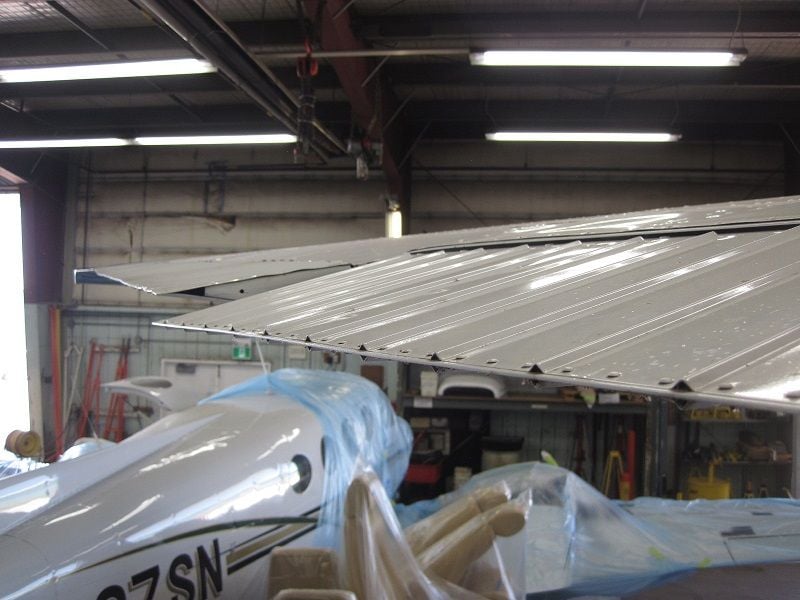
Is the defect observed in the rigging of ailerons on a Cessna 185 amphibian I was called to review. (Essentially the same control system as a 172). All of the trailing edges med neatly except the gap shown. The airplane flew perfectly level. But, That gap is not permitted. As an aside, the 185 had had 182 wings installed, with a very, very vague reference to the swap in the technical records - but that mysterious wing swap was not a factor in the defective aileron gap - separate issue. To correct this defect, I required that both ailerons be rebuilt with the correct washout in them, and the wings be rerigged. After that, I test flew the plane, and got it so it flew very well, and the ailerons were correctly rigged. With that, and a number of other defects corrected (stall warning horn was operating very wrongly, landing gear warning system had errors, emergency landing gear operation was backward - yes... backward!), I approved the use of the 182 wings on the 185. Once this was all corrected (took 8 months in the shop, and 9 hours of my flight testing), the airplane was super!
For that airplane (as any), we assured correct aileron operation, no freeplay, correct neutral position, correct cable tension, and correct control wheel position. Understanding the operation and rigging of the control system is pretty important, and, as the pilot, being able to observe, and possibly question a defect is important.