I had no idea that a Heinkel 177 had visited Bovingdon until I saw a photograph thought to have been taken at the airfield. I looked at John Young's diary and it is on his list. I read that Winkle Brown had flown a Heinkel 177 and wondered if he had listed it amongst his most or least favourite of aeroplanes flown - then I realised I had lent my copy of his recent biography to a friend. So I had a listen to Winkle on 'You Tube' where he dismissed the 177 in one imperious word, "Disasterous !" This, Germany's only heavy Bomber, designed initially as a long-range Glide-Dive Bomber powered by twin coupled side by side Daimler-Benz engines which had a propensity to overheat and set the aircraft afire, a weakness that persisted throughout the type's short operational life (1943-1944). This was combined with a long, slow period of development and testing and an erratic production of an aircraft which was finally put into service without being fully proven. At great and wasted expenditure upwards of a thousand or more were eventually built. Nevertheless when serviceable and operating in optimum conditions the Heinkel 177 could pack a very lethal punch. I'm not sure how I came across this first photograph........
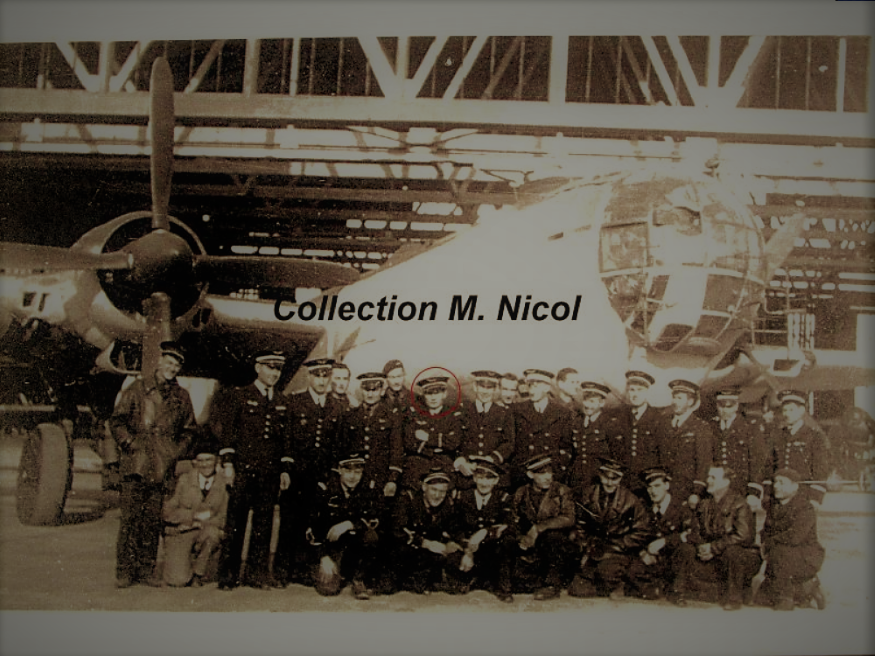
Image: Nicol Family via Aviation-Ancienne.fr
At Toulouse Blanac period September-November 1944. These are thought to be members of the French Dor Group who obtained enemy aircraft after the Germans had fled. There is a story about L. Nicol whose head is circled. I will include it in a postscript as I'm limited to the amount of stuff I can download per post. More importantly the aircraft is Heinkel 177A-5 Wk-Nr 550256.

550256 in French markings location unknown but probably either at Toulouse or Villacoublay.
This aircraft was surrendered to the Resistance/Dor Group at Toulouse in September 1944. It was then overhauled by SNCASE at Toulouse and test flown by Col Watson USAAF (of Watson's Whizzers) on 28th November 1944 and flown to Villacoublay on the same day. Here on this bombed and flattened aerodrome it came into the care of the 10th Depot Repair Squadron where it was fitted with radios and received further maintenance. On 14th January 1945 it was flown from Villacoublay to RAE Farnborough by Squadron Leader Randrup.

550256 Location unknown but very likely at Villacoublay with what looks like an American truck visible.

Photo:Robert Forsyth with thanks. This was originally thought to be at Bovingdon. However the distant buildings seen behind the port tail-plane resemble more those at Farnborough (near threshold R/W 24) rather than those at Bovingdon.
On the 19th January 1945 the Heinkel was flown to Bovingdon where it remained until February 9th 1945 when it was flown to Orly (there is some uncertainty here because the aircraft was being ferried to the USA and some sources say it diverted into Orly with an engine failure). However an engine change was made at Orly and the Heinkel attempted to depart from there on 28th February 1945 but burst a tyre on takeoff, ground looped, broke its fuselage and was damaged beyond repair.
Meanwhile there had been a second Heinkel 177 A-5 at Toulouse Wk-Nr 550062 this was flown to Farnborough on 10th September 1944 and given the serial number TS439.

Source: britmodeller.com

550062 in French markings at Farnborough.

As TS439 in British markings.
Aware that the Americans had lost 550256 RAE Farnborough gifted TS439 to them.The Heinkel had already been flown to Boscombe Down on 20th February 1945 where it was later dismantled and shipped to the USA. On arrival in America it was discovered to have an unserviceable engine and disappeared unflown into the mists of time.
MARITIME OPERATIONS
The Heinkel 177 proved to be a suitable platform for the use of the Henschel HS293 Guided Bomb - one being carried below each wing. Demonstration launch from a Heinkel He 111 seen here:

Image benjidog.co.uk
This is the SS Marsa of Court Line (Yes the same multi-coloured outfit that were my erstwhile employers - I was so proud of the small number of shares I once held!) .
The Marsa was part of Convoy SL139/MKS30 sailing from Gibraltar to Britain when attacked not only by U boats but also Heinkel 177s on November 21st 1943.

Source Aviastar.org Aircraft Profile #234.
Henschel HS293 sinks HMT Rohna. The sinking of the Rohna (British India Line) sailing from Oran to Alexandria in Convoy KMF26 in the Mediterranean on the late afternoon of 26th November 1943 resulted in the largest loss of life at sea of American servicemen in WW2. Heavy losses were inflicted on the 22 Heinkel 177s that had departed Bordeaux Merignac earlier that day to attack the convoy. Only six managed to penetrate the Allies' air defences. At the time this incident was hushed up in the USA and to a lesser extent in Britain and then after the war rather forgotten about. I'll put a video as a Postscript - it's a bit long but not without interest and thankfully devoid of all the sensationalism that you often find on the internet.
OPERATION STEINBOCK/CAPRICORN.
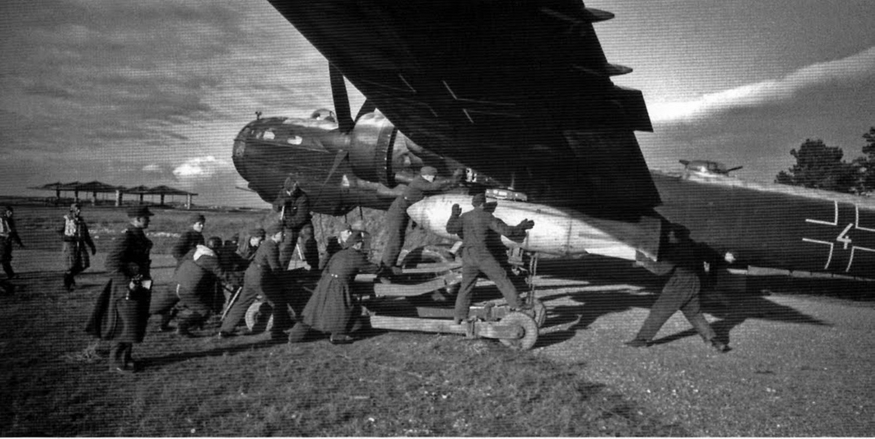
Heinkel HS177 A-3 loading an SC1800 (kg) bomb.
This is referred to in modern parlance as Britain's Mini Blitz which was concentrated on London and the South Coast ports west to Plymouth and Cardiff and north to Hull.
This last throw of the dice from an ailing Luftwaffe occurred over a period from January 21st 1944 until early May 1944. Britain suffered much damage and a not inconsiderable loss of life. The Luftwaffe aircraft comprised mostly of Ju88s and Do217s with comparatively smaller numbers of Heinkel 177s which operated from Chateaudun in The Loire and Rheine in Germany. It was initially planned that the Heinkel 177s would to fly low to the European coast and then climb to altitude over the sea before commencing a shallow dive towards their target which would often be marked.The return to base being made at a low level. Fortunately by this stage of the war Mosquito night-fighters were swarming in the darkness.........Heinkel 177 kills listed below.
F8+HH. 21st January 1944. Whitmore Vale near Hindhead, Surrey. Crew: 2 killed 4 POW. Mosquito 151 Squadron. (First Heinkel 177 downed in Britain).
5J+2L. 22nd January 1944. At sea 6 miles s/e Hastings, Sussex. Crew ordered to bale out at 20,000ft due engine failure. 2 crew did so and were wind-blown to successfully land near Hastings. Remaining 4 crew shot down and missing - 2 bodies later recovered washed up from sea. Mosquito 85 Squadron.
5J+QL. 23rd February 1944. Wolsey Farm, Yoxford, Suffolk. Crew: 5 killed 1 POW (seriously injured). Mosquito 25 Squadron.
5J+PK. 24th February 1944. Chequers Farm, Lamberhurst, Kent. Crew: 2 killed 3 POW 1 missing. Mosquito 488 Squadron.
 5J+PK
5J+PK wreckage in hop field. Image: Aircrew Remembered.
6N+KK. 2nd March 1944. Hammer Wood near East Grinstead, Sussex. Crew: 2 killed 3 POW 1 seriously injured and repatriated. Mosquito 151 Squadron.
 6N+KK.
 Image Parry via Aircrew Remembered.
6N+DK. 20th March 1944. At sea off Skegness, Lincolnshire. Crew: 6 missing. Mosquito 307 Squadron.
6N+AK. 19th April 1944. Butler's Farm near Ashdon, Essex. Crew: 2 killed 4 POW. Mosquito 410 Squadron.
 6N+AK
6N+AK Photo Julian Evan-Hart and David Stuckey.
6N+1K. 21st April 1944. At sea 40 miles east of Spurn Head, Yorkshire. Crew: 6 missing. Mosquito 264 Squadron.
Finis
Further Reading: Heinkel He177 Units of World War 2. By Robert Forsyth. Osprey Publishing 2018.