Joeyc41
A few posts after the post you quoted from, the author was asked the same question:
... Could you explain the reason for those Vmo changes with altitude and weight?...
And his reply was, and still is:
..."I’m afraid not, as this is getting in to an area well beyond my own level of technical knowledge! However, there are one or two learned gentlemen on this forum who were heavily involved in the design of Concorde and who may come along to shed some light on the matter"...
Fortunately one of those learned gentlemen did:
Originally Posted by
CliveL
Last time I logged in someone was asking why the Vmo/Mmo was the way it was, but it seems to have disappeared along with Bellerophon's suggestion that someone else might be able to throw some light on it. This might help.
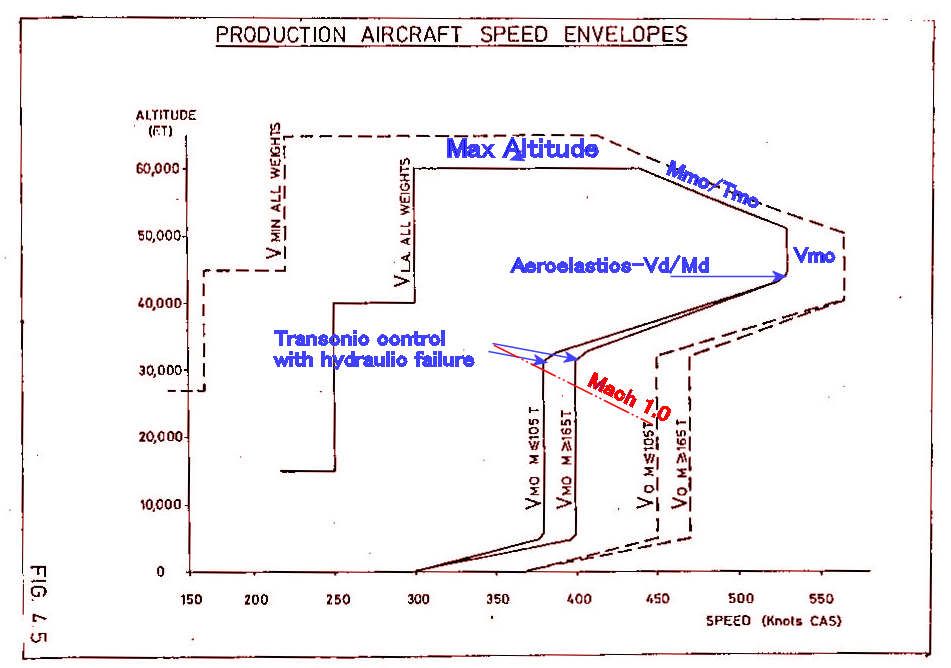
To be honest I can't remember exactly why 530 kts was chosen for the supersonic Vmo, but it was probably the best climb speed.
Mmo/Tmo was limited by a combination of intake and structural temperature.
The 'cut-off' in the sloping/530 kts boundary was, if I remember correctly, to avoid a minor aeroelastic problem at the Vd/Md condition one arrived at from that corner.
The variation of Vmo with weight was a device which, when associated with the CG corridor, allowed the aircraft to meet the manoeuvre requirements when flying on half hydraulics.
400 kts CAS gave 0.93M at around 28000 ft if I recall correctly, which was just below drag rise and gave optimum subsonic cruise performance
If
CliveL is not able to shed any further light on your question, beyond his answer already given, I suspect there may not be too many others who can!
Kind Regards
Bellerophon