This is an interesting counter-view on the actions taken with the Australian fleet, and a potentially identifiable source of some of the logistical issues. It is an interesting comparison between the experience of New Zealand and Australia, which has been discussed here in detail, but doesn't fully recognize the dissatisfaction expressed by other operators outside Australia, which is also discussed here.
https://asiapacificdefencereporter.c...nce-logistics/Helicopters-There is nothing wrong with Tiger and Taipan – the problem is Defence logistics
An Australian Army MRH90 Taipan helicopter from 6th Aviation Regiment conducts reconnaissance at Shepparton, Victoria. Credit: CoA / Carolyn Barnett
By
Kym Bergmann / Canberra
-
28/02/2023 513
68
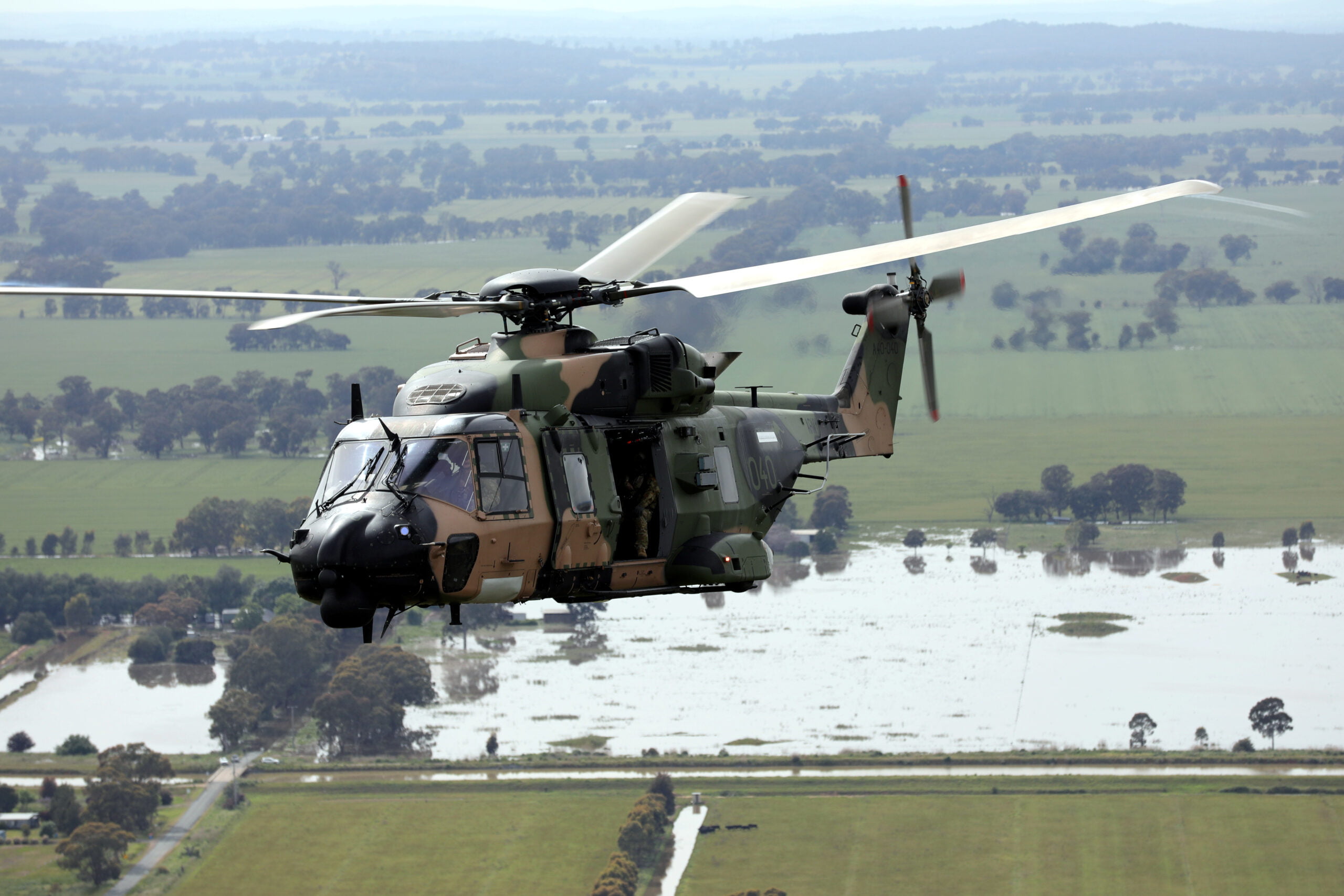
This startling conclusion is the culmination of several years of effort to find out why Australia has had disproportionate problems keeping our 22 Tiger Armed Reconnaissance Helicopters (ARH) and 47 Taipan Multi-Role Helicopters (MRH) flying. Other countries have nowhere near the same level of difficulty as has been experienced here.
Just about all the blame has been heaped on the manufacturer Airbus Helicopters and both classes are being retired and replaced about 20 years ahead of schedule. All the helicopters have plenty of structural life remaining. Instead, we will spend an extra $10 billion dollars on 29 Apache AH-64E attack helicopters and 40 UH-60M Blackhawks. Added to this is mix are 12 MH-60R Seahawks to replace the RAN’s six MHRs at a cost of $1.4 billion.
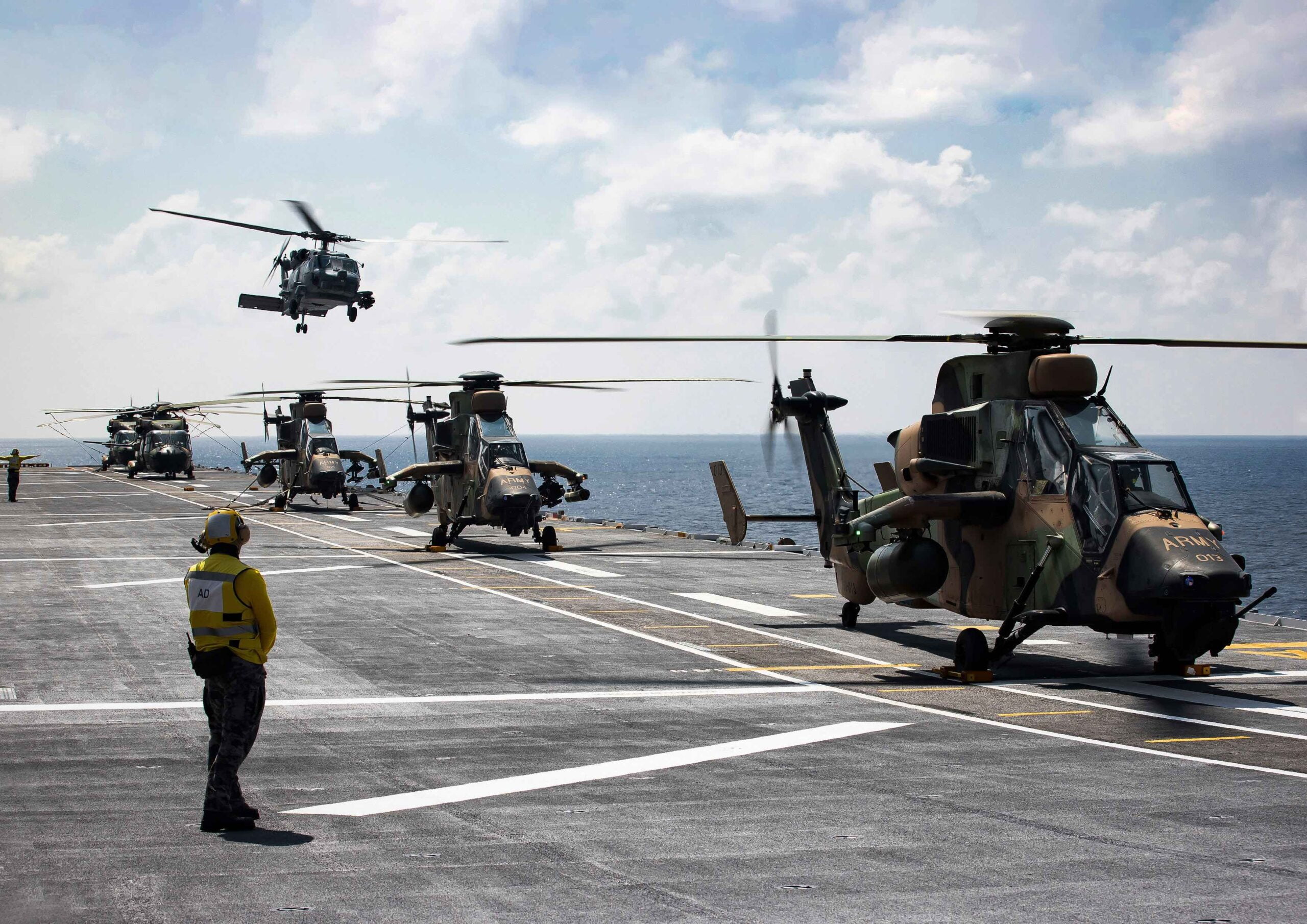
HMAS Anzac’s MH-60R helicopter launches from HMAS Adelaide’s flight deck to assist in a hellfire missile firing with Australian Army ARH Tiger helicopters during Indo-Pacific Endeavour 2022.To put it more bluntly, all this might be based on an incorrect premise – namely that the ARH and MRH fleets are chronically unreliable because of spare parts shortages, and they therefore must be retired in the national interest. This is not correct, with the major culprit being the Defence / CASG support process – a major element of which is a software package called CAMM2. It looks as if this is at the heart of the problem and not the helicopters themselves.
Many readers will be surprised because of the repeated vitriol directed at the MRH and ARH for more than a decade – some of it seemingly orchestrated – that has created the false impression that the helicopters are unreliable. Everyone has piled on – politicians of all backgrounds; large sections of the media; think tanks; and Defence itself. Airbus has not publicly defended itself – and wanted nothing to do with this article – which might be a combination of management fatigue battling the Australian system and having bigger fish to fry in the shape of bids such as JP 9102 for communications satellites.
This article should have been written five years ago when it might have made a difference to the series of decisions leading to the recent Apache and Blackhawk purchases. However, getting detailed information from Defence has been impossible and events such as Senate Estimates have only provided fragments of disconnected data.
Some retired Army staff who know what has been going on remain loyal to their former service and while confirming facts about CAMM2 will not go on the record. Additionally, few people are interested in the detail of Defence logistics when it is much easier to blame the French in general and Airbus Helicopters in particular.
Today, both the ARH and MRH fleets have an availability rate of about 70%. This is likely to be better than most – if not all – RAAF platforms and for the future Apache and Blackhawk fleets. The 30% of time when they are unavailable is not necessarily because of a problem but instead they are offline for routine, preventative maintenance. This is standard on complex machines such as military aircraft – and it takes up an unavoidable chunk of time.
However, getting to this 70% figure has involved a struggle going back at least a decade, much of which has involved discussions between the manufacturer and CASG about streamlining support processes. The reality is that there have always been plenty of spare parts available. What has stopped them getting from the warehouse to multiple workshops has been burdensome bureaucracy caused mainly by outdated Defence software.
Consider the case of New Zealand. Their air force operates eight MRHs almost identical to Australia’s – and they could not be happier, flying a reliable modern helicopter with one of the highest usage rates of the global fleet. The contrast with Australia is stark and worth examining. How can one customer have no problems with maintenance – yet the other is retiring its fleet 20 years early?
New Zealand has all their helicopters at one facility; Australia’s are scattered across five bases. They have a streamlined approach to logistics with a single point of contact and modern, interconnected data bases. The difference with Australia was illustrated during Talisman Sabre in 2019 when the Australian MRH fleet was grounded because of a tail rotor issue – but the New Zealanders were able to keep flying theirs because they had already installed the fix according to the OEM’s recommendations well in advance of the exercise.
Instead, the Australian CAMM-2 (Computer Aided Maintenance Management) system was fielded in 2005 to address deficiencies in CAMM-1, which was an earlier attempt to digitise logistics. Very few organisations continue to use a logistics software package from 20 years ago – certainly none in the commercial world – and CAMM-2 has been described as labour intensive and costly to maintain.
It was designed to support military aircraft – though it is not being universally applied, with exceptions including the RAAF C-17 fleet with software from the manufacturer, Boeing, via the USAF. The F-35s come with their own separate Automatic Logistics Information System (ALIS) supplied by Lockheed Martin that supports the global fleet of aircraft.
CAMM-2 was meant to integrate seamlessly with several other databases such as Army’s separate, orphan, Weapons System Data Base (WSDB) but that has not proven to be the case. Apart from being old, CAMM-2 has several limits, for example not doing inventory management. There is a veritable alphabet soup of other unconnected logistic packages such as MRI, LSAR, MILIS, ADAASS and WFD that are all part of the Australian military support structure – in additional to local uncontrolled databases and spreadsheets.
This means that for one of the simplest tasks that frequently occurs – a part number change on an engineer-approved basis from the OEM – must be manually entered into about eight different systems, potentially by eight different people. This lack of integration and a labour-intensive approach to updating documentation is why the Australian system is such a mess. That is neither the fault of the helicopters nor the company making them.
Another issue in play is the figure being used by Army that retiring the MRH early rather than in 2037 will result in a $2.7 billion saving. The problem is that this improbably large number of $200 million per year can only be achieved if things are included that have no factual basis – such as equipment that isn’t needed or upgrades that don’t exist. It feels like someone has been given the job of finding a scary number and they have worked backwards to come up with the desired result. Defence has not responded to a request for a breakdown of the figure.
As part of the process of demonising both Tiger and Taipan, the Canberra bubble has been awash with commentary that neither aircraft was wanted by Army in the first place, and they were imposed from above by politicians. These claims are incorrect.
The situation with Tiger is clear: it was preferred by Defence (Army) because it met all the key performance requirements, was the most modern of the helicopters offered, the price was attractive – and it had a high level of Australian content. In procurement terms it was a slam dunk. Apache was fourth on the list after the Mangusta and the Cobra. After these came the Rooivalk from South Africa.
The situation with the MRH is more complex. Both it and the Blackhawk met performance requirements and since Defence could live with either, it was finally selected for a range of reasons. These included a high level of local content and that it was a better fit with the overall AIR 9000 objective of rationalising the ADF helicopter fleet.
This masterplan was based in part on the assumption that the naval version of the MRH – the NFH90 – would be mature enough to replace RAN Seahawks around 2016. However, that fell apart with the cancellation of the Seasprite project in 2008 – Defence did not cover itself in glory after spending $1.5 billion on that failed undertaking – and that led to the subsequent selection of the MH-60R.
A further claim is that other MRH customers are also unhappy, and the prime example is Norway. Indeed, Norway is threatening to scrap their helicopter fleet. The only problem is that the Norwegians purchased the ASW version of the helicopter – the NFH90 referred to above, not the MRH – and then decided to fit their own dipping sonar and indigenous lightweight torpedo, guaranteeing that it would be a program manager’s nightmare.
This has no relevance to Australia. Nor does the Swedish case of their MEDEVAC helicopters. The cabin size of the MRH is one of its attractive features – being more spacious than a Blackhawk – but for reasons known only to themselves the Swedes insisted on raising the cabin height by 20cm. Despite the resultant delays they remain an important part of the program.
If the fundamentals of APDR’s research are correct – that there’s basically nothing wrong with the helicopters – something has gone badly awry with Defence’s processes. The result is that people from Ministers all the way through to the media have been misinformed for years.
External agencies such as the ANAO that have been critical of Tiger and Taipan – but have relied on information supplied to them by Defence. An independent review of the Tiger program conducted in 2016 was quickly classified as SECRET and consequently has never seen the light of day.
All this needs to be checked out – urgently.
There has already been far too much selective use of information to support a particular pre-determined outcome, and someone needs to objectively evaluate and report on the situation – preferably publicly. Australians are entitled to know where their money is going.
It looks too late to stop the purchase of Apache and Blackhawk – which are fine helicopters of an older design – but it might be possible to achieve billions of dollars of savings by slowing down the delivery schedule and keeping Tiger and Taipan in service for longer.
The problem is that a lot of powerful people – on both sides of politics and at high levels in Defence – run the risk of looking like fools for not doing their homework. All the matters detailed in this article are not the result of espionage, they are the product of asking a lot of questions and not being fobbed off with simple explanations.
For anyone who remains unconvinced: how else is it possible to explain the vast difference between the Australian and New Zealand experiences with the MRH?
Unfortunately, this might all be swept under the carpet because the embarrassment caused by revealing the facts will be too great – which should never be a factor when taking decisions in the security interests of Australia.