Megan's first video is looking in the opposite direction of the approach, and shows the aircraft was quite stable, wings level for some time before the flight path deteriorated. There is not enough resolution to have any idea of the speed, but she sure does plummet below slope there towards the end of the flight.
Hans Brinker: I cannot believe there are pilots that think aerodynamics are affected by ground speed. Yes, landing distances are. Yes turn radiuses across the ground are. YOU WILL NOT LOSE AIRSPEED TURNING INTO A "TAILWIND".
Hans... we get taught to fly light aircraft, and do stuff like ground reference manouevers in what are generally light aircraft, low inertia. Where inertia is considered to be zero, there would be no such thing as wind shear... as you say the plane only sees the air. The only difference that would arise would be a change in the flight path angle, FPA, as whatever the vertical speed, VS is relative to Ground Speed, GS, would change, FPA being VS/GS. An aircraft with inertia cannot suddenly accelerate the inertial mass instantaneously from one kinetic energy state to another, except on star trek maybe.
If you are turning into an increasing tailwind in a high inertia aircraft, you will see CAS sag and the ATR system compensate up to MCT to maintain the commanded speed. In a Boeing, that will be seen as the thrust levers moving rapidly forward, and then once the rate of change of wind (shear; dv/dt) has stabilized, and on target speed, the thrust will rapidly recover to the pre-turn levels. In an airbus, you get to see the command arcs move, the thrust values go up, then everything goes back to normal, and the crew pokemon game is undisturbed by the Boeing racket. On a B737, you also of course get the rattle of the trim system for the speed variations (there is also usually a slight trim change to maintain altitude even in calm conditions, so a clack or two is pretty normal in an extended turn on a B737).
There are two general types of wind shears that we mess about with, that related to microbursts which drivers tend to avoid wherever possible, and the common or garden horizonal shear. (There are also thermal shears, stock shares etc... ) Microbursts provide vertical and horizontal shear components that get pretty nasty quickly, and drivers tend to avoid them where possible. Horizontal shears happen every day at all altitudes, and arise from the component change to the direction of motion of the aircraft. That can be a velocity change or a vector change. If the component changes at the aircraft, there is a shear occurring.
Shear is time dependent. The driver can alter that in most cases by controlling the mode that the aircraft is controlling to. For vertical shears, (and with the ususal caveats that the driver is responsible at all times to remain within limitations and to follow company policy), traversing a vertical shear can be easily managed by using a VS mode... a nice simple 500FPM up or down is pretty darn difficult to bust a limit, or to stall the plane (but not impossible... ) a shear of 100kts in 4000' vertical is entertaining in a speed mode for climb or descent, such as FLCH, dropping out of the wind, with a reducing headwind component in FLCH will cause the plane to increase the sink rate with a pitch down to maintain speed, and the steady state sink rate will rapidly dissapear. Most memorable data I can recollect of that was a B772ER going through a 180 kt jet core, from above in a descent. Guys started the descent with the speed brake out, and the tailwind increased as they entered the core from a lower tailwind condition (taking advantage of a lower tailwind on the day.... ) so the tail wind rapidly increased, and that led to a rapid pitch down and higher sink rate... that then led to entering the airmass under the core which had a reducing tailwind component with a sink rate of greater than 12,000FPM, and a major pitch up and overspeed as the APFD wasn't nearly capable of keeping up with the rates that the driver had set up... apparently was spectacular from the inside. had the descent been done in VS at a modest rate, no ones beer would have spilled, even the pilots beer. In a modest VS, the trust would have changed to maintain the speed, and the VS would have controlled pitch. The VS compared to shear rate would have kept it boring, and boring is good. This is the reverse sort of event to the B767 commented on by me before in the climb...
For the ground reference cases, if you are zipping about the cans at Reno, even around 380CAS the rate of turn is relatively low and the winds are almost always light, so there is not much shear, and the planes are not very heavy... Doing that even in a B747 at VMO while fun would probably not give a particularly high shear rate, but it would get tea and bikkies with the boss for the overstress, or with RARA for disqualification for running off the course.
Biggest horizontal shear I ever came across was going into a VFR forecast airport, in a big twin, and noting at about 20 miles to run for a gentle turn to final that we had a northerly wind of 56kts, and the reported wind on the ground was 36kts from the south. Asked the FO who was PF to slow down early as we were going to get a pretty good shear at some point, so we configured to approach flaps, and at 1200'AGL, we still had 55kts tailwind, and 35kts in the opposite direction on the ground. Neither the ground or the upper wind were on the forecast. At 400ft the wind started to change, and the FO blew straight out of the slot with the flaps load relief getting a fair work out. As we had min fuel and no alternate, it became fun to do the final approach. It could be done, but it took controlling the rate of change to make it manageable and to land with reduced flaps. All other inbounds were diverted for the next 4 hours, and we would have too, had we had gas.
If inertia wasn't a factor, shear would not do anything other than change the VS to maintain a path, the wrecks on finals dotted around the world suggest that inertia and kinetic energy is indeed a factor, irrespective of what physics we train pilots in, akin to teaching Bernoulli's theory to explain why wings work. The oracle Google gives a number of popular science level descriptions that are completely wrong but follow the guidance that pilots get encumbered with at the start of their flying career. When DFDR data is looked at, the inertial effects can be seen in the data relatively clearly.
If this is surprising, then you should try screening out coriolis effects on jet aircraft performance data, or the variation in SAR that occurs when flying from one airmass to another. In the old days that was a pain, but with GPS geometric altitude that becomes easy to resolve, and actually ends up giving some interesting info on the actual weight/drag count, with W/delta still being a factor in the background.
If this sound pedantic or boorish, a disproportionate amount of time in DFDR QAR analysis gets used up educating ops managers that the crew were in conditions that caused changes to the flight path, and that the problem is not one of compliance it is one of awareness. That is about 37 years on that subject and it seems to have no end in sight.
Note, the reactive windshear alert algorithm is the F factor:
F=Wh G - Vd As
where:
Wh is the rate of airspeed loss in kts per seconds,
g is gravity,
Vd is the vertical down draft rate, and
As is the aircraft airspeed.
The Wh/g term represents the rate of change in the horizontal winds. The Vd/As represents a measure of down draft strength. A way to think of F-factor is the rate of removal of energy from the aircraft.
Back in the day, I suggested to the design team that the reactive alert include a +/- value rather than just a minus, as what goes up usually goes down... The predictive alert came in soon enough to be a better bet.
Stated another way...:
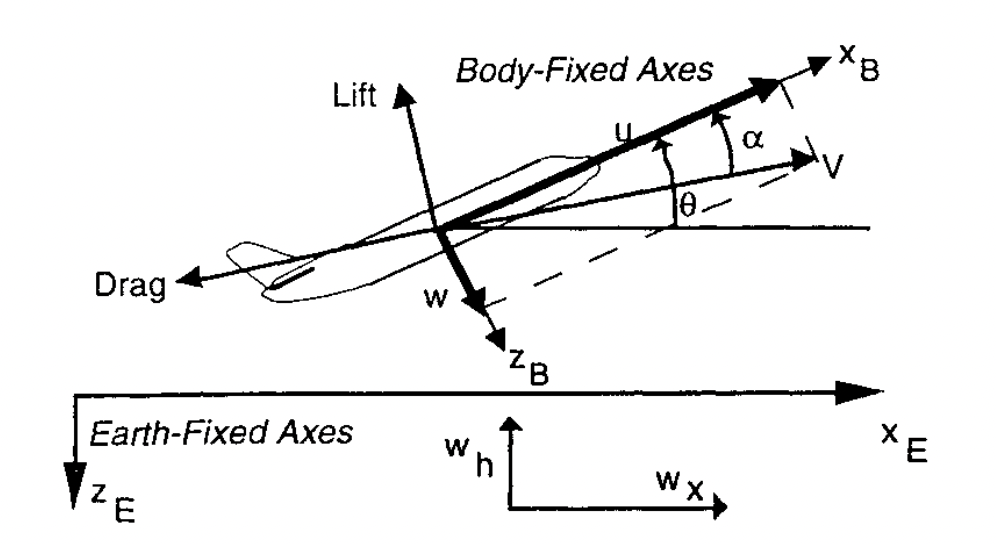
given the equations of motion of:
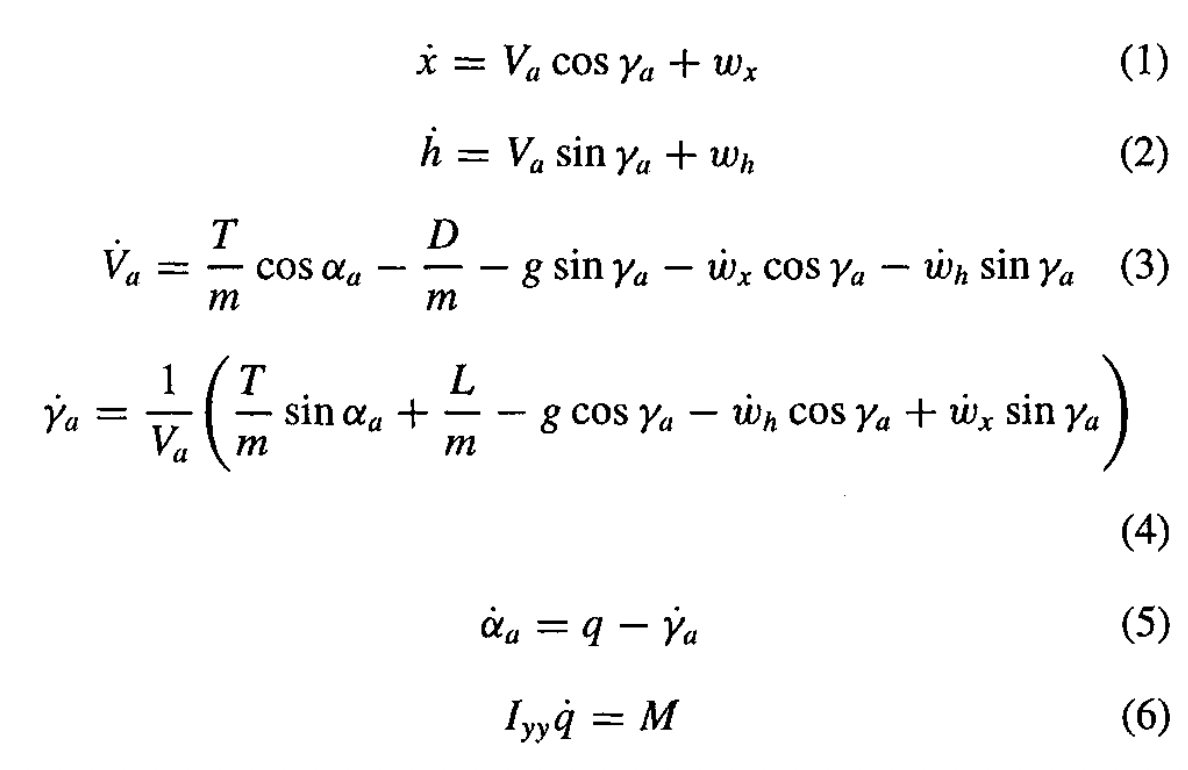
(refer the model below)
The specific energy Es becomes:
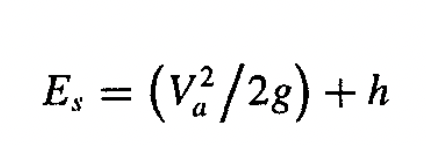
and can be expanded to:

The first component being the airplanes specific excess power, so the rest is the wind effects which is a restated F factor:
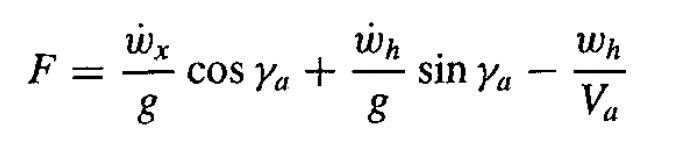
So, in the end, there are triggers for, vertical rates that arise from the vertical shear, and dCAS that comes from the horizontal shear, both items affecting the specific energy, Es, of the plane.
PS: if you want to quantify the rate of shear that your plane can encounter and not have a bit of fun, you can sit in the sim and try from a steady state in whatever configuration that you have to go to full thrust, and record the acceleration rate that you achieve. The sim will normally be within 10% or so of the specific excess thrust available, which is the thrust avaliable minus the drag. The drag curves are able to be determined to be representative by looking at the acceleration rates and rate of climb for the same weights, vs the aircraft, and the same for the approach etc, but when without that, it will be ruffly +/-10% or better in most sims that have passed QTGs.
A B747-200B has about 3.6kts/sec in landing configuration on a 3 degree slope.... so for that case, a change of component in excess of 3.6kts will result in a change of CAS. Of course the overshoot shear gets to add CAS initially, and then the driver has to deal with the speed trim change, thrust trim change, balloon, pitch, and then get the toy back to stable. Which is why the DFDR and QAR data gets to be interesting to look at when the boys have had a wobbly day out. Transition of a shear can be drawn happily on a white board, and that is the only point of this long winded comment, if the drivers can't draw the pitch, speed, thrust, trim, dGS, attitude, AOA changes that occur then there is a gap in the education, and that is systemic, not an individual failing.
Suggested reading:
Townsend, J., Low-Altitude Wind Shear and Its Hazard to Aviation, National Academy, Washington, DC, 1983.
Hinton, D. A., "Flight Management Strategies for Escape from Microburst Encounters," NASA TM-4057, Aug. 1988.
Bowles, R. L., "Reducing Windshear Risk Through Airborne Systems Technology," presented at the 17th Congress of the Intl. Council of the Aeronautical Sciences, Stockholm, Sweden, Sept. 1990.
Kupcis, E. A., "Manually Flown Windshear Recovery Technique," Proceedings of the 29th Conference on Decision and Control, Honolulu, HI Dec. 1990, pp. 758, 759.
Miele, A., "Optimal Trajectories and Guidance Trajectories for Aircraft Flight Through Windshezis" Proceedings of the 29th Conference on Decision and Control, Honolulu, HI, Dec. 1990, pp. 737-746.
Psiaki, M. L., and Stengel, R. F., "Analysis of Aircraft Control Strategies for Microburst Encounter," Journal of Guidance, Control, and Dynamics Vol. 8, No. 5, 1985, pp. 553-559
Psiaki, M. L., "Control of Flight Through Microburst Wind Shear Using Deterministic Trajectory Optimization," Ph.D. Dissertation, Princeton Univ., Princeton, NJ, 1987 (Rept. No. 1787-T)
Zhao, Y, and Bryson, A. E., "Optimal Paths Through Downbursts," Journal of Guidance, Control, and Dynamics, Vol. 13, No. 5,1990, pp. 813- 818.
Miele, A., Wang, T., and Melvin, W, "Guidance Strategies for NearOptimum Takeoff Performance in Wind Shear," Journal of Optimization Theory and Applications, Vol. 50, No. 1, 1986, pp. 1-47.
Miele, A., Wang, T., and Melvin, W., "Optimization and Gamma/Theta Guidance of Plight Trajectories in a Windshear," presented at the 15th Congress of the Intl. Council of the Aeronautical Sciences, London Sept 1986.
Morton, B. G., Elgersma, M. R., Harvey, C, and Hines, G., "Nonlinear Plying Quality Parameters Based on Dynamic Inversion," Honeywell Systems and Research Center, AFWAL-TR-87-3079, Minneapolis MN Oct 1987.
Lane, S., and Stengel, R. R, "Flight Control Using Non-Linear Inverse Dynamics," Automatica, Vol. 24, No. 4, 1988, pp. 471-483.
Menon, P. K., Badgett, M., and Walker, R., "Nonlinear Flight Test Controllers for Aircraft," Journal of Guidance, Control, and Dynamics, Vol. 10, No. 1,1987.
Meyer, G., and Cicolani, L., "Application of Nonlinear System Inverses to Automatic Flight Control Designs: System Concepts and Flight Evaluations," Theory and Application of Optimal Control in Aerospace Systems, AGARD, AG251, pp. 10.1-10.29.
Elgersma, M., and Morton, B., "Partial Inversion of Noninvertible Nonlinear Aircraft Models," Honeywell Systems Research Center, Minneapolis, MN, Aug. 1989.
Frost, W, and Bowles, R., "Wind Shear Terms in the Equations of Aircraft Motion" Journal of Aircraft, Vol. 21, No. 11, 1984, pp. 866-872
Stengel, R. P., "Course Notes for MAE 566: Aircraft Dynamics," Princeton Univ., Princeton, NJ, Jan. 1990.
Singh, S. N, and Rugh, W. J., "Decoupling in a Class of Nonlinear Systems by State Feedback," ASME Journal of Dynamic Systems, Measurement, and Control, Series G, Vol. 94, Dec. 1972, pp. 323-329.
Etkin, B., Dynamics of Atmospheric Flight, Wiley, New York, 1972
Mulgund, S. S., and Stengel, R. F, "Optimal Nonlinear Estimation for Aircraft Flight Control in Wind Shear," Proceedings of the 1994 Congress of the International Council ofAstronautical Sciences, Anaheim, CA, 1994, pp. 1747-1755.
Greene, R.A., The Effects of Low-Level Wind Shear on the Approach and Go-Around Performance of a Landing Jet Aircraft, SAE Transactions
Vol. 88, Section 3: 790527–790858 (1979), pp. 2009-2015 (7 pages)
Mulgund S.S. & Stengel, R.F.; Aircraft Flight Control in Wind Shear Using Sequential Dynamic Inversion, J. Guidance, Control & Dynamics, Vol 18, No. 5, September-October 1995.
and...
Ostroff, A. J., et al., "Evaluation of a Total Energy-Rate Sensor on a Transport Airplane," NASA TP-2212,1983.