


Twin tails and asymmetric flight

Thread Starter

Joined: Sep 2008
Aviation Qualifications: ATPL
Posts: 940
Likes: 57
From: Scotland
Twin tails and asymmetric flight
I was looking at pictures of the Lockheed Electra today and was wondering what effect they have on controllability OEI. Would a twin tail or single tail aircraft have a lower Vmca? I can see that having a rudder directly in the slipstream of the live engine would aid directional control butbwhat effect would the extra drag of the second fin have?
I'm guessing that the costs outweigh the benefits or more aircraft would have them but would be interested in the exact explanation as to why.
I'm guessing that the costs outweigh the benefits or more aircraft would have them but would be interested in the exact explanation as to why.

Joined: Jan 2008
Posts: 761
Likes: 9
From: Herts, UK
The drag is almost certainly a more minor consideration. They will have better effect in a propwash slipstream and that is a consideration.
However, I believe the major reason for their adoption is not Stability & control, but simply geometry and a/c arrangement. the rear fuselage can be of a different layout, without the internal fin structure encroaching.. i.e. space can be utilised further aft.
They were used in several WWII British engined bomber designs, to allow a rear turrent and access.
However, I believe the major reason for their adoption is not Stability & control, but simply geometry and a/c arrangement. the rear fuselage can be of a different layout, without the internal fin structure encroaching.. i.e. space can be utilised further aft.
They were used in several WWII British engined bomber designs, to allow a rear turrent and access.
Drain Bamaged


Joined: Mar 2000
Aviation Qualifications: ATPL
Posts: 569
Likes: 107
From: Earth
I flew Beech 18's for some time and those small twin tails where not much help at low speed...
The pic below is a tradewind conversion twin beech with the tall single tail.
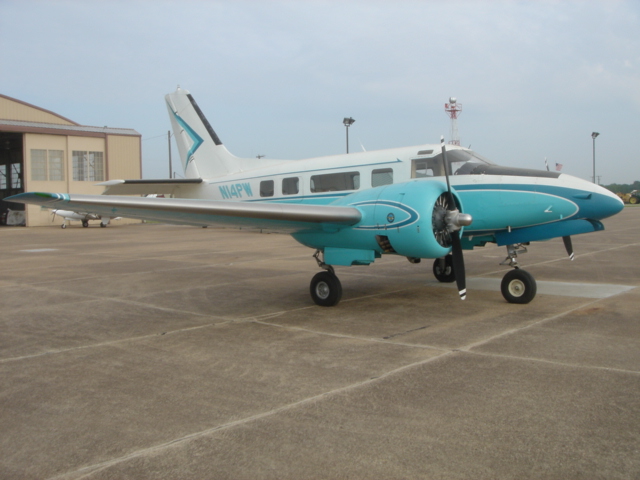
Horrible look but VMC listed at 74KTS.
Versus the various original twin tails models which had their fluctuates between 89 and 91 kts as per the manuals.
See, looks doesn't matter it's all about the size
The pic below is a tradewind conversion twin beech with the tall single tail.
Horrible look but VMC listed at 74KTS.
Versus the various original twin tails models which had their fluctuates between 89 and 91 kts as per the manuals.
See, looks doesn't matter it's all about the size

Joined: Jan 2008
Posts: 675
Likes: 7
From: On the lake
All else being equal (it never is, of course) a single tail operating in free, undisturbed air is a better solution (i.e. lighter, cheaper, more effective) than two tails of the same total area operating in the disturbed airflow behind the props.

Joined: Feb 2005
Posts: 4,581
Likes: 0
From: flyover country USA
The Lockheed 14 "Super Electra" (prewar BA had a few) had twin fins per the smaller L-10 Electra. A few years later the 14 was stretched to create the L-18 Lodestar. Riding in the aft cabin of the prototype stretched aircraft, one could feel the prop blade wake frequency striking the tail surfaces, so to prevent this, the entire tail was raised 12 inches - thus the up-swept aft fuselage.
Production model - Lockheed 18 (USAAF C-60) Lodestar: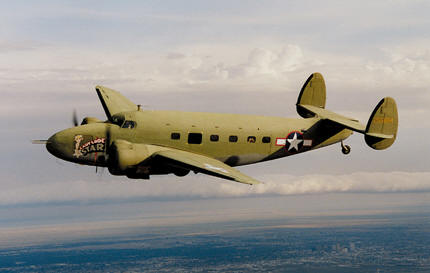
Lockheed 14 Super Electra of LOT :
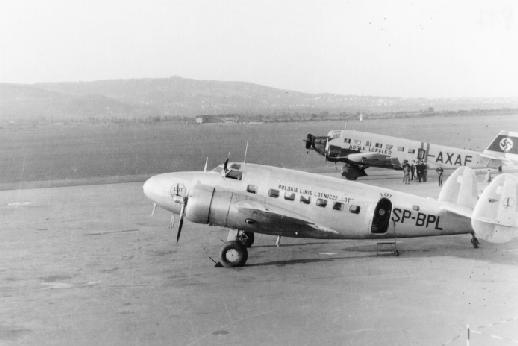
Production model - Lockheed 18 (USAAF C-60) Lodestar:
Lockheed 14 Super Electra of LOT :
Last edited by barit1; 18th August 2011 at 02:29.

Joined: Aug 2011
Posts: 1
Likes: 0
From: NY State USA
Chief Engineer of the Beech 18 design, Ted Wells, recalling the decision to use twin vertical stabilizers, admitted that neither he nor his small engineering staff had any experience in analyzing the stresses imposed on the rear fuselage of a single tail, twin-engine, all-metal, semi-monocoque structure when it suffered an 'engine-out' situation. They knew that great torsional loads were placed on the rear fuselage in that situation but were unsure how to accurately do the stress analysis. They were confident analyzing stresses present in single-engine, single-tail aircraft. Engineers in the other companies in that Bureau of Air Commerce competition, Lockheed and Barkley-Grow, came to the same conclusions and were using twin tails. Large aircraft companies (Martin, Curtiss, Boeing & Douglas) with large engineering teams, were designing military single tail multi-engine aircraft.
The above is from my book, "Beech 18: A Civil & Military History" page 21 which noted its source as a videocassette interview with Wells in the History of Aviation Collection, Wichita State University, Spl Collections, #20-602 #9.
Regards, Bob Parmerter
The above is from my book, "Beech 18: A Civil & Military History" page 21 which noted its source as a videocassette interview with Wells in the History of Aviation Collection, Wichita State University, Spl Collections, #20-602 #9.
Regards, Bob Parmerter
Thread Starter
Joined: Sep 2008
Aviation Qualifications: ATPL
Posts: 940
Likes: 57
From: Scotland
Very interesting - thanks. Do you know if the effective area of the replaced single tail is the same as that of the two smaller tail surfaces?
I hadn't thought of the structural loads OEI, and am still in my ignorance trying to figure out the theory between the different Vmc speeds.
I hadn't thought of the structural loads OEI, and am still in my ignorance trying to figure out the theory between the different Vmc speeds.
Drain Bamaged
Joined: Mar 2000
Aviation Qualifications: ATPL
Posts: 569
Likes: 107
From: Earth
About this particular Tradewind conversion Twin Beech and according to this website:
Beech 18 differences and modifications
No idea about its surface area, same thing about the twin tail.
And hard to judge from a single picture:

Beech 18 differences and modifications
Incidentally the vertical stabilizer is made from a Twin Beech horizontal stabilizer turned on end, cut and fit to form the vertical.
And hard to judge from a single picture:
Joined: Jun 2006
Posts: 42
Likes: 0
From: UK
Torsional Loads
Beech18Bob
I recall, late 60's, seeing Airspeed Ambassadors doing engine runs on their twin Centaurus radials. The torsional oscillations of the triple finned rear fuse was quite alarming - at least 12" displacement. What it did to airframe life let alone PAX nerves can only be imagined. But, the tail never fell off so it must have been strong enough.
I recall, late 60's, seeing Airspeed Ambassadors doing engine runs on their twin Centaurus radials. The torsional oscillations of the triple finned rear fuse was quite alarming - at least 12" displacement. What it did to airframe life let alone PAX nerves can only be imagined. But, the tail never fell off so it must have been strong enough.
