


Polish Government Tu154M crash

Join Date: Apr 2010
Location: St. Petersburg
Posts: 270
Likes: 0
Received 0 Likes
on
0 Posts
I'm an outsider, for a short time here only, sorry. Simply interested whaat foreign pilots think of it, as compared with our pilot's forum. I'm Russian, and no relation to aviation, but naturally interested, why the Poles broke on our land. As we were a host country.
This is the link to the local blog with the discussion. Many maps of? something. that you find here important. I'll translate you the conclusion on wghich the discussion stopped at a Russian forum, if you wish. That is, until new data, of boxes, becomes available.
Êàòàñòðîôà Òó-154 ïðåçèäåíòà Ïîëüøè - Ñòðàíèöà 55 - Àâèàöèîííûé ôîðóì AVIAFORUM.RU
This is the link to the local blog with the discussion. Many maps of? something. that you find here important. I'll translate you the conclusion on wghich the discussion stopped at a Russian forum, if you wish. That is, until new data, of boxes, becomes available.
Êàòàñòðîôà Òó-154 ïðåçèäåíòà Ïîëüøè - Ñòðàíèöà 55 - Àâèàöèîííûé ôîðóì AVIAFORUM.RU

Join Date: Apr 2010
Location: Poland
Age: 49
Posts: 5
Likes: 0
Received 0 Likes
on
0 Posts
Here is the crew total flight time in hours by 36 splt www:
- (captain) kpt. pil. Arkadiusz PROTASIUK - total time: 3528h (on Tu-154M - 2937h)
- (first officer) mjr pil. Robert GRZYWNA - total time: 1939h (on Tu-154M - 506h)
- (navigator) por. pil. Artur ZIĘTEK - total time: 1069h (on Tu-154M - 59h, as navigator)
- (flight engineer) chor. Andrzej MICHALAK - total time 330h
- (captain) kpt. pil. Arkadiusz PROTASIUK - total time: 3528h (on Tu-154M - 2937h)
- (first officer) mjr pil. Robert GRZYWNA - total time: 1939h (on Tu-154M - 506h)
- (navigator) por. pil. Artur ZIĘTEK - total time: 1069h (on Tu-154M - 59h, as navigator)
- (flight engineer) chor. Andrzej MICHALAK - total time 330h
Join Date: Jun 2009
Location: Italy
Age: 50
Posts: 6
Likes: 0
Received 0 Likes
on
0 Posts
Controller
Here's the link to what appears to be the interview with the aerodrome controller on duty that day:
Äèñïåò÷åð ðàññêàçàë î ïðè÷èíàõ êðóøåíèÿ Òó-154 : LIFE | NEWS
Sorry, it's in Russian. The controller (Pavel Plusnin) speaks about language barrier problems etcc.. If someone thinks it could be interesting I could translate it.
Äèñïåò÷åð ðàññêàçàë î ïðè÷èíàõ êðóøåíèÿ Òó-154 : LIFE | NEWS
Sorry, it's in Russian. The controller (Pavel Plusnin) speaks about language barrier problems etcc.. If someone thinks it could be interesting I could translate it.

Join Date: Apr 2010
Location: Poland
Age: 57
Posts: 1
Likes: 0
Received 0 Likes
on
0 Posts
I am following this thread with great interest. Seems you guys dig down to the bare facts and are getting closer to the core cause of the crash.
It has been made public this afternoon that the records from the crew cabin revealed the pilots knew they were are going to crash about 3-5 secs before the impact, with assumption of a speed of 150-180 m/sec.
This would make a distance of max 900 mts (my calculation) before the impact and could possible be more less when they did hit the first tree (?).
Being no pilot, I would assume realising only 3-5 sec before impact is scary late and would indicate the pilot was convinced their heading was OK almost till impact.
Rafal
It has been made public this afternoon that the records from the crew cabin revealed the pilots knew they were are going to crash about 3-5 secs before the impact, with assumption of a speed of 150-180 m/sec.
This would make a distance of max 900 mts (my calculation) before the impact and could possible be more less when they did hit the first tree (?).
Being no pilot, I would assume realising only 3-5 sec before impact is scary late and would indicate the pilot was convinced their heading was OK almost till impact.
Rafal
Join Date: Apr 2010
Location: St. Petersburg
Posts: 270
Likes: 0
Received 0 Likes
on
0 Posts
An opinion of a Russian pilot. (translated)
"The reason may be in the lay-out of the terrain. TU was on course 267-268, to the left from the axis by only 50-55m at the distance of a 1,000 m from the butt-end of the stripe. Had tangage +1...+2. Which means was rising. Where does it follow from? From the trees cut. One, the birch, was cut h=12...13m H=238m (above the sea level), the second, by the road, was cut h=5...6m at height H=249m. The distance btw them 270,, that is little enough for the crew to have time to make any sharp maneuvres. The crew simply didn't know or lost out of attention that the stripe is practically (if to move from the E) located at an elevation, and had lowered much lower than the glissade. The butt-end of the stripe H=253m. This is all on the base of GE and it lies by height not more than 1%, and this is in the worst cases.
At the distance over 1,000m from the stripe they have, possibly, sat down even lower, due to even lesser height above the sea-level of the Eastern slope. "
"The reason may be in the lay-out of the terrain. TU was on course 267-268, to the left from the axis by only 50-55m at the distance of a 1,000 m from the butt-end of the stripe. Had tangage +1...+2. Which means was rising. Where does it follow from? From the trees cut. One, the birch, was cut h=12...13m H=238m (above the sea level), the second, by the road, was cut h=5...6m at height H=249m. The distance btw them 270,, that is little enough for the crew to have time to make any sharp maneuvres. The crew simply didn't know or lost out of attention that the stripe is practically (if to move from the E) located at an elevation, and had lowered much lower than the glissade. The butt-end of the stripe H=253m. This is all on the base of GE and it lies by height not more than 1%, and this is in the worst cases.
At the distance over 1,000m from the stripe they have, possibly, sat down even lower, due to even lesser height above the sea-level of the Eastern slope. "
VNAV/GPS
Anyone know if the -154 avionics update included GPS? If so then would not an LNAV/VNAV approach been safer? Mind you since the CIS is not WGS-84 that may have put them in the weeds anyway!
As to QFE/ QNH... when in Rome etc springs to mind. Fly meters and QFE.
As to QFE/ QNH... when in Rome etc springs to mind. Fly meters and QFE.
Join Date: Oct 2005
Location: Europe
Posts: 23
Likes: 0
Received 0 Likes
on
0 Posts
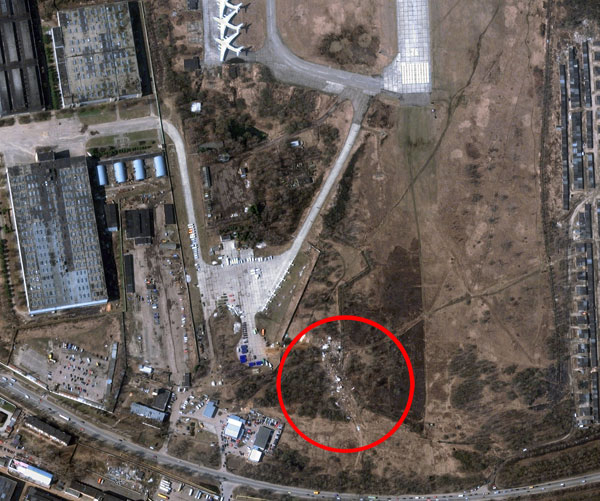
It easier to see situation on this map. I have added distance from the tree that was first to be hit, and then elevation, in meters. First point (first tree) is at elevation 237m. Final breakdown was at elevation 257m. Second road and the runaway are at 253m. Trees at the second road, although on the higher terrain, were cut much higher than the first tree. If we add elevation difference, it means that they, despite first hit, were still climbing. They gained in absolute height some 20 - 30 meters. It is independent proof that the motors were still operational. It was very, very near thing. One second earlier, and they would be OK.
Map with distances and elevations.jpg
Map with distances and elevations.jpg
Had tangage +1...+2. Which means was rising.
I do not know the pitch attitude the TU-154 would use on approach, but a bit of nose up is common on jets on approach.
Of course the evidence of the trees shows a slight climb from the initial impact. The crew may have been making a modest altitude correction and may not have been aware of the initial contact(s).
At the reported 150-180 m/sec, there would have been >= 1.5 second between the two trees.
While these initial impacts may not have incurred major structural damage, hydraulic, electrical and pneumatic runs may have suffered damage at these points that compromised further flight.
Join Date: Oct 2005
Location: Europe
Posts: 23
Likes: 0
Received 0 Likes
on
0 Posts
A bit more precise data and calculation. I have used Goggle Earth distance and elevation information. Goggle data errors should not be significant because I am using only the difference of that data for nearby points. Reference points were established according to Picasa composite and other available pictures. We are comparing what Picasa composite has called point 1 and point 7. In point 1, if we assume reasonable height for that fence (1.2 m), then the height of that tree is now 4.2 meters. According to Goggle, terrain elevation at that point is 238m. So, the first tree cutting point is at 238+4=242m elevation. Dirt road in picture 7 is at elevation 250m. If the man in red 1.8m tall, then all trees in that picture were cut at 7.2m height above the level of the road. Which means that trees were cut at 250+7=257m. That means that in, approximately, 295m of horizontal distance we have increase in elevation of 257-242=15m, or 5% climb.
Last edited by PaleBlueDot; 15th Apr 2010 at 05:05.
Join Date: Oct 2004
Location: Europe
Posts: 483
Likes: 0
Received 0 Likes
on
0 Posts
Google translator, slightly polished up, from the Russsian forum:
Rarely speak at the forum, but then grieved. So many put forward the most featured version, a shot from the satellite for me personally, put things in order.
I do not know if there is Instrument landing system, or just a drive, and maybe the crew once used to call a satellite navigation - it does not matter. The plane was on the glide path, PF controlled flight to about CDF.
At CDF captain began to look for land. I'm not talking about the reasons behind it, I'm talking about elementary incompetence. And no doubt the skills of captain makes him a small plaque in general, and on the Tu-154 - obviously, grossly inadequate.
To master the piloting of such a complex aircraft as the Tu-154, is required considerable flight time. I came to the Tu-154 at the age of 35 years, with a total 9000 hours of flight time on the three types of aircraft, each of them I flew as the captain, and still the first year was very, very difficult. I flew as the second pilot, 1500 hours, and only then became the commander of the aircraft. And all the older pilots in one voice telling me: fear, fear of the first thousand hours of command in the new type! If it will appear to you, that you are familiar with this aircraft throughout - do not believe it!
Later I saw many times the truth of those warnings and then I also warned the young. And this applies to any new pilots for the aircraft type.
The flight killed a pilot was about 3500 hours (according to his father - 1930 hours), one part of it flown on the Yak-40, part (if you believe the media) as a FO (!) Tu-154, and then somehow became the commander, and (if, again, to believe the media) as PIC on the Tu he had only 200 hours. And this half-educated (albeit talented) was entrusted to carry the president! And the military pilot somewhere to gain experience in the most complex operations in the flying ship, on imperfect systems similar to the one installed in Smolensk? And in general - the experience of flight in adverse weather conditions?
And where is the experience gathered over the years, hundreds of complex approaches to different airports. Where and when he gathered them?
As a result, he made a self-confident, school, simple error: He was searching the ground below the decision height. And found it.
How to help the captain? This aircraft can not fly alone. Data for the crew, too, suggest the doubt. Navigator (if you believe the media) was produced from the school mechanic.
Weather conditions were just deadly: I would, in all my experience, do not dare to go for landing in the fog 400, but he went there blind and stupid.
Ground control had nothing to do with it. The head ATC crew gave advance information about the bad weather, gave advice on caring for an alrternate. He controlled the decline and warned of the flight below the glide path. But flying is done by the pilot!
Do not believe the words: "the pilot of the first class," the best among the best, "chief pilot of the president."
Rarely speak at the forum, but then grieved. So many put forward the most featured version, a shot from the satellite for me personally, put things in order.
I do not know if there is Instrument landing system, or just a drive, and maybe the crew once used to call a satellite navigation - it does not matter. The plane was on the glide path, PF controlled flight to about CDF.
At CDF captain began to look for land. I'm not talking about the reasons behind it, I'm talking about elementary incompetence. And no doubt the skills of captain makes him a small plaque in general, and on the Tu-154 - obviously, grossly inadequate.
To master the piloting of such a complex aircraft as the Tu-154, is required considerable flight time. I came to the Tu-154 at the age of 35 years, with a total 9000 hours of flight time on the three types of aircraft, each of them I flew as the captain, and still the first year was very, very difficult. I flew as the second pilot, 1500 hours, and only then became the commander of the aircraft. And all the older pilots in one voice telling me: fear, fear of the first thousand hours of command in the new type! If it will appear to you, that you are familiar with this aircraft throughout - do not believe it!
Later I saw many times the truth of those warnings and then I also warned the young. And this applies to any new pilots for the aircraft type.
The flight killed a pilot was about 3500 hours (according to his father - 1930 hours), one part of it flown on the Yak-40, part (if you believe the media) as a FO (!) Tu-154, and then somehow became the commander, and (if, again, to believe the media) as PIC on the Tu he had only 200 hours. And this half-educated (albeit talented) was entrusted to carry the president! And the military pilot somewhere to gain experience in the most complex operations in the flying ship, on imperfect systems similar to the one installed in Smolensk? And in general - the experience of flight in adverse weather conditions?
And where is the experience gathered over the years, hundreds of complex approaches to different airports. Where and when he gathered them?
As a result, he made a self-confident, school, simple error: He was searching the ground below the decision height. And found it.
How to help the captain? This aircraft can not fly alone. Data for the crew, too, suggest the doubt. Navigator (if you believe the media) was produced from the school mechanic.
Weather conditions were just deadly: I would, in all my experience, do not dare to go for landing in the fog 400, but he went there blind and stupid.
Ground control had nothing to do with it. The head ATC crew gave advance information about the bad weather, gave advice on caring for an alrternate. He controlled the decline and warned of the flight below the glide path. But flying is done by the pilot!
Do not believe the words: "the pilot of the first class," the best among the best, "chief pilot of the president."
Join Date: Oct 2000
Location: Berkshire, UK
Age: 79
Posts: 8,268
Likes: 0
Received 0 Likes
on
0 Posts
x213a..... Modern ATC radars in the western world are rarely effected by weather which, in simple terms, is "filtered out" by the electronics.
ATC surveillance radars often operate around 23cms. Shorter range airfield radars maybe around 10cms. However, I have no knowledge of the radar equipment employed in Russia.
ATC surveillance radars often operate around 23cms. Shorter range airfield radars maybe around 10cms. However, I have no knowledge of the radar equipment employed in Russia.
Join Date: Oct 2004
Location: Europe
Posts: 483
Likes: 0
Received 0 Likes
on
0 Posts
From the trees cut. One, the birch, was cut h=12...13m H=238m (above the sea level), the second, by the road, was cut h=5...6m at height H=249m. ... The threshold was H=253m.
below the runway elevation and well below the radar.

Being below rwy-elevation could also count for some comm-problems (line of sight?).
Another question: The airfield looks like a unused junkyard with no operational aircraft. For an active military airfield there should be more trucks, more cars and more logistic visible.
Could it be, that it was just only opened for the very purpose of bringing the polish delegation to smolensk without having to use a public airfield?
And how would this inflict safety- hazards concerning equipment like Radar, radios, approach-lighting?
franzl
Another question: The airfield looks like a unused junkyard with no operational aircraft. For an active military airfield there should be more trucks, more cars and more logistic visible.
Could it be, that it was just only opened for the very purpose of bringing the polish delegation to smolensk without having to use a public airfield?
And how would this inflict safety- hazards concerning equipment like Radar, radios, approach-lighting?
franzl