


Pro's and Con's for a T-Tail

Thread Starter
Joined: May 2007
Posts: 120
Likes: 0
From: Brighton
Pro's and Con's for a T-Tail
Hi,
I am trying to find out what the advantages and disadvantages are of having a T-tail like on the Embraer 145?
So far i've found: -
Disadvantages to be: -
I am trying to find out what the advantages and disadvantages are of having a T-tail like on the Embraer 145?
So far i've found: -
Disadvantages to be: -
- The possibility of a deep stall
- The vertical stablizer must be made stronger and stiffer to support the forces generated by the tailplane
- The elevator and stabilizer are out the way of FOD being kicked up the the tires, engines etc etc.
- Allows high performance aerodynamics and excellent glide ratio as the empennage is not effected by the wing slip steam.


Joined: Apr 2009
Posts: 13,226
Likes: 2
From: down south
A T-tail does not cause deep stall, although it may well aggravate it when it happens.
The deep stall is caused by tip stall on a swept wing, which causes the lift centre to move inboard and forward.
The deep stall is caused by tip stall on a swept wing, which causes the lift centre to move inboard and forward.
Joined: Dec 2001
Aviation Qualifications: ATPL
Posts: 3,765
Likes: 424
From: GA, USA
At least incomplete LM, in theory a deep stall in a T tail light airplane is possible.
Ultimately it would depend on CoG and the momentum of the airplane
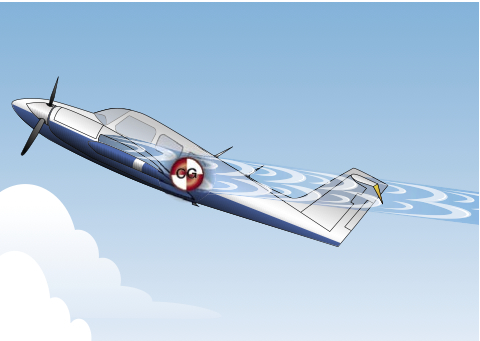
Source: FAA Flying handbook
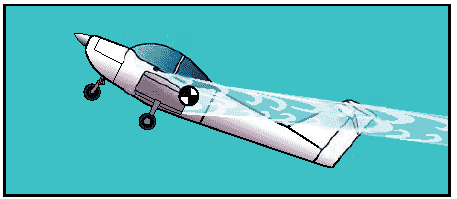

Let me google that for you
Another advantage is that the arm to the CG is longer so the elevator is more effective which means the manufacturer can make it smaller.
Smaller stabilizer and elevator means less drag.
Ultimately it would depend on CoG and the momentum of the airplane
When flying at a very high AOA with a low airspeed and an aft CG, the T-tail aircraft may be susceptible to a deep stall. In a deep stall, the airflow over the horizontal tail is blanketed by the disturbed airflow from the wings and fuselage. In these circumstances, elevator or stabilator control could be diminished, making it difficult to recover from the stall. It should be noted that an aft CG is often a contributing factor in these incidents, since similar recovery problems are also found with conventional tail aircraft with an aft CG.
Let me google that for you
Another advantage is that the arm to the CG is longer so the elevator is more effective which means the manufacturer can make it smaller.
Smaller stabilizer and elevator means less drag.
Last edited by B2N2; 20th December 2012 at 12:49.
Joined: Nov 2011
Posts: 93
Likes: 0
From: Newark UK
My understanding of the deep stall was as the a/c is sinking the relative airflow now comes more from below the wing meaning you can have angles of attack of around 20 degrees with 0 degrees pitch angle. This is then exacerbated by the nose up moment from the centre of pressure moving forward.
The T-tail can make the deep stall impossible to recover from due to tail blanking, where the wash from the wing also disturbs airflow over the tailplane. This would make pitch inputs difficult/impossible.
Anyone please feel free to correct me if my understanding of this is incorrect.
The T-tail can make the deep stall impossible to recover from due to tail blanking, where the wash from the wing also disturbs airflow over the tailplane. This would make pitch inputs difficult/impossible.
Anyone please feel free to correct me if my understanding of this is incorrect.
Joined: Dec 2001
Aviation Qualifications: ATPL
Posts: 3,765
Likes: 424
From: GA, USA
B2N2 nice pictures, but would any of the aircraft in those illustrations ever get to the point where the elevators are blanketed by the disrupted air from the mainplane?
I even mentioned the reference source.
Per Ardua ad Astraeus
Joined: Mar 2000
Posts: 18,575
Likes: 4
From: UK
Originally Posted by 2 LGW
but would any of the aircraft in those illustrations ever get to the point where the elevators are blanketed by the disrupted air from the mainplane?

Joined: May 2003
Posts: 111
Likes: 0
From: Canada
An advantage of a T-tail is that the endplate effect of the horizontal allows the vertical tail to be substantially (25% or so) smaller.
Another one is that the rudder is not blanked by the horizontal at very high angle of attack, making it more effective to get out of a spin.
A T-tail does not necessarily lead to deep stall tendencies, it depends on a number of factors such as wing loading, etc.
Your second listed advantage (wing slip stream) is questionable, I wouldn't list it as such.
--M
Another one is that the rudder is not blanked by the horizontal at very high angle of attack, making it more effective to get out of a spin.
A T-tail does not necessarily lead to deep stall tendencies, it depends on a number of factors such as wing loading, etc.
Your second listed advantage (wing slip stream) is questionable, I wouldn't list it as such.
--M
Last edited by Machdiamond; 21st December 2012 at 19:01.
Joined: Oct 2007
Posts: 1,656
Likes: 0
From: fort sheridan, il
A t tail allows for placing engines on the rear end of the plane...this allows for more efficent design of the wing
it allows engines to be closer together and allows for a smaller rudder/vertical fin to compensate for engine out situations, thereby reducing drag.
however putting all that stuff on the tail makes the plane tail heavy and it must be carefully balanced up in the nose.
my favorite plane is the DC9...flys great...engines at the tail means they are slightly more protected and no one has been sucked into the engines on a DC9.
oh, and putting the engines in the tail means the whole plane is quieter.
it allows engines to be closer together and allows for a smaller rudder/vertical fin to compensate for engine out situations, thereby reducing drag.
however putting all that stuff on the tail makes the plane tail heavy and it must be carefully balanced up in the nose.
my favorite plane is the DC9...flys great...engines at the tail means they are slightly more protected and no one has been sucked into the engines on a DC9.
oh, and putting the engines in the tail means the whole plane is quieter.
Joined: Feb 2004
Posts: 1,410
Likes: 37
From: Australia
A t tail allows for placing engines on the rear end of the plane...
If there are four engines on the tail, the engine pairs are very close to each other, increasing the risk of one affecting another.
Person Of Interest
Joined: Jan 2000
Posts: 842
Likes: 0
From: Keystone Heights, Florida

Everyone (almost) here seems to have an opinion about a "deep stall"...
Lots of theory....all B.S. in the real world of commercial flight...
Get some experience you "puppies" and then hopefully you won't ever have to answer the "what happens in a deep stall?"
'Nuff said...
Lots of theory....all B.S. in the real world of commercial flight...
Get some experience you "puppies" and then hopefully you won't ever have to answer the "what happens in a deep stall?"
'Nuff said...
Joined: Apr 2012
Posts: 101
Likes: 0
From: Southern Jessieland
Additional advantages:
Mounting the tailplane high puts it in an area of low downwash gradient making the tailplane a more effective stabiliser and a more aft cg is possible. This also leads to the tail generally having a more positive loading and thereby reducing trim drag
The T-tail raises the tailplane out of the fuselage drag-hole which can reduce your tailplane effective aspect ratio by 20% or more.
Disadvantages:
Very messy loading and structural design.
Tailplane more difficult to clear snow off and access for maintenance and checking.
Tilting of the principle axes of inertia giving rise to coupling issues in roll.
Mounting the tailplane high puts it in an area of low downwash gradient making the tailplane a more effective stabiliser and a more aft cg is possible. This also leads to the tail generally having a more positive loading and thereby reducing trim drag
The T-tail raises the tailplane out of the fuselage drag-hole which can reduce your tailplane effective aspect ratio by 20% or more.
Disadvantages:
Very messy loading and structural design.
Tailplane more difficult to clear snow off and access for maintenance and checking.
Tilting of the principle axes of inertia giving rise to coupling issues in roll.
Last edited by Plastic Bonsai; 27th December 2012 at 10:49.
Joined: Feb 2007
Posts: 478
Likes: 0
From: -------
A T-tail does not cause deep stall, although it may well aggravate it when it happens.
The deep stall is caused by tip stall on a swept wing, which causes the lift centre to move inboard and forward.
The deep stall is caused by tip stall on a swept wing, which causes the lift centre to move inboard and forward.
I agree that that FAA figures give a different perspective, but in my opinion they are depicting a slight different scenario, where the wing is NOT actually stalled even if close to. By design, in the real stall (with weight and balance within certified limits of course) the nose should drop forward so giving better authority to the elevators while in the real deep stall that doesn't happen, because the CG keeps moving forward to a point that the recovery is virtually impossible. Anyway, imho, i think that the same term "deep stall" is used to define 2 different situations.
FB

Joined: Oct 2009
Posts: 644
Likes: 6
From: Old Hampshire
When it comes to military transport aircraft a T tail means you dont have to spend time worrying about parachute static lines fouling the elevator (as you have to for the Hercules).
Also I had to smile when I saw the size of the tailplane design grow on the A400M after we had supplied Airbus with data on the cg transients of a heavy drop.
Also I had to smile when I saw the size of the tailplane design grow on the A400M after we had supplied Airbus with data on the cg transients of a heavy drop.
Joined: May 2003
Posts: 111
Likes: 0
From: Canada
By design, in the real stall (with weight and balance within certified limits of course) the nose should drop forward
Anyway, imho, i think that the same term "deep stall" is used to define 2 different situations.
--M
Last edited by Machdiamond; 14th January 2013 at 17:05.
Joined: Dec 2006
Posts: 535
Likes: 0
From: Bury St. Edmunds
One advantage in a glider (sailplane) of having a T tail is that when doing an out-field landing it helps keep the elevators and horizontal stabilisor out of a tall standing crop.
It also looks pretty!
MB
It also looks pretty!
MB
Fleet Manager


Joined: Aug 2006
Aviation Qualifications: CPL
Posts: 7,089
Likes: 2,952
From: Ontario, Canada
T tail advantage: If the aircraft is a flying boat, it keeps the tail out of the water.
Disadvantages: Much more difficult to inspect for frost/snow/ice, and clean if required.
More complex elevator and trim control systems, and,
Depending upon aircraft type and configuration, a high tail might be out of the prop wash, which reduces pitch control on the ground (less able for soft field takeoffs).
Generally yes, though more vulnerable to snow and ice from the top of the fuselage being ingested.
Disadvantages: Much more difficult to inspect for frost/snow/ice, and clean if required.
More complex elevator and trim control systems, and,
Depending upon aircraft type and configuration, a high tail might be out of the prop wash, which reduces pitch control on the ground (less able for soft field takeoffs).
engines at the tail means they are slightly more protected