


New big prop, facing the A320 & 737: TurboLiner.

Join Date: Apr 2008
Location: Toronto
Posts: 8
Likes: 0
Received 0 Likes
on
0 Posts
ATR92
I've heard of ATR mulling over a clean sheet..but haven't seen any concepts. I'd love to know more.
Being a KIWI flier, I'd bet you do some pretty steep aproaches (being mostly mountain out there)...and on that I know the Q's are better than the ATR. I wonder if the ATR92 will address that defficiency. That would allow a nice big turboprop to service the city centre airport here in Toronto and improve service to some of the busier destinations.
Any links to where I can see what they have on the shopping list?
Being a KIWI flier, I'd bet you do some pretty steep aproaches (being mostly mountain out there)...and on that I know the Q's are better than the ATR. I wonder if the ATR92 will address that defficiency. That would allow a nice big turboprop to service the city centre airport here in Toronto and improve service to some of the busier destinations.
Any links to where I can see what they have on the shopping list?

Join Date: Apr 2008
Location: Toronto
Posts: 8
Likes: 0
Received 0 Likes
on
0 Posts
ATR and Hotel Mode
Even ATR is beginning to admit that Hotel Mode isn't very good. They've implemented in their -600 variant an electrothermal air conditioning unit to "supplement" hotel mode bleed powered cabin cooling. (Talk about adding weight!) You've gotta love how they spin this correction for lack of original performance as a wonderful enhancement LOL (Engineer's rule #2: If you can't fix it, call it a feature)
The APU on the Q series is much better than hotel mode, and DOES operate unattended. (unlike some APUs and Hotel mode).
ATR also put the hotel mode on the same side as the service entrance and fuel fill port. so no servicing can be done. So much for turnaround time at the gate.
Sure, they cal Hotel time "ZERO ENGINE" time ...but the prop brake fails pretty often. (under 3000 hrs mtbf). I am pretty sure APUs last longer than THAT!
(Engineer's rule #2: If you can't fix it, call it a feature)The APU on the Q series is much better than hotel mode, and DOES operate unattended. (unlike some APUs and Hotel mode).
ATR also put the hotel mode on the same side as the service entrance and fuel fill port. so no servicing can be done. So much for turnaround time at the gate.
Sure, they cal Hotel time "ZERO ENGINE" time ...but the prop brake fails pretty often. (under 3000 hrs mtbf). I am pretty sure APUs last longer than THAT!
Join Date: Aug 2003
Location: Godzone
Posts: 73
Likes: 0
Received 0 Likes
on
0 Posts
ATR & Hotel Mode
I agree that the APU maybe the more cooler method but part of that reason is that it can be left going for the whole turn around, hence has a longer period to try and cool the aircraft. In hotel, it needs to be shut down for servicing, fuel and unloading the rear of the aircraft. It is generally started only 5 sometimes 10minutes before departure so with a full load on a hot day it is already way behind trying to cool down a 30+C cabin. The complaints we get from the cabincrew the most is with a full cabin the air con struggles to keep it cool.
ATR92
I know a little about this only in the form that with our fleet soon to be up for renewal ATR have been briefing our managers on the replacement for the atr 500/600 which i think is to be designated the 700 (high70seats) and the atr92 (90+ seats). Both clean sheet designs.
Same general layout as the current atr but with a major change being that the baggage/cargo holds will be placed underfloor. Still the gear in pods from the fuselage. Passenger entry will be via a front door. Not sure if it is going with a prop brake or not?
The target design speed is a cruise TAS of 320-330, so I guess an indication that atr conceed a little more speed would be better.
Will incorporate all new A350/380 technoligies. Will have a new technology anti/de-ice system which won't require bleed air. Hydralulics will be individual power packs at each point which requires them. No central system.
I am pretty sure that it is going to be side stick, so fly by wire also.
Will try and find more out but there is nothing on the net yet as is all still concept and planning at ATR.
Cheers
ATR92
I know a little about this only in the form that with our fleet soon to be up for renewal ATR have been briefing our managers on the replacement for the atr 500/600 which i think is to be designated the 700 (high70seats) and the atr92 (90+ seats). Both clean sheet designs.
Same general layout as the current atr but with a major change being that the baggage/cargo holds will be placed underfloor. Still the gear in pods from the fuselage. Passenger entry will be via a front door. Not sure if it is going with a prop brake or not?
The target design speed is a cruise TAS of 320-330, so I guess an indication that atr conceed a little more speed would be better.
Will incorporate all new A350/380 technoligies. Will have a new technology anti/de-ice system which won't require bleed air. Hydralulics will be individual power packs at each point which requires them. No central system.
I am pretty sure that it is going to be side stick, so fly by wire also.
Will try and find more out but there is nothing on the net yet as is all still concept and planning at ATR.
Cheers
Last edited by kiwilad; 15th Apr 2008 at 23:04. Reason: Hit send to early
Sun worshipper
Join Date: Dec 2001
Location: Paris
Posts: 494
Likes: 0
Received 0 Likes
on
0 Posts
Keesje,
Good work !
Still two remarks :
1/- Have you thought of the *gull wing* solution for a low wing project ?
Seems to work on a 380... and will improve the design (aerodynamics ) wing-to-fuselage connection ( perpendicular attachment )while shortening the landing gear legs.
2/- I notice that your props turn the same way...with 11,000 hp behind them, you have a massive torque effect while manoeuvering (right turn on a pitch-up, left on a pitch-down)...That will lead to piloting difficulties -and certification requirements on a *critical engine* (pitch-down moment on a right engine failure) or a serious study of autopilot controlled engine failure.
IMHO, you'll have two solutions :
2-a/- Contra-rotating props (that will also improve your trans-sonic aerodynamics on the prop tips)
2-b/- opposite rotation directions on the props...which means an increased investment on spare parts...not my favourite idea.
Your choice.
Regards
Still two remarks :
1/- Have you thought of the *gull wing* solution for a low wing project ?
Seems to work on a 380... and will improve the design (aerodynamics ) wing-to-fuselage connection ( perpendicular attachment )while shortening the landing gear legs.
2/- I notice that your props turn the same way...with 11,000 hp behind them, you have a massive torque effect while manoeuvering (right turn on a pitch-up, left on a pitch-down)...That will lead to piloting difficulties -and certification requirements on a *critical engine* (pitch-down moment on a right engine failure) or a serious study of autopilot controlled engine failure.
IMHO, you'll have two solutions :
2-a/- Contra-rotating props (that will also improve your trans-sonic aerodynamics on the prop tips)
2-b/- opposite rotation directions on the props...which means an increased investment on spare parts...not my favourite idea.
Your choice.
Regards
Join Date: Apr 2008
Location: Toronto
Posts: 8
Likes: 0
Received 0 Likes
on
0 Posts
ATR92
Sounds exciting.
I read in ATI that they were looking at a mid 80s size, but not the 70s...I hope it isn't a deplug of the 90 version. Deplugs are heavy and not really worth it. (look at the A318 vs the A320).
Cool that ATR caught on to a single baggage bay, I thought the 3 different points was a pain..and the largest compartment being in a shared area with pax boarding and galley service was stupid. And speed looks good, but is it enough?? Donno. We regularly push the Q4s right to the 360s...it is incredible when we get to Ottawa, some AC Airbus drivers complain how we leave them in the dust...beating them to YOW by 5 mins easy! ATR should go big...
That's what I kinda like about this Turboliner..big, fast. (Hey, maybe this is ATRs way of gauging public reaction to the next ATR, we could be influencing history here!)
I read in ATI that they were looking at a mid 80s size, but not the 70s...I hope it isn't a deplug of the 90 version. Deplugs are heavy and not really worth it. (look at the A318 vs the A320).
Cool that ATR caught on to a single baggage bay, I thought the 3 different points was a pain..and the largest compartment being in a shared area with pax boarding and galley service was stupid. And speed looks good, but is it enough?? Donno. We regularly push the Q4s right to the 360s...it is incredible when we get to Ottawa, some AC Airbus drivers complain how we leave them in the dust...beating them to YOW by 5 mins easy! ATR should go big...
That's what I kinda like about this Turboliner..big, fast. (Hey, maybe this is ATRs way of gauging public reaction to the next ATR, we could be influencing history here!)
Thread Starter
Join Date: Oct 2007
Location: netherlands
Age: 56
Posts: 769
Likes: 0
Received 0 Likes
on
0 Posts
Thnx for the responses. I was on a trip this week. In the week-end I will find time for a better look & maybe do a mark IV based on your comments.
- Question 1: I included DLC to improve approach handling. Now it's spoilers + DLC spoilers, which seems overdone. Maybe they could be combined, any suggestions? Could save some weight / complexity.
- Question 2: I included "active cooled power brakes" because thrust reverse works very well for props but makes a lot of noise too. No thrust reverse after landing & electric drive to the gate would really make a difference in total noise pollution. Is there a smart way to use the electric engines as generators during roll out & use the energy to cool the brakes? Or would it be simpler to put on the APU before landing to provide power to a blower/compressor?
- On the low wings+ big props: I took a look & will post some configs I looked at. Think about the recent LH A320 wingtip incident.. http://www.youtube.com/watch?v=z42fchrzhHY Ground clearance would be a design concern.
- On speed : Mach 0.7 is a lot of speed at 25k ft, the Turboliner should be able to do 440 knots like the bulkier A400M (max cruise M.72).
- On prop tip fuselage clearance : I looked at A400M prop-fuselage clearance and added ~20%. Powerplants to far from the cg creates asymetric / 1 engine out issues (bigger tail, weight /drag)
- Counter rotating props are being looked at by the OEMS indeed. They offer advantages (reduced rotor diameter) but also have some issues of there own I think: heavy gearboxes and noise (interference between props) e.g. I guess I sticked on the safe side with an existing engine / prop combination.
- Opposite rotation seems possible (A400M has it too). Less trimming means less drag. It had so in post 1..
Last edited by keesje; 21st Apr 2008 at 08:28. Reason: spelling
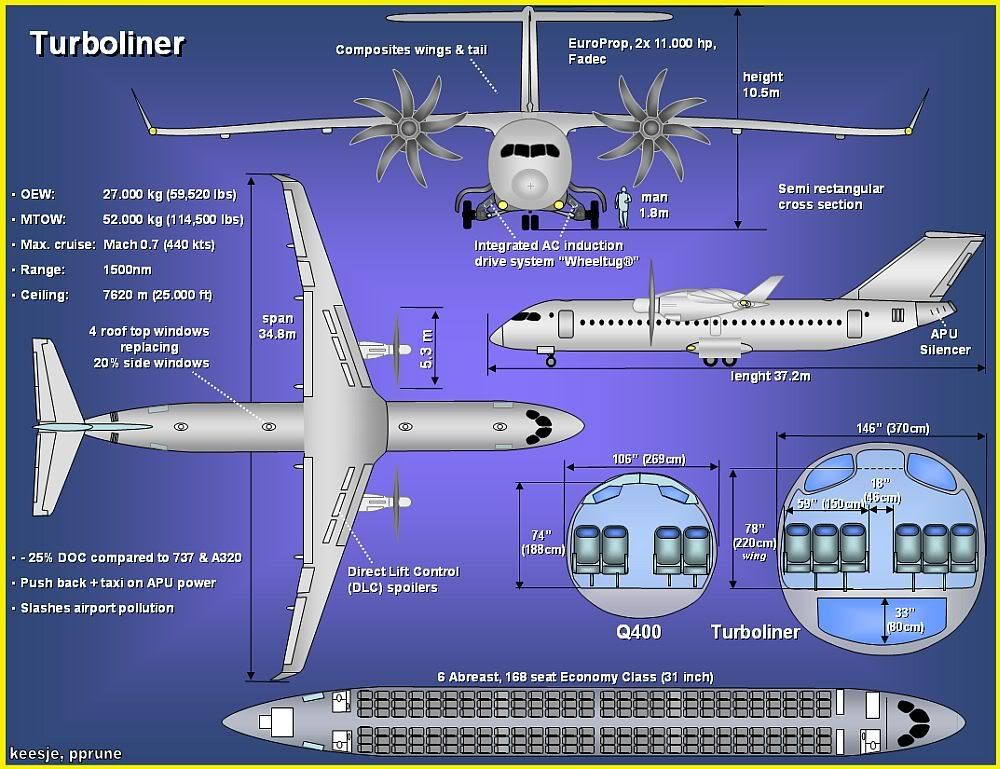

Delightful to see the original and lateral thinking. Kees, congratulations for pushing it beyond the first negative responses of the “it’ll never work” variety.
Maybe it won’t. But the thinking behind it – and the general response on Pprune – is surely being quietly observed by many an aeronautical enginner and market analyst in Boeing, Airbus and a few others.
Kiwilad in post 34 pointed out that most people don’t know/aren’t given a choice as to the aircraft type they’ll be traveling on. I agree, and I think an increasing proportion of travelers are more concerned with the combination of price/comfort/direct flight, not necessarily in that order. The relative speed advantage of a jet over a turboprop over 1-1.5 hour sectors, when considered in the context of all the time getting to an airport, checking in and waiting, just seems risible. And if you can get a TP aircraft closer to the passenger than would be possible with a jet, hurrah. Operators,as we’ve seen in the USA in the last few weeks, are more than a little concerned with the cost of fuel, however much they might have hedged.
In my industry, the rising fuel cost component is already nudging shipowners to reduce speed and maintain their weekly port call schedules by inserting another vessel in the cycle. It could be the seventh, the ninth or the eleventh ship but the savings are in the high millions. Sounds easy enough in liner shipping, yes, where there is an icreasing capacity glut; I know it’s more difficult in aviation where the parameters of fuel efficiency are much more restrictive. Just perhaps, you’ve come up with the right idea at the right time.
 All you need now is a better name than "TurboLiner" and that reflects all the thoughtful Pprune input. That might perhaps better be left to JetBlast.
Maybe it won’t. But the thinking behind it – and the general response on Pprune – is surely being quietly observed by many an aeronautical enginner and market analyst in Boeing, Airbus and a few others.
Kiwilad in post 34 pointed out that most people don’t know/aren’t given a choice as to the aircraft type they’ll be traveling on. I agree, and I think an increasing proportion of travelers are more concerned with the combination of price/comfort/direct flight, not necessarily in that order. The relative speed advantage of a jet over a turboprop over 1-1.5 hour sectors, when considered in the context of all the time getting to an airport, checking in and waiting, just seems risible. And if you can get a TP aircraft closer to the passenger than would be possible with a jet, hurrah. Operators,as we’ve seen in the USA in the last few weeks, are more than a little concerned with the cost of fuel, however much they might have hedged.
In my industry, the rising fuel cost component is already nudging shipowners to reduce speed and maintain their weekly port call schedules by inserting another vessel in the cycle. It could be the seventh, the ninth or the eleventh ship but the savings are in the high millions. Sounds easy enough in liner shipping, yes, where there is an icreasing capacity glut; I know it’s more difficult in aviation where the parameters of fuel efficiency are much more restrictive. Just perhaps, you’ve come up with the right idea at the right time.
All you need now is a better name than "TurboLiner" and that reflects all the thoughtful Pprune input. That might perhaps better be left to JetBlast.
Join Date: Jul 2000
Location: Thailand
Posts: 942
Likes: 0
Received 0 Likes
on
0 Posts
In the name of pax safety, place the seats facing rearwards. Make row 1 at the rear of the aircraft. If pax board via two doors, they will hardly notice the difference. Tilt the fixed seat-back angle at about 20 degrees and Take off angles will not be a problem. It might well be that seat fixings and rails can be of lighter construction and still maintain crash G criteria.
Place the windows slightly lower in the fuselage to give the aisle seat pax a view outside. Who wants to look sideways anyway?
Place the windows slightly lower in the fuselage to give the aisle seat pax a view outside. Who wants to look sideways anyway?
Join Date: Feb 2008
Location: YQL
Posts: 43
Likes: 0
Received 0 Likes
on
0 Posts
As I understand it, rear facing seats do have the advantage of being safer than forward facing seats for the pax in the event of an incident. Given proper structural design of course.
I believe the issue with them, or all airliners would have them already, is that the loads are placed higher into the back of the seat, therefore requiring a stiffer structure to resist the forces in the event of a sudden deceleration. {Forward facing seats put the loads into the seat at seatbelt level.} Which therefore requires a stronger floor, therefore a bit more weight, therefore increased cost of fuel per flight, therefore increasing the operational costs of the aircraft ...
I'm not sure how much of an impact this would have in terms of a relatively short haul aircraft like the Turboliner, but it would be a consideration. Economics vs. innovation as always.
Keesje - interesting design. Hopefully I'll get a chance to fly in it or something like it someday.
I believe the issue with them, or all airliners would have them already, is that the loads are placed higher into the back of the seat, therefore requiring a stiffer structure to resist the forces in the event of a sudden deceleration. {Forward facing seats put the loads into the seat at seatbelt level.} Which therefore requires a stronger floor, therefore a bit more weight, therefore increased cost of fuel per flight, therefore increasing the operational costs of the aircraft ...
I'm not sure how much of an impact this would have in terms of a relatively short haul aircraft like the Turboliner, but it would be a consideration. Economics vs. innovation as always.
Keesje - interesting design. Hopefully I'll get a chance to fly in it or something like it someday.
Thread Starter
Join Date: Oct 2007
Location: netherlands
Age: 56
Posts: 769
Likes: 0
Received 0 Likes
on
0 Posts
broadreach
!
All you need now is a better name than "TurboLiner" and that reflects all the thoughtful Pprune input. That might perhaps better be left to JetBlast.
 , the combined creativity of PPrune should be able to come up with something better!
In the name of pax safety, place the seats facing rearwards.
 . I think the Aerospace community concluded rearward facing seats are a good idea decades ago. It's up to the airlines, as you say little technical complications. Still no one uses them. I'm thinking about doing the rows in front of the emergency exit rearward, leaving a choice to the passengers. Maybe statisticly the seats after and in front of the wing would offer similar safety (an aircraft seldom crashes on its tail..)
Place the windows slightly lower in the fuselage to give the aisle seat pax a view outside. Who wants to look sideways anyway?

787
IMO the rooftop windows could improve the experience in the cabin, specailly for aisle passengers. It a dense cabin, being able to see the blue sky / sunlight entering the cabin could improve the general admosphere.
Talking about the windows, nobody questioned the higher windows next to the doors. They have a double function : allowing the crew to easily see what's outside before opening the doors & provide natural light in the galleys / lavatory areas. For an aircraft doing up to 8 flights a day this could prevent docking damage / enhance working conditions during intense crew / catering work.
I thought the above version would be the final one, but I guess another one. Any additional modifications / insights /ideas?

rgds
Join Date: Apr 2008
Location: Toronto
Posts: 8
Likes: 0
Received 0 Likes
on
0 Posts
Don't go low
Skip the thought on low windows... I'm over 6 feet tall and have to slouch to see anything. Sure, bring the lower part of the sill down, but the topp sill should be created to maximise viewing angle for someone of my height (it IS all about me). Mind you, where I usually sit on a plane, I have the best veiw of all!
I think Broadreach hit it on the head...there's got to be a trawler or 2 here from OEMs...what do you plan on doing with yout idea when you're done? Sell it? Just hope an oem picks it up for bragging rights?
Hell, DO you work for an OEM and you're getting a feeling for what we pilots want? That's cool by me too! You don't have to say who ya work for, I'd just be damn glad someone asked a pilot's opinion before they build the thing!
I think Broadreach hit it on the head...there's got to be a trawler or 2 here from OEMs...what do you plan on doing with yout idea when you're done? Sell it? Just hope an oem picks it up for bragging rights?
Hell, DO you work for an OEM and you're getting a feeling for what we pilots want? That's cool by me too! You don't have to say who ya work for, I'd just be damn glad someone asked a pilot's opinion before they build the thing!
Sun worshipper
Join Date: Dec 2001
Location: Paris
Posts: 494
Likes: 0
Received 0 Likes
on
0 Posts
Hello, Keesje.
Quote :"...thrust reverse works very well for props but makes a lot of noise too. No thrust reverse after landing & electric drive to the gate would really make a difference in total noise pollution. Is there a smart way to use the electric engines as generators during roll out & use the energy to cool the brakes? Or would it be simpler to put on the APU before landing to provide power to a blower/compressor?
"
1/- You can do away with reversers altogether, the props give enough drag in the Betra range ( you'll need to keep that one, if only for line-up ! ) and a 1500 m runway should be ample for your performance.
2/- I do not think that the brake cooling is that much of an issue : your landing speeds would be a lot lower than on an equivalent jet and it's not as though the brake temps would shoot-up immediately.
3/- Why not go a bit further and have an APU auto-start + auto switching to the APU generator after landing. As you'll need some cooling / temp stabilisation time before you cut the engines off, the transition from traction to wheel drive would be very smooth.
Now a few issues with the flight controls : at the speeds you're considering, a trimmable horizontal tail is the best choice --> The to-day position needs to be re-designed again.
The high-lift devices solution are still not very clear...and the roll control ? high speed aileron, spoilers, low speed ailerons/flapperons ?
Quote :"...thrust reverse works very well for props but makes a lot of noise too. No thrust reverse after landing & electric drive to the gate would really make a difference in total noise pollution. Is there a smart way to use the electric engines as generators during roll out & use the energy to cool the brakes? Or would it be simpler to put on the APU before landing to provide power to a blower/compressor?
"
1/- You can do away with reversers altogether, the props give enough drag in the Betra range ( you'll need to keep that one, if only for line-up ! ) and a 1500 m runway should be ample for your performance.
2/- I do not think that the brake cooling is that much of an issue : your landing speeds would be a lot lower than on an equivalent jet and it's not as though the brake temps would shoot-up immediately.
3/- Why not go a bit further and have an APU auto-start + auto switching to the APU generator after landing. As you'll need some cooling / temp stabilisation time before you cut the engines off, the transition from traction to wheel drive would be very smooth.
Now a few issues with the flight controls : at the speeds you're considering, a trimmable horizontal tail is the best choice --> The to-day position needs to be re-designed again.
The high-lift devices solution are still not very clear...and the roll control ? high speed aileron, spoilers, low speed ailerons/flapperons ?
Join Date: Jan 2008
Location: lancs.UK
Age: 77
Posts: 1,191
Likes: 0
Received 0 Likes
on
0 Posts
wheel motors and "dead engine" taxying
The principle of regenerative braking is already very well established in the automotive and railway worlds...so your wheel-motors would ,presumably be fixed stators with rotating discs (hall-effect)...the disc could also be used as a brake-disc.
regarding the main engines, I understood they needed to run a while for temperatures to stabilise. Unlike a car, you couldn't just drive your overgrown electric golf-buggy to the end of the runway, switch from "drive" to "ignition ", light the fires and "balls to the wall"
so, you'd still need the engines startedwell in advance of takeoff.
would the fuel-burn be considerably less than running the APU?
what would be the feasibility of a big generator built-into the main engine(s) to power the gear-propulsion ? this could "drop-out" at a pre-determined engine RPM, saving mechanical drag.
(or is the on-board battery-system envisaged to store sufficient power for ground-manoeuvers?
Sorry if I'm talking crap! I'm not "in the trade"
regarding the main engines, I understood they needed to run a while for temperatures to stabilise. Unlike a car, you couldn't just drive your overgrown electric golf-buggy to the end of the runway, switch from "drive" to "ignition ", light the fires and "balls to the wall"
so, you'd still need the engines startedwell in advance of takeoff.
would the fuel-burn be considerably less than running the APU?
what would be the feasibility of a big generator built-into the main engine(s) to power the gear-propulsion ? this could "drop-out" at a pre-determined engine RPM, saving mechanical drag.
(or is the on-board battery-system envisaged to store sufficient power for ground-manoeuvers?
Sorry if I'm talking crap! I'm not "in the trade"
Thread Starter
Join Date: Oct 2007
Location: netherlands
Age: 56
Posts: 769
Likes: 0
Received 0 Likes
on
0 Posts
Hi FireLight, mcgnuggitt, Lemurian, cockney steve, thnx for your comments. I'll take a close look in the week-end.
Ecoflyer, ppropliner, cityhopper, ppropexpress, ropconnect, whisperliner, electroflyer , cityexpress, ecoexpress, ecopprop..  any inspiration?
Just let it flow maybe trigger someone to find the right name..
All you need now is a better name than "TurboLiner" and that reflects all the thoughtful Pprune input. That might perhaps better be left to JetBlast.
any inspiration? Just let it flow maybe trigger someone to find the right name..
Join Date: May 2006
Location: Africa
Posts: 46
Likes: 0
Received 0 Likes
on
0 Posts
I would make sure it is possible to close the window blinds on the roof windows while standing in the aisle , blazing midday sun on your face when you trying to doze could result in air rage!
Join Date: Dec 2003
Location: Sussex
Posts: 22
Likes: 0
Received 0 Likes
on
0 Posts
Innovative ideas
We have got to come up with some new ideas or we will not have an industry to work in.
Have you thought of talking to the Royal Aeronautical Society - you might get some worthwhile feedback from some of the people there.
"New Truths are first ridiculed, then violently opposed, and then accepted."
Have you thought of talking to the Royal Aeronautical Society - you might get some worthwhile feedback from some of the people there.
"New Truths are first ridiculed, then violently opposed, and then accepted."
Thread Starter
Join Date: Oct 2007
Location: netherlands
Age: 56
Posts: 769
Likes: 0
Received 0 Likes
on
0 Posts
In the name of pax safety, place the seats facing rearwards.
1/- You can do away with reversers altogether, the props give enough drag in the Betra range ( you'll need to keep that one, if only for line-up ! ) and a 1500 m runway should be ample for your performance.
2/- I do not think that the brake cooling is that much of an issue : your landing speeds would be a lot lower than on an equivalent jet and it's not as though the brake temps would shoot-up immediately.
2/- I do not think that the brake cooling is that much of an issue : your landing speeds would be a lot lower than on an equivalent jet and it's not as though the brake temps would shoot-up immediately.
3/- Why not go a bit further and have an APU auto-start + auto switching to the APU generator after landing. As you'll need some cooling / temp stabilisation time before you cut the engines off, the transition from traction to wheel drive would be very smooth.
regarding the main engines, I understood they needed to run a while for temperatures to stabilise. Unlike a car, you couldn't just drive your overgrown electric golf-buggy to the end of the runway, switch from "drive" to "ignition ", light the fires and "balls to the wall"
Now a few issues with the flight controls : at the speeds you're considering, a trimmable horizontal tail is the best choice --> The to-day position needs to be re-designed again.
The high-lift devices solution are still not very clear...and the roll control ? high speed aileron, spoilers, low speed ailerons/flapperons ?
The high-lift devices solution are still not very clear...and the roll control ? high speed aileron, spoilers, low speed ailerons/flapperons ?
would the fuel-burn be considerably less than running the APU?
what would be the feasibility of a big generator built-into the main engine(s) to power the gear-propulsion ? this could "drop-out" at a pre-determined engine RPM, saving mechanical drag. (or is the on-board battery-system envisaged to store sufficient power for ground-manoeuvers?
what would be the feasibility of a big generator built-into the main engine(s) to power the gear-propulsion ? this could "drop-out" at a pre-determined engine RPM, saving mechanical drag. (or is the on-board battery-system envisaged to store sufficient power for ground-manoeuvers?
I would make sure it is possible to close the window blinds on the roof windows while standing in the aisle , blazing midday sun on your face when you trying to doze could result in air rage!
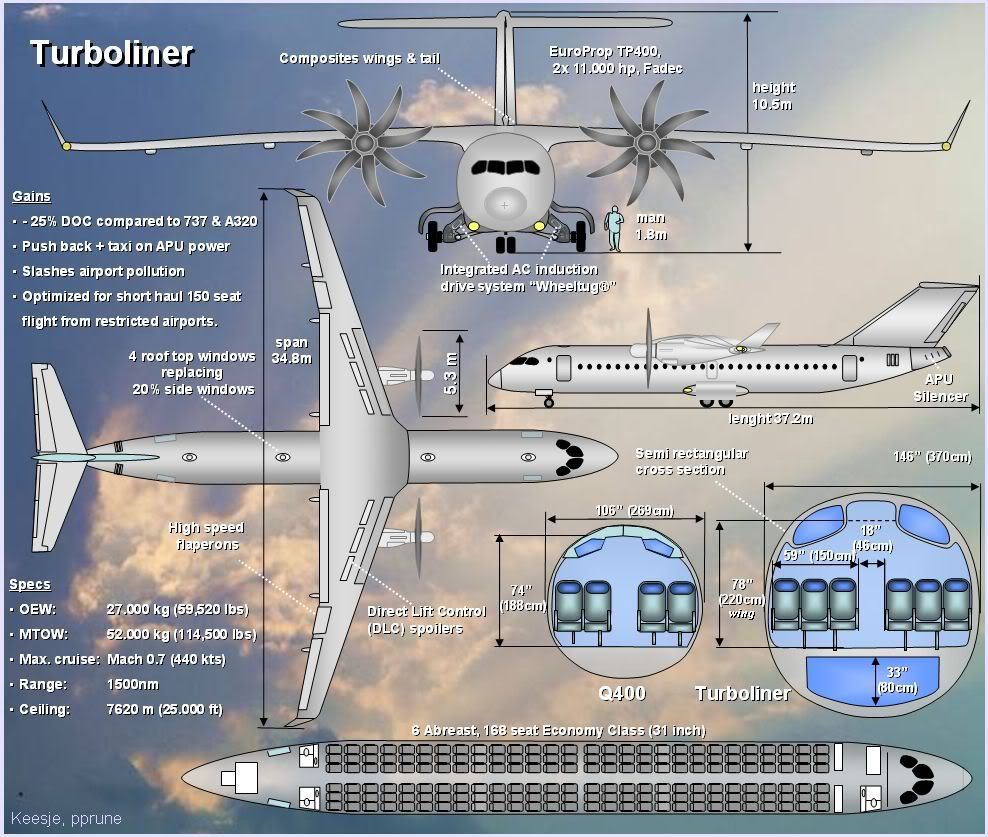
Masai, thnx, haven't communicated outside pprune.
Join Date: Oct 2005
Location: UK
Posts: 209
Likes: 0
Received 0 Likes
on
0 Posts
Keesje, Fantastic concept my friend. I can appriciate what your trying to do, blend the advantages of jets and TP's.
The 6 abreast seating is a great idea for a start. I fly the 146, and as far as I can tell, most pax prefer a roomy, quiet cabin, rather than the engine type (jet or prop) It's irrelevant if you can keep the noise down inside your cabin, noise and vibration are the key factors in pax comfort.
Regarding your idea of taxiing out with your engines shut down, using the electric drives, I'm certain at LCY (where I fly the 146 into ) this wouldn't be advantageous. Holding times at WORST in my experience are 10-15 mins. And backtracking down the runway requires a higher than normal taxi speed. I'm not sure your electric drives could produce up to 30knots in taxi speed. And to be honest, using TP engines, your fuel efficiency is higher than a regional jet anyway, so I would guess that any fuel saving from taxiing with your engines shutdown will be negligible.
Another thing about starting your engines at the runway (or near it) that concerns me is electrical power. Considering your APU will be running your electrical drives, as well as the entire AC system of your aircraft, The chance for failure of the APU generator is higher. Imagine if your APU/APU generator failed on taxi out. Your aircraft would come to a halt in the middle of the taxiway. With no AC electrical power. PA system wouldn't work so communications with cabin crew and pax would be difficult, and if at night, cabin plunged into darkness with only emergency lighting. Not good.
Also the late starting of engines poses problems (again)
Say one of your engines won't start or you suffer a hot start or even a fire. You have no ground crew support. Evacuation of pax (if required) would be a major problem, considering you may have other aircraft infront and behind you. And the clousure of a whole taxiway (or even the airport) is a possibilty, what with a fire damaged A/C and 160+ pax on the loose near an active runway.
I'd say ditch these drives (it's just something else that needs to be maintained) And your onto a winner.
As for your window at the door being elevated up, it's a nice idea, but can't you just build it into the door? The door is a heavy system anyway...
Good work though!!
Atreyu
The 6 abreast seating is a great idea for a start. I fly the 146, and as far as I can tell, most pax prefer a roomy, quiet cabin, rather than the engine type (jet or prop) It's irrelevant if you can keep the noise down inside your cabin, noise and vibration are the key factors in pax comfort.
Regarding your idea of taxiing out with your engines shut down, using the electric drives, I'm certain at LCY (where I fly the 146 into
) this wouldn't be advantageous. Holding times at WORST in my experience are 10-15 mins. And backtracking down the runway requires a higher than normal taxi speed. I'm not sure your electric drives could produce up to 30knots in taxi speed. And to be honest, using TP engines, your fuel efficiency is higher than a regional jet anyway, so I would guess that any fuel saving from taxiing with your engines shutdown will be negligible.Another thing about starting your engines at the runway (or near it) that concerns me is electrical power. Considering your APU will be running your electrical drives, as well as the entire AC system of your aircraft, The chance for failure of the APU generator is higher. Imagine if your APU/APU generator failed on taxi out. Your aircraft would come to a halt in the middle of the taxiway. With no AC electrical power. PA system wouldn't work so communications with cabin crew and pax would be difficult, and if at night, cabin plunged into darkness with only emergency lighting. Not good.
Also the late starting of engines poses problems (again)
Say one of your engines won't start or you suffer a hot start or even a fire. You have no ground crew support. Evacuation of pax (if required) would be a major problem, considering you may have other aircraft infront and behind you. And the clousure of a whole taxiway (or even the airport) is a possibilty, what with a fire damaged A/C and 160+ pax on the loose near an active runway.
I'd say ditch these drives (it's just something else that needs to be maintained) And your onto a winner.
As for your window at the door being elevated up, it's a nice idea, but can't you just build it into the door? The door is a heavy system anyway...
Good work though!!
Atreyu
Last edited by Atreyu; 28th Apr 2008 at 00:55.
Join Date: Oct 2005
Location: UK
Posts: 209
Likes: 0
Received 0 Likes
on
0 Posts
Also while I remember, If one of your wheel drives fails, that could be an embaressing moment for the crew.
Par exemple,
Both crew being 'heads in', say dealing with a problem. (naughty, I know, but not unfeasable is it?) One of your drives fails, and asymetrically, the aeroplane rolls onto the grass. (or water at LCY ) Or say one of the drives jams up, It could be akin to using full braking on one wheel. ATC frown upon aircraft doing handbrake turns, it's considered a tad rude.
Also could you dispatch with one inop? Airliners have built in redundency in most systems to allow dispatch with a number of components inop. Would just one of your wheel tug thingies have enough power to move the aeroplane?
If certification deems it necessary that both be working, it wouldn't be fun to ground an aeroplane for something that doesnt even affect it when it's flying!
And even if you could 'switch off' the working one and taxi out on engine power, your defeating the purpose of having them installed. I imagine alot of airlines would eventually remove them anyway. Less cost, weight (and as you've stated; less weight=more pax) and complexity
Just like re-enforced flight deck doors and CVRs for example, manufacturers will only install things when they have to by law. And why? Because the airlines want a machine that is as simple as legally possible.
(granted these are safety related items, but you see my point?)
I know I've banged on about these drives but they just stick out to me as a bit unnecessary.
Just a thought
(I always think of failures, too much RJ/146 flying!!!)
I watch with interest.
Atreyu
Par exemple,
Both crew being 'heads in', say dealing with a problem. (naughty, I know, but not unfeasable is it?) One of your drives fails, and asymetrically, the aeroplane rolls onto the grass. (or water at LCY
) Or say one of the drives jams up, It could be akin to using full braking on one wheel. ATC frown upon aircraft doing handbrake turns, it's considered a tad rude. Also could you dispatch with one inop? Airliners have built in redundency in most systems to allow dispatch with a number of components inop. Would just one of your wheel tug thingies have enough power to move the aeroplane?
If certification deems it necessary that both be working, it wouldn't be fun to ground an aeroplane for something that doesnt even affect it when it's flying!
And even if you could 'switch off' the working one and taxi out on engine power, your defeating the purpose of having them installed. I imagine alot of airlines would eventually remove them anyway. Less cost, weight (and as you've stated; less weight=more pax) and complexity
Just like re-enforced flight deck doors and CVRs for example, manufacturers will only install things when they have to by law. And why? Because the airlines want a machine that is as simple as legally possible.
(granted these are safety related items, but you see my point?)
I know I've banged on about these drives but they just stick out to me as a bit unnecessary.
Just a thought
(I always think of failures, too much RJ/146 flying!!!
)I watch with interest.
Atreyu
Last edited by Atreyu; 28th Apr 2008 at 00:45.