


Airblue down near Islamabad

Join Date: Nov 2008
Location: Crew lounge
Posts: 87
Likes: 0
Received 0 Likes
on
0 Posts
BOAC
Hi BOAC (and thank you for the "score"),
You're right about 205 Kts a NOMINAL IAS for CAT D A/C.
It's just that PANS OPS specifies that the OCA must include a provision for 25 Kts wind + altitude :
"7.2.3 Determination method
The radius is determined using the formulas in Section 2, Chapter 3, “Turn area construction”, by applying a 46 km/h (25 kt) wind to the true airspeed (TAS) for each category of aircraft using the visual manoeuvring IAS from Tables I-4-1-1 and I-4-1-2 in Chapter 1. The TAS is based on:
a) altitude: aerodrome elevation + 300 m (1 000 ft); and
b) temperature: ISA + 15°."
thus, they end up with the figures I quoted. (See table I-4-7-2 ; Volume II).
Concerning crews's recent experience (no matter Islamabad being "A" ; "B" ;or "C"), I cannot imagine either of the pilots NOT flying to Islamabad during the past few months (Airblue is based in Pakistan ; Islamabad is the capital of Pakistan, right ?).
Flying once to an airport makes you current with this airport for one more year. (At least with my airline...).
CU
You're right about 205 Kts a NOMINAL IAS for CAT D A/C.
It's just that PANS OPS specifies that the OCA must include a provision for 25 Kts wind + altitude :
"7.2.3 Determination method
The radius is determined using the formulas in Section 2, Chapter 3, “Turn area construction”, by applying a 46 km/h (25 kt) wind to the true airspeed (TAS) for each category of aircraft using the visual manoeuvring IAS from Tables I-4-1-1 and I-4-1-2 in Chapter 1. The TAS is based on:
a) altitude: aerodrome elevation + 300 m (1 000 ft); and
b) temperature: ISA + 15°."
thus, they end up with the figures I quoted. (See table I-4-7-2 ; Volume II).
Concerning crews's recent experience (no matter Islamabad being "A" ; "B" ;or "C"), I cannot imagine either of the pilots NOT flying to Islamabad during the past few months (Airblue is based in Pakistan ; Islamabad is the capital of Pakistan, right ?).
Flying once to an airport makes you current with this airport for one more year. (At least with my airline...).
CU

Guest
Join Date: Apr 2009
Location: On the Beach
Posts: 3,336
Likes: 0
Received 0 Likes
on
0 Posts
BOAC:
Although I am not familiar with the specifics of EUOPS 1.975, I would have presumed such a system exists. But, not necessarily for carriers in some parts of the world.
It very well should be a special-qualification airport as to the use of Runway 12. The lack of straight-in IAPs strongly suggests some peculiar local restrictions or conditions. We know about the unusually close restricted airspace to the south side. I suspect there are issues about overflight of certain areas on the north side that could be better served by flight-track CTL procedures.
It's possible that the captain had never before landed on Runway 12 (or perhaps he had, but only in good weather conditions). That is no stretch of logic at all given the circumstances of this airport. In any case with monsoonal rain conditions, I submit CTL is a very demanding, difficult maneuver for the most competent of pilots. The egress to the missed approach procedure is no small consideration among other factors.
For all we know perhaps the captain was flying an ad hoc visual maneuver attempting to avoid known (to him) areas "unfriendly" to overflight. Also, from earlier comments it appears there are landmarks that can be confused with the airport, at least during rain conditions, which rain could have easily intensified as they proceeded towards the hills.
aterpster - that, I think, is a world-wide system (not peculiar to 'this part of the world'), called (under EUOPS 1.975) 'route and area qualification' and all crews are so qualified. Category A is normally renewed by the annual recurrent line check, whilst Cat B and Cat C airports and areas have different training and testing requirements.
You are suggesting, I take it, that OPRN is a special category airport, possibly requiring a route check before circling is attempted or some specific 'company directives' for circling? If so, do we know that this Captain was so checked or trained?
Perhaps you have opened a door onto this tragedy which may explain the apparent crew error. Perhaps someone familiar with AirBlue's ops manual could comment? I cannot see why a competent crew could not be expected to conduct a straightforward and simple CTL at OPRN (or any airport), but maybe herein lies part of the reason for this accident?
For all we know perhaps the captain was flying an ad hoc visual maneuver attempting to avoid known (to him) areas "unfriendly" to overflight. Also, from earlier comments it appears there are landmarks that can be confused with the airport, at least during rain conditions, which rain could have easily intensified as they proceeded towards the hills.
Per Ardua ad Astraeus
Join Date: Mar 2000
Location: UK
Posts: 18,579
Likes: 0
Received 0 Likes
on
0 Posts
Gerard - I had forgotten the 'excess' kts 
I totally concur with your last para - no excuses!
- once again we diverge. Not 'demanding' nor 'difficult' and the MAP is not difficult to brief and master.
- none I am aware of to the north.
- "aye - there's the rub" (more Shakespeare)
Anyone else with a stab at impact heading for kota?
AL1 - do I hear rumours of a coup in Pakistan?
I totally concur with your last para - no excuses!
Originally Posted by aterpster
I submit CTL is a very demanding, difficult maneuver for the most competent of pilots. The egress to the missed approach procedure is no small consideration among other factors.
attempting to avoid known (to him) areas "unfriendly" to overflight
as they proceeded towards the hills.
Anyone else with a stab at impact heading for kota?
AL1 - do I hear rumours of a coup in Pakistan?
Guest
Join Date: Apr 2009
Location: On the Beach
Posts: 3,336
Likes: 0
Received 0 Likes
on
0 Posts
Here is a much better topographical rendering than the one I submitted earlier in the thread. The topo program I use recently began offering a world-wide 1:250,000 geo-referenced topo map derived from the Space Shuttle mapping flight made a few years ago. Jeppesen considers the data, as implemented by Delorme, to be sufficient for Jeppesen's purposes, so they have bought into these topo data.
I also changed the CTL airspace from 5.2 to 5.4 n.m. in this rendering.
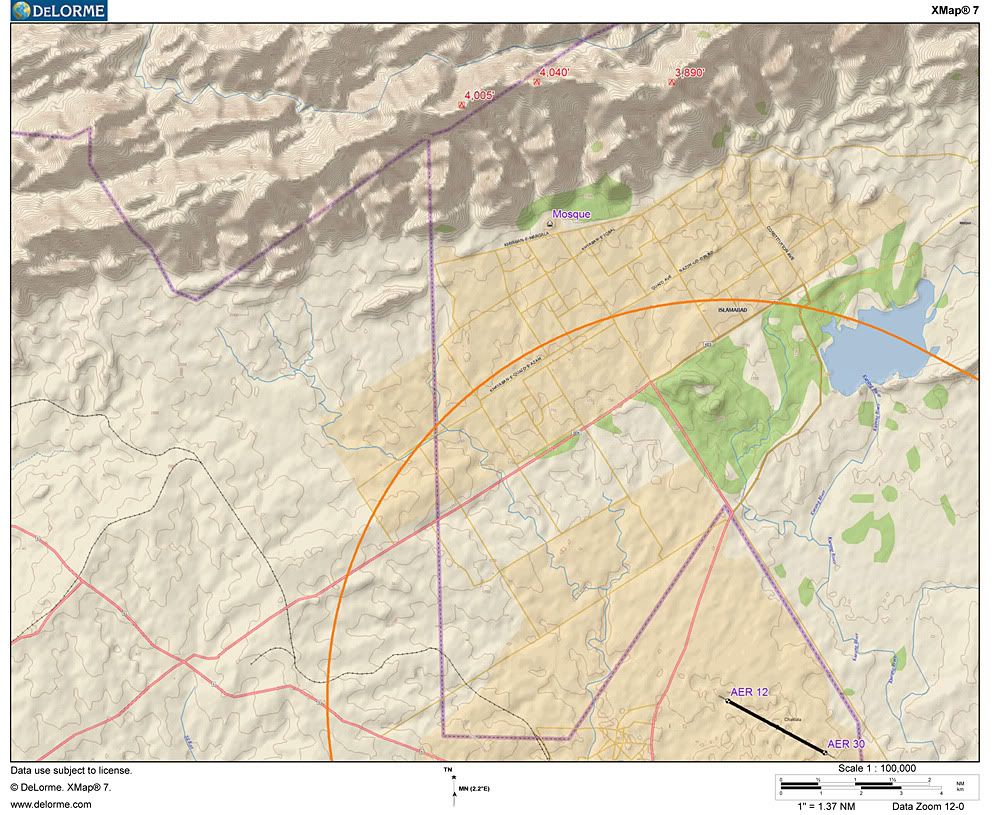
I also changed the CTL airspace from 5.2 to 5.4 n.m. in this rendering.
Guest
Join Date: Apr 2009
Location: On the Beach
Posts: 3,336
Likes: 0
Received 0 Likes
on
0 Posts
BOAC:
I agree with your view of egress to the missed approach procedure, provided there is a briefed plan of action.
As to the difficulty of CTL is lousy weather, the expert safety view tends to share my view of that world. But, any further debate on that issue between you and me would be pointless. I may be forced to quote Alfred E. Neuman.
- once again we diverge. Not 'demanding' nor 'difficult' and the MAP is not difficult to brief and master.
As to the difficulty of CTL is lousy weather, the expert safety view tends to share my view of that world. But, any further debate on that issue between you and me would be pointless. I may be forced to quote Alfred E. Neuman.
Per Ardua ad Astraeus
Join Date: Mar 2000
Location: UK
Posts: 18,579
Likes: 0
Received 0 Likes
on
0 Posts
The 'CTL airspace' is not CTL airspace. It is the protected area (5.28nm) in which the CTL minimum will be at least 394' above the highest obstacle. It is not the area in which you PLAN to 'circle to land', just as 2.3nm (2 for 411A ) is not the area in which you PLAN to circle to land in TERPS - it is the area that gives you vertical separation (300') at the minima. The circle you have drawn is not relevant to this accident. The a/c was outside it. That is why it hit the hill - simple.
"CTL is lousy weather," - well, quit if you cannot do it. Just like a Cat I ILS in 200m RVR - simple.
Alfred E. Neuman? aah! Mad.
) is not the area in which you PLAN to circle to land in TERPS - it is the area that gives you vertical separation (300') at the minima. The circle you have drawn is not relevant to this accident. The a/c was outside it. That is why it hit the hill - simple."CTL is lousy weather," - well, quit if you cannot do it. Just like a Cat I ILS in 200m RVR - simple.
Alfred E. Neuman? aah! Mad.
Guest
Join Date: Apr 2009
Location: On the Beach
Posts: 3,336
Likes: 0
Received 0 Likes
on
0 Posts
BOAC:
Thanks for the flying and procedure design lessons.
The circle (oval actually) I have drawn is most pertinent. It shows the limits of protected airspace, which is an appropriate aid in the understanding of this accident.
The 'CTL airspace' is not CTL airspace. It is the protected area (5.28nm) in which the CTL minimum will be at least 394' above the highest obstacle. It is not the area in which you PLAN to 'circle to land', just as 2.3nm (2 for 411A ) is not the area in which you PLAN to circle to land in TERPS - it is the area that gives you vertical separation (300') at the minima. The circle you have drawn is not relevant to this accident. The a/c was outside it. That is why it hit the hill - simple.
) is not the area in which you PLAN to circle to land in TERPS - it is the area that gives you vertical separation (300') at the minima. The circle you have drawn is not relevant to this accident. The a/c was outside it. That is why it hit the hill - simple.
The circle (oval actually) I have drawn is most pertinent. It shows the limits of protected airspace, which is an appropriate aid in the understanding of this accident.
For all we know perhaps the captain was flying an ad hoc visual maneuver attempting to avoid known (to him) areas "unfriendly" to overflight.
A circling manoeuvre is a visual segment of an instrument approach, not a 'visual approach'. The in-flight visibility, maximum distance from the airfield and operating altitudes are all exactly specified, as BOAC has pointed out. As are the actions to be taken if you lose your reference or reach any of the other limitations.
If you're not completely clear about what you're attempting, it's possible to get caught by doing something half-instrument, half-visual and mostly dangerous. Minima are there for a reason.
Guest
Join Date: Apr 2009
Location: On the Beach
Posts: 3,336
Likes: 0
Received 0 Likes
on
0 Posts
FullWings:
Gee, guys, I have probably as much flying time as any of you, plus I have worked with TERPs criteria and FAA instrument flight operations regulations and policy since 1970 and still do to this day as a professional.
In fact, my issue with BOAC on this subject is that my considered view, shared by lots of safety experts, that the circle-to-land maneuver is a very demanding maneuver, especially in minimal weather conditions and in a jet transport aircraft.
BOAC is of the opinion that it is just another routine aspect of instrument flying. I strongly disagree.
As to this particular accident, there is some reason that the captain, for lack of a better term, went on an excursion rather than flying a disciplined CTL pattern. Please note that I used the phrase "ad hoc visual" with reference to the captain's apparent actions. Please also note that I mentioned earlier in the thread the hazard of CTL in monsoonal rain conditions. Those hills were almost certainly experiencing upslope, moist conditions. (orographical lift)
The aviation community, both in the U.S. and Europe, is working to advance the use of 3-D approaches to virtually every runway end using RNP AR or at least Advanced RNAV (known as "APCH" in ICAO-speak). And, in RNP AR criteria CTL is specifically prohibited because of the high risk of the operation.
A circling manoeuvre is a visual segment of an instrument approach, not a 'visual approach'. The in-flight visibility, maximum distance from the airfield and operating altitudes are all exactly specified, as BOAC has pointed out. As are the actions to be taken if you lose your reference or reach any of the other limitations.
In fact, my issue with BOAC on this subject is that my considered view, shared by lots of safety experts, that the circle-to-land maneuver is a very demanding maneuver, especially in minimal weather conditions and in a jet transport aircraft.
BOAC is of the opinion that it is just another routine aspect of instrument flying. I strongly disagree.
As to this particular accident, there is some reason that the captain, for lack of a better term, went on an excursion rather than flying a disciplined CTL pattern. Please note that I used the phrase "ad hoc visual" with reference to the captain's apparent actions. Please also note that I mentioned earlier in the thread the hazard of CTL in monsoonal rain conditions. Those hills were almost certainly experiencing upslope, moist conditions. (orographical lift)
The aviation community, both in the U.S. and Europe, is working to advance the use of 3-D approaches to virtually every runway end using RNP AR or at least Advanced RNAV (known as "APCH" in ICAO-speak). And, in RNP AR criteria CTL is specifically prohibited because of the high risk of the operation.
Join Date: Jun 2009
Location: US
Posts: 497
Likes: 0
Received 0 Likes
on
0 Posts
I agree with BOAC on this one. We are all trained and have done hundreds of CTL approaches with hopefully no close calls. I haven't. Dumbing down aviation so beginners in an airbus with 300 hrs can do it with automation should not be the future of aviation. It seems to be headed that way however.
Last edited by p51guy; 25th Aug 2010 at 15:00. Reason: additional statement
Per Ardua ad Astraeus
Join Date: Mar 2000
Location: UK
Posts: 18,579
Likes: 0
Received 0 Likes
on
0 Posts
aterpster - however difficult you may have found CTL before you and flying parted company, it remains a straightforward exercise to fly. Like all bits of aviation, some of which are more difficult than others, it requires a basic flying skill (circuit flying) and judgement of when to quit if things go pear-shaped.
- this is all irrelevant!
"monsoonal rain conditions" - nasty, but don't carry on when you lose sight of where you are - exactly the same on a damp 'stratusey' day in the UK. - look - no monsoon!
"Those hills" - forget them! The CTL goes nowhere near them. Orographic stratus is not part of this equation. Had the crew flown a sensible DOWNWIND heading the hills could have been covered in snow or skyscrapers for all the difference it would have made.
Once again you have avoided answering questions. What were the "areas "unfriendly" to overflight" of which you speak?
40 years is a long time out of it. All these glitzy approaches of which you speak are terrific, but let's not take away the requirement to be able to fly sensibly? You almost post as if you believe that when something requires a basic flying skill that cannot be achieved with an autopilot or computer it should be stopped.
You need to accept that regardless of circles/ovals/whatever drawn on maps, this crew went steaming off straight to the scene of the accident. That is the issue that needs to be addressed.
hazard of CTL in monsoonal rain conditions. Those hills were almost certainly experiencing upslope, moist conditions. (orographical lift)
"monsoonal rain conditions" - nasty, but don't carry on when you lose sight of where you are - exactly the same on a damp 'stratusey' day in the UK. - look - no monsoon!
"Those hills" - forget them! The CTL goes nowhere near them. Orographic stratus is not part of this equation. Had the crew flown a sensible DOWNWIND heading the hills could have been covered in snow or skyscrapers for all the difference it would have made.
Once again you have avoided answering questions. What were the "areas "unfriendly" to overflight" of which you speak?
40 years is a long time out of it. All these glitzy approaches of which you speak are terrific, but let's not take away the requirement to be able to fly sensibly? You almost post as if you believe that when something requires a basic flying skill that cannot be achieved with an autopilot or computer it should be stopped.
You need to accept that regardless of circles/ovals/whatever drawn on maps, this crew went steaming off straight to the scene of the accident. That is the issue that needs to be addressed.
aterpster,
My comments weren't directly aimed at you, more to others reading this thread who maybe don't have the benefit of your knowledge & experience. Apologies if it seemed that way.
I sort of agree, only it is still one of the necessary tools in the armoury of a professional pilot. These approaches do exist (I've had to do three in the last two days in the 777! Unusual, I'll admit...) and, with suitable training and realistic minima, can be executed safely (which also includes throwing them away).
Part of me wants to say "yes, do away with circling approaches for jets, just too much risk/difficulty" and the other part wants to say "a jet pilot should be competent in all manoeuvres expected of him". After all, "I just can't cope with engine failures" doesn't fast-track you through an LPC/OPC... Same should apply to circling, *while it's a recognised, approved and sometimes only method of landing at certain aerodromes*
On the day, if you're not sure and full of dread at the idea of a CTL, then take the tailwind or divert. It's not compulsory to 'have a go', apart from in the sim...
My comments weren't directly aimed at you, more to others reading this thread who maybe don't have the benefit of your knowledge & experience. Apologies if it seemed that way.
...my considered view, shared by lots of safety experts, that the circle-to-land maneuver is a very demanding maneuver, especially in minimal weather conditions and in a jet transport aircraft.
Part of me wants to say "yes, do away with circling approaches for jets, just too much risk/difficulty" and the other part wants to say "a jet pilot should be competent in all manoeuvres expected of him". After all, "I just can't cope with engine failures" doesn't fast-track you through an LPC/OPC... Same should apply to circling, *while it's a recognised, approved and sometimes only method of landing at certain aerodromes*
On the day, if you're not sure and full of dread at the idea of a CTL, then take the tailwind or divert. It's not compulsory to 'have a go', apart from in the sim...
aterpster:
"The circle to land maneuver (sic) is a very demanding maneuver, especially in minimal weather conditions and in a jet transport aircraft.
BOAC is of the opinion that it is just another routine aspect of instrument flying. I strongly disagree".
I'm sorry old son but I agree 100% with BOAC.
Like it or lump it, there is still a lot of the world out there that "Try Walking Across" probably never visited that still requires a circling approach.
I certainly would never sign anyone off until they had demonstrated to me that they had mastered what I consider to be a basic skill.
"The circle to land maneuver (sic) is a very demanding maneuver, especially in minimal weather conditions and in a jet transport aircraft.
BOAC is of the opinion that it is just another routine aspect of instrument flying. I strongly disagree".
I'm sorry old son but I agree 100% with BOAC.
Like it or lump it, there is still a lot of the world out there that "Try Walking Across" probably never visited that still requires a circling approach.
I certainly would never sign anyone off until they had demonstrated to me that they had mastered what I consider to be a basic skill.
In the company I fly for we quite regularly fly CTL as we fly to some smaller airports which only have an instrument approach to one runway. We have a very structured way of doing this which works very well.
CTLs are perfectly safe so long as pilots are trained and checked in how to do them and also aware of knowing how to go around if unable to maintain the required visual reference.
CTLs are perfectly safe so long as pilots are trained and checked in how to do them and also aware of knowing how to go around if unable to maintain the required visual reference.
@ fireflybob:  Command climate/company internal culture are factors the flying public are too often blind to. In this case those factors may remain opaque. One hopes not.
In re point 2: This brings us back to qualificatino, training, currency, and proficiency ...
- We have a very structured way of doing this which works very well.
- CTLs are perfectly safe so long as pilots are trained and checked in how to do them and also aware of knowing how to go around if unable to maintain the required visual reference.
Command climate/company internal culture are factors the flying public are too often blind to. In this case those factors may remain opaque. One hopes not. In re point 2: This brings us back to qualificatino, training, currency, and proficiency ...
Likewise, I am with BOAC - but maybe from a more modern perspective (sorry!)
A regular instrument approach is a safe and happy place to be, because as pilots we can use two or more independent nav aids to confirm our position and path.
A circling approach in the 320 is also two sets of independent references that tie together to confirm our position and path:
1. You fly at F speed, break right for 30s level just above minima, turn left to track downwind, start timing abeam the threshold (for a pre-calculated height/wind corrected time), turn left (disconnect the AP) and descend. Do this and you'll be in roughly the right place.
2. You become visual with the runway and break off, you remain visual with the airport on downwind, you are visual with the threshold when you start the watch and your are visual with the threshold as you descend and turn towards it.
They are the two independent systems. One always cross references with the other - just like 2 nav aids. Even though either system will get you there, if you lose one - or lose the cross-check between the two, then that's your clue that it has gone wrong and you go around and think again.
Simple, cross-referenced and safe. Even a 200 hour cadet can do it.
A regular instrument approach is a safe and happy place to be, because as pilots we can use two or more independent nav aids to confirm our position and path.
A circling approach in the 320 is also two sets of independent references that tie together to confirm our position and path:
1. You fly at F speed, break right for 30s level just above minima, turn left to track downwind, start timing abeam the threshold (for a pre-calculated height/wind corrected time), turn left (disconnect the AP) and descend. Do this and you'll be in roughly the right place.
2. You become visual with the runway and break off, you remain visual with the airport on downwind, you are visual with the threshold when you start the watch and your are visual with the threshold as you descend and turn towards it.
They are the two independent systems. One always cross references with the other - just like 2 nav aids. Even though either system will get you there, if you lose one - or lose the cross-check between the two, then that's your clue that it has gone wrong and you go around and think again.
Simple, cross-referenced and safe. Even a 200 hour cadet can do it.
Join Date: May 2007
Location: Western Pacific
Posts: 721
Likes: 0
Received 0 Likes
on
0 Posts
I agree that CTL approaches can be perfectly safe. However, they are higher risk than straight in CDA's and are less tolerant of error.
This risk can be mitigated by a number of things, including adequate training and recency. However, whether or not pilots are receiving adequate training and recency in the current cost cutting climate, is debatable.
VSD's and EGPWS displayed on ND's are two pieces of modern technology that go along way to enhance pilot situational awareness, which also increases the safety margins of NPA's and CTL approaches. However, the current cost cutting climate means that they are not always fitted.
This risk can be mitigated by a number of things, including adequate training and recency. However, whether or not pilots are receiving adequate training and recency in the current cost cutting climate, is debatable.
VSD's and EGPWS displayed on ND's are two pieces of modern technology that go along way to enhance pilot situational awareness, which also increases the safety margins of NPA's and CTL approaches. However, the current cost cutting climate means that they are not always fitted.
Join Date: Jul 2002
Location: LHS
Posts: 70
Likes: 0
Received 0 Likes
on
0 Posts
Sounds like aterpster is one of the guys whose recommendations led to the depreciation of the US major airline pilot's certificate.
All US majors that type rate their pilots seem to have a no circling restriction on their certificates. That was the case at the major I was at, but funnily enough their contract training for non employed pilots did not have this restriction. Alaska may be an exception, I don't know.
Circling even in non radar (which this wasn't) is just part of the job. If you don't like it go around and do it again.
Rather like a memo from a desk job. Except its not. It is a bit more serious than that. It is what we are trained to do.
All US majors that type rate their pilots seem to have a no circling restriction on their certificates. That was the case at the major I was at, but funnily enough their contract training for non employed pilots did not have this restriction. Alaska may be an exception, I don't know.
Circling even in non radar (which this wasn't) is just part of the job. If you don't like it go around and do it again.
Rather like a memo from a desk job. Except its not. It is a bit more serious than that. It is what we are trained to do.
Per Ardua ad Astraeus
Join Date: Mar 2000
Location: UK
Posts: 18,579
Likes: 0
Received 0 Likes
on
0 Posts
100% - no need for apologies - that represents good C(ockpit) RM. The point I was making (trying anyway!) is that you don't NEED all the 'gubbins' to do it.
- I would add "or don't start it"? Tailwind or divert.
Originally Posted by bus junkie
If you don't like it go around and do it again.
Per Ardua ad Astraeus
Join Date: Mar 2000
Location: UK
Posts: 18,579
Likes: 0
Received 0 Likes
on
0 Posts
One source is claiming incapacitation, but another source (unverified, but sounding plausible) is claiming that the CVR and FDR show that the F/O was anxious about the heading but that the Captain said he would make a "wider circuit". It would appear that the Captain may have been unaware of the proximity to the hills and the F/O called for a pull-up, but the Captain turned the heading pointer to the left (correct direction) but through more than 180 degrees so the a/c reversed the turn the right.
This heading 'bug' was present on early 737s but was 'softwared' out so the a/c maintained the initial turn direction. Any input from AB pilots on this please?
This heading 'bug' was present on early 737s but was 'softwared' out so the a/c maintained the initial turn direction. Any input from AB pilots on this please?