


Russian task group

Some nice Su-33 and Kuznetsov footage at the following link. Footage from a camera on the underside of an Su-33.
Video Link - Russian website
Google Translation.
Video Link - Russian website
Google Translation.
The Russian squadron led by the aircraft carrying cruiser "Admiral Kuznetsov" leaves the Mediterranean Sea
The Russian squadron led by heavy aircraft carrying cruiser "Admiral Kuznetsov" leaves the Mediterranean Sea, to go back to Murmansk. During the long voyage the ship's crew conducted dozens of different exercises, and the crews of carrier-based aircraft have flown more than 120 hours. daybreak the next day driving trip to meet the ship at the exit of the Strait of Gibraltar. Since the end of December 2011 the Northern Fleet sailors were carrying on combat duty in the Mediterranean. During this time, in areas of central and eastern Mediterranean, our sailors were covered several thousand miles. Every day aboard aircraft carrier group training exercises of various military units.
The gunners and soldiers survivability division, Marines and special operations units, and of course, the two wings of our squadron aircraft - fighter pilots and helicopter pilots. During the long period of Mediterranean campaign fliers of two squadrons of the Northern Fleet had almost a dozen changes of flight, with a common touch about 120 hours. It was done over a hundred landings on the deck, held on 20 training air combat and interception purposes.
Among the pilots were both very young officers, the first landing on the deck of an aircraft carrier in a long march, and the pilots, planted dozens of times on the Su-33 " Admiral Kuznetsov ", and one of them, Pavel Ivanovich Pryadko in this entry into the Mediterranean Sea was the anniversary, one hundredth landing on aircraft carrier. Out in the Atlantic Ocean means for the crew of the Russian squadron awaited the approach to their native shores. But before his return to the raid in Murmansk, ships and aircraft of the Northern Fleet is still a few maneuvers in the Atlantic Ocean.
The Russian squadron led by heavy aircraft carrying cruiser "Admiral Kuznetsov" leaves the Mediterranean Sea, to go back to Murmansk. During the long voyage the ship's crew conducted dozens of different exercises, and the crews of carrier-based aircraft have flown more than 120 hours. daybreak the next day driving trip to meet the ship at the exit of the Strait of Gibraltar. Since the end of December 2011 the Northern Fleet sailors were carrying on combat duty in the Mediterranean. During this time, in areas of central and eastern Mediterranean, our sailors were covered several thousand miles. Every day aboard aircraft carrier group training exercises of various military units.
The gunners and soldiers survivability division, Marines and special operations units, and of course, the two wings of our squadron aircraft - fighter pilots and helicopter pilots. During the long period of Mediterranean campaign fliers of two squadrons of the Northern Fleet had almost a dozen changes of flight, with a common touch about 120 hours. It was done over a hundred landings on the deck, held on 20 training air combat and interception purposes.
Among the pilots were both very young officers, the first landing on the deck of an aircraft carrier in a long march, and the pilots, planted dozens of times on the Su-33 " Admiral Kuznetsov ", and one of them, Pavel Ivanovich Pryadko in this entry into the Mediterranean Sea was the anniversary, one hundredth landing on aircraft carrier. Out in the Atlantic Ocean means for the crew of the Russian squadron awaited the approach to their native shores. But before his return to the raid in Murmansk, ships and aircraft of the Northern Fleet is still a few maneuvers in the Atlantic Ocean.
Last edited by TEEEJ; 1st Feb 2012 at 14:48.

2 February, 12 GMT
Lena
12464 RMP DE RKO81 02121 99423 70118 22283
42.3N 11.8W Heading North at 11-15 Knots
Map Link
Vyazma ?
8345 RAL46 02121 99534 10038 22283
53.4N 03.8E Heading North at 11-15 Knots
Map Link
Kama ?
8345 RMP DE RAL65 02121 99529 10033 22252
52.9N 03.3E Heading South West at 6-10 Knots
Map Link
Ivan Bubnov
12464 RCV DE RCJG 02121 99370 10026 22222
37.0N 02.6E Heading East at 6-10 Knots
Map Link
The Kuznetsov video has now been posted on You Tube.
Confirmation that call sign RIR98 in previous posts was the Black Sea Fleet PM-56 Floating Workshop.
BSF Floating Workshop PM-56 Returned to Sevastopol
Lena
12464 RMP DE RKO81 02121 99423 70118 22283
42.3N 11.8W Heading North at 11-15 Knots
Map Link
Vyazma ?
8345 RAL46 02121 99534 10038 22283
53.4N 03.8E Heading North at 11-15 Knots
Map Link
Kama ?
8345 RMP DE RAL65 02121 99529 10033 22252
52.9N 03.3E Heading South West at 6-10 Knots
Map Link
Ivan Bubnov
12464 RCV DE RCJG 02121 99370 10026 22222
37.0N 02.6E Heading East at 6-10 Knots
Map Link
The Kuznetsov video has now been posted on You Tube.
Confirmation that call sign RIR98 in previous posts was the Black Sea Fleet PM-56 Floating Workshop.
BSF Floating Workshop PM-56 Returned to Sevastopol
Black Sea Fleet (BSF) floating workshop PM-56 commanded by Capt Igor Bakuradze on Jan 31 returned to Sevastopol from a 6-month deployment in the Mediterranean Sea, BSF press service told Central
Navy Portal. Being deployed in the Mediterranean, the vessel maintained activities of Russian Navy's task force. To provide security during the cruise, PM-56 had an anti-terror group and boarding party consisting of BSF marines. A solemn meeting ceremony took place in Sevastopol; the crew was handed traditional bread-and-salt and a piglet roast. BSF seagoing tanker Ivan Bubnov continues to maintain Russian Navy's carrier group in the Mediterranean Sea. Floating workshop PM-56 was built in Szczecin, Poland in 1973.
Black Sea Fleet (BSF) floating workshop PM-56 commanded by Capt Igor Bakuradze on Jan 31 returned to Sevastopol from a 6-month deployment in the Mediterranean Sea, BSF press service told Central
Navy Portal. Being deployed in the Mediterranean, the vessel maintained activities of Russian Navy's task force. To provide security during the cruise, PM-56 had an anti-terror group and boarding party consisting of BSF marines. A solemn meeting ceremony took place in Sevastopol; the crew was handed traditional bread-and-salt and a piglet roast. BSF seagoing tanker Ivan Bubnov continues to maintain Russian Navy's carrier group in the Mediterranean Sea. Floating workshop PM-56 was built in Szczecin, Poland in 1973.
Update on Morse Code weather info.
3 February, 12 GMT
Vyazma ?
8345 RMP DE RAL46 03121 99571 10002 22273
57.1N 00.2E Heading North West at 11-15 Knots
Map Link
Kama ?
8345 RMP DE RAL65 03121 99501 70021 22253
50.1N 02.1W Heading South West at 11-15 Knots
Map Link
Lena
12464 RMP DE RKO81 03121 99467 70098 22283
46.7N 09.8W Heading North at 11-15 Knots
Map Link
Ivan Bubnov
12464 RCV DE RCJG 03121 99377 10071 22222
37.7N 07.1E Heading East at 6-10 Knots
Map Link
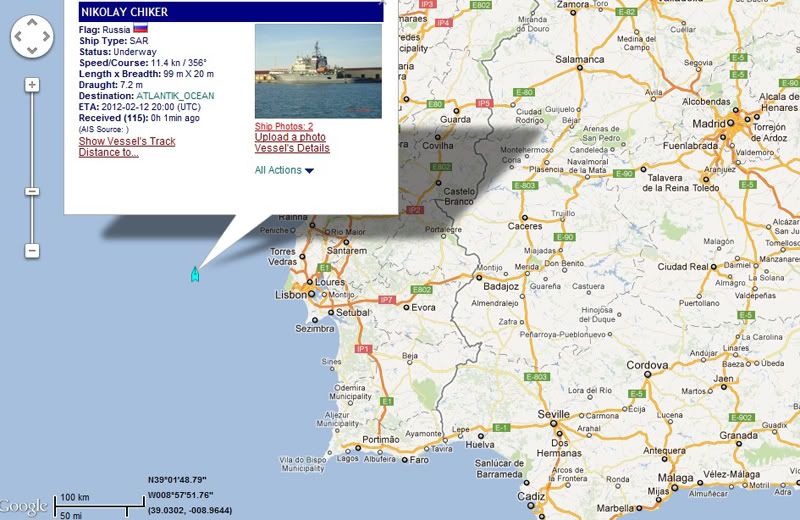
Nikolay Chiker was active on AIS last night. See following.
Daily Vessel's Itineraries - AIS Marine Traffic
Live Ships Map - AIS - Vessel Traffic and Positions
3 February, 12 GMT
Vyazma ?
8345 RMP DE RAL46 03121 99571 10002 22273
57.1N 00.2E Heading North West at 11-15 Knots
Map Link
Kama ?
8345 RMP DE RAL65 03121 99501 70021 22253
50.1N 02.1W Heading South West at 11-15 Knots
Map Link
Lena
12464 RMP DE RKO81 03121 99467 70098 22283
46.7N 09.8W Heading North at 11-15 Knots
Map Link
Ivan Bubnov
12464 RCV DE RCJG 03121 99377 10071 22222
37.7N 07.1E Heading East at 6-10 Knots
Map Link
Nikolay Chiker was active on AIS last night. See following.
Daily Vessel's Itineraries - AIS Marine Traffic
Live Ships Map - AIS - Vessel Traffic and Positions
4 February, 12 GMT
Lena
12464 RMP DE RKO81 04121 99507 70088 22200
50.7N 08.8W Hove to
Map Link
Vyazma
12464 RMP DE RAL46 04121 99580 70023 22200
58.0N 02.3W Hove to
Map Link
Kama
12464 RIT DE RAL65 04121 99499 70075 22272
49.9N 07.5W Heading North West at 6-10 Knots
Map Link
4 February, 06 GMT
Ivan Bubnov
8139 RCV DE RCJG 04061 99376 10096 22232
37.6N 09.6E Heading South East at 6-10 Knots
Map Link
Lena
12464 RMP DE RKO81 04121 99507 70088 22200
50.7N 08.8W Hove to
Map Link
Vyazma
12464 RMP DE RAL46 04121 99580 70023 22200
58.0N 02.3W Hove to
Map Link
Kama
12464 RIT DE RAL65 04121 99499 70075 22272
49.9N 07.5W Heading North West at 6-10 Knots
Map Link
4 February, 06 GMT
Ivan Bubnov
8139 RCV DE RCJG 04061 99376 10096 22232
37.6N 09.6E Heading South East at 6-10 Knots
Map Link
6 February, 12 GMT
Lena
8345 RIT DE RKO81 06121 99495 70064 22233
49.5N 06.4W Heading South East at 11-15 Knots
Map Link
6 February, 06 GMT
Kama
8345 RAL65 06061 99534 70113 22283
53.4N 11.3W Heading North at 11-15 Knots
Map Link
6 February, 12 GMT
Vyazma
12464 RAL46 06121 99601 10014
60.1N 01.4E
Map Link
6 February, 12 GMT
Ivan Bubnov
12464 RCV DE RCJG 06121 99363 10197 22221
36.3N 19.7E Heading East at 1-5 Knots
Map Link
Lena
8345 RIT DE RKO81 06121 99495 70064 22233
49.5N 06.4W Heading South East at 11-15 Knots
Map Link
6 February, 06 GMT
Kama
8345 RAL65 06061 99534 70113 22283
53.4N 11.3W Heading North at 11-15 Knots
Map Link
6 February, 12 GMT
Vyazma
12464 RAL46 06121 99601 10014
60.1N 01.4E
Map Link
6 February, 12 GMT
Ivan Bubnov
12464 RCV DE RCJG 06121 99363 10197 22221
36.3N 19.7E Heading East at 1-5 Knots
Map Link
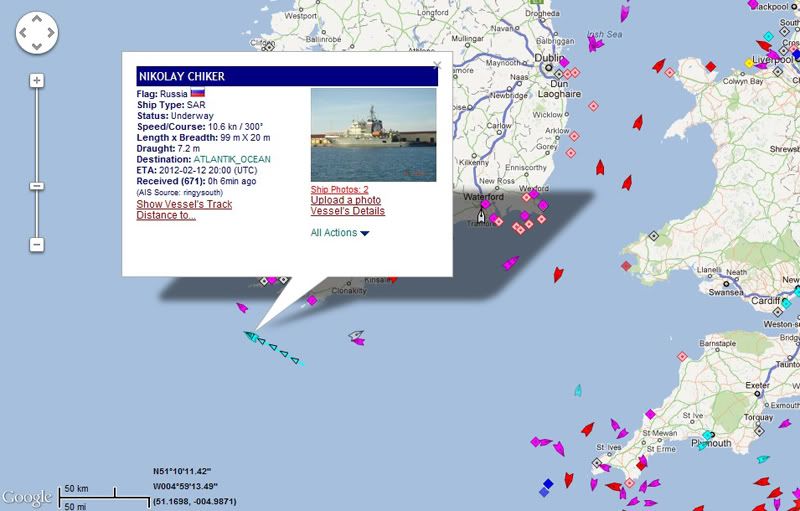
Lena has now left the main Task Force and entered the English Channel.
6 February, 18 GMT
Lena
8345 RMP DE RKO81 06181 99496 70044 22213
49.6N 04.4W Heading North East at 11-15 Knots
Map Link
Kama
8345 RIW DE RAL65 06181 99557 70107 22213
55.7N 10.7W Heading North East at 11-15 Knots
Map Link
Vyazma
8345 RIT DE RAL46 06181 99609 10034 22212
60.9N 03.4E Heading North East at 6-10 Knots
Map Link
6 February, 18 GMT
Lena
8345 RMP DE RKO81 06181 99496 70044 22213
49.6N 04.4W Heading North East at 11-15 Knots
Map Link
Kama
8345 RIW DE RAL65 06181 99557 70107 22213
55.7N 10.7W Heading North East at 11-15 Knots
Map Link
Vyazma
8345 RIT DE RAL46 06181 99609 10034 22212
60.9N 03.4E Heading North East at 6-10 Knots
Map Link
7 February, 12 GMT
Lena
8345 RMP DE RKO81 07121 99504 10007 22212
50.4N 0.07E Heading North East at 6-10 Knots
Map Link
Kama
12464 RIT DERAL65 99588 70081 22213
58.8N 08.1W Heading North East at 11-15 Knots
Map Link
Vyazma
8345 RIT DE RAL46 07121 99644 10056 22283
64.4N 05.6E Heading North at 11-15 Knots
Map Link
Ivan Bubnov
12464 RCV DE RCJG 07121 99364 10229 22222
36.4N 22.9E Heading East at 6-10 Knots
Map Link
Lena
8345 RMP DE RKO81 07121 99504 10007 22212
50.4N 0.07E Heading North East at 6-10 Knots
Map Link
Kama
12464 RIT DERAL65 99588 70081 22213
58.8N 08.1W Heading North East at 11-15 Knots
Map Link
Vyazma
8345 RIT DE RAL46 07121 99644 10056 22283
64.4N 05.6E Heading North at 11-15 Knots
Map Link
Ivan Bubnov
12464 RCV DE RCJG 07121 99364 10229 22222
36.4N 22.9E Heading East at 6-10 Knots
Map Link
Nikolay Chiker currently active on AIS off the North of Scotland.
12 GMT
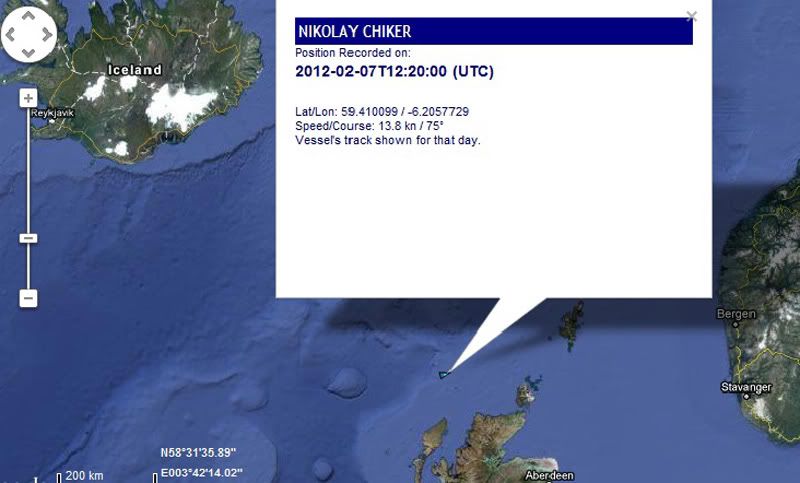
Live Ships Map - AIS - Vessel Traffic and Positions
Daily Vessel's Itineraries - AIS Marine Traffic
12 GMT
Live Ships Map - AIS - Vessel Traffic and Positions
Daily Vessel's Itineraries - AIS Marine Traffic
Last edited by TEEEJ; 10th Feb 2012 at 09:42.
7 February, 18 GMT
Lena
8345 RMP DE RKO81 07181 99516 10018 22213
51.6N 01.8E Heading North East at 11-15 Knots
Map Link
Kama
8345 RMP DE RAL65 07181 99596 70063 22213
59.6N 06.3W Heading North East at 11-15 Knots
Map Link
Vyazma
8345 RAL46 07181 99655 10067 22213
65.5N 06.7E Heading North East at 11-15 Knots
Map Link
Ivan Bubnov
8345 RCV DE RCJG 07181 99361 10251 22222
36.1N 25.1E Heading East at 6-10 Knots
Map Link
Lena
8345 RMP DE RKO81 07181 99516 10018 22213
51.6N 01.8E Heading North East at 11-15 Knots
Map Link
Kama
8345 RMP DE RAL65 07181 99596 70063 22213
59.6N 06.3W Heading North East at 11-15 Knots
Map Link
Vyazma
8345 RAL46 07181 99655 10067 22213
65.5N 06.7E Heading North East at 11-15 Knots
Map Link
Ivan Bubnov
8345 RCV DE RCJG 07181 99361 10251 22222
36.1N 25.1E Heading East at 6-10 Knots
Map Link

British warship escorts Russian aircraft carrier passed UK waters

From
British warship escorts Russian aircraft carrier passed UK waters - Telegraph
7:42AM GMT 07 Feb 2012
The destroyer sailed alongside the 50,000-tonne Russian aircraft carrier Admiral Kuznetsov as it made its way north. The Portsmouth-based Type 42 warship was acting as fleet escort as it followed a carrier-led Russian task group from the Channel off south-west England to the seas off south-west Ireland.
The task group of two warships and five support ships were making their way home to the northern and Baltic fleets of the Russian navy. The images were released by the Royal Navy.
HMS Liverpool's commanding officer, Commander Colin Williams, said: ''As an island nation, it is essential for the UK to maintain a military presence in our waters.
The destroyer sailed alongside the 50,000-tonne Russian aircraft carrier Admiral Kuznetsov as it made its way north. The Portsmouth-based Type 42 warship was acting as fleet escort as it followed a carrier-led Russian task group from the Channel off south-west England to the seas off south-west Ireland.
The task group of two warships and five support ships were making their way home to the northern and Baltic fleets of the Russian navy. The images were released by the Royal Navy.
HMS Liverpool's commanding officer, Commander Colin Williams, said: ''As an island nation, it is essential for the UK to maintain a military presence in our waters.
British warship escorts Russian aircraft carrier passed UK waters - Telegraph
Looks like they are heading for the Moray Firth, again! Scramble the Fleet Ready Escort!
8 February, 09 GMT
Kama
12464 RIT DE RAL65 08091 99594 70022 22232
59.4N 02.2W Heading South East at 6-10 Knots
Map Link
Nikolay Chiker as of 09 GMT
Live Ships Map - AIS - Vessel Traffic and Positions
Live Ships Map - AIS - Vessel Traffic and Positions
8 February, 09 GMT
Kama
12464 RIT DE RAL65 08091 99594 70022 22232
59.4N 02.2W Heading South East at 6-10 Knots
Map Link
Nikolay Chiker as of 09 GMT
Live Ships Map - AIS - Vessel Traffic and Positions
Live Ships Map - AIS - Vessel Traffic and Positions
A quick update on the positions.
8 February, 18 GMT
Lena - Probably returning to the Baltic?
8345 RKO81 08181 99542 10051
54.2N 05.1E
Map Link
8 February, 18 GMT
Kama
8345 RAL65 08181 99588 70020
58.8N 02.0W
Map Link
8 February, 18 GMT
Vyazma
8345 RIT DE RAL46 08181 99696 10147 22213
69.6N 14.7E Heading North East at 11-15 Knots
Map Link
8 February, 12 GMT
Ivan Bubnov - Possibly heading for Syria?
12464 RCV DE RCJG 08121 99355 10283 22222
35.5N 28.3E Heading East at 6-10 Knots
Map Link
8 February, 18 GMT
Lena - Probably returning to the Baltic?
8345 RKO81 08181 99542 10051
54.2N 05.1E
Map Link
8 February, 18 GMT
Kama
8345 RAL65 08181 99588 70020
58.8N 02.0W
Map Link
8 February, 18 GMT
Vyazma
8345 RIT DE RAL46 08181 99696 10147 22213
69.6N 14.7E Heading North East at 11-15 Knots
Map Link
8 February, 12 GMT
Ivan Bubnov - Possibly heading for Syria?
12464 RCV DE RCJG 08121 99355 10283 22222
35.5N 28.3E Heading East at 6-10 Knots
Map Link
The Russian Carrier Task Force has been sighted in the Moray Firth this morning (9th Feb). The Royal Navy Fleet Ready Escort has been sighted shadowing the vessels.
Conditions on HF have been very poor with no Morse readable from RAL65 (Kama) that is currently with the Task Force off Scotland.
Tanker Lena, previously with the Task Force, is returning to the Baltic and Tanker Ivan Bubnov is still heading east in the Mediterranean with a likely destination of Tartus, Syria.
Ivan Bubnov deployed from the Black Sea to refuel the Task Force in the western Mediterranean.
9 February, 12 GMT
Lena
8345 RMP DE RKO81 09121 99565 10074 22212
56.5N 07.4E Heading North East at 11-15 Knots
Map Link
9 February, 00 GMT
Ivan Bubnov
5129 RCV DE RCJG 09001 99349 10307 22222
34.9N 30.7E Heading East at 6-10 Knots
Map Link
Conditions on HF have been very poor with no Morse readable from RAL65 (Kama) that is currently with the Task Force off Scotland.
Tanker Lena, previously with the Task Force, is returning to the Baltic and Tanker Ivan Bubnov is still heading east in the Mediterranean with a likely destination of Tartus, Syria.
Ivan Bubnov deployed from the Black Sea to refuel the Task Force in the western Mediterranean.
9 February, 12 GMT
Lena
8345 RMP DE RKO81 09121 99565 10074 22212
56.5N 07.4E Heading North East at 11-15 Knots
Map Link
9 February, 00 GMT
Ivan Bubnov
5129 RCV DE RCJG 09001 99349 10307 22222
34.9N 30.7E Heading East at 6-10 Knots
Map Link

