


P-3 Orion VMCa incident.

Thread Starter
P-3 Orion VMCa incident.
Apologies if already posted, I recieved this in an email and thought it interesting enough to post here.
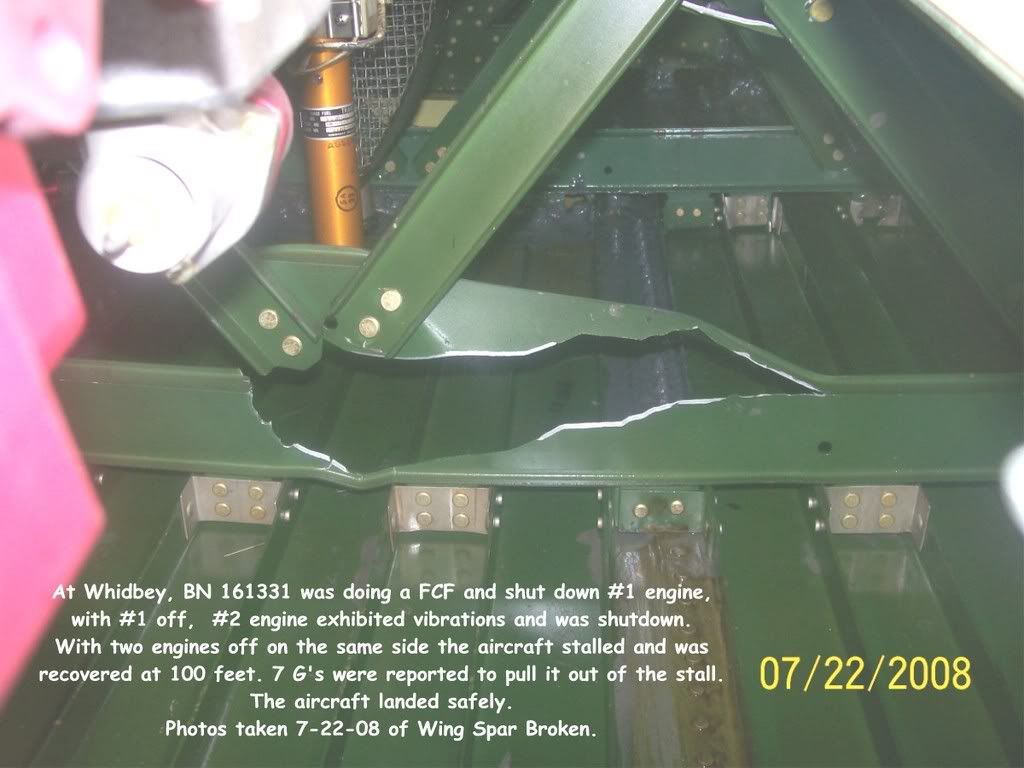
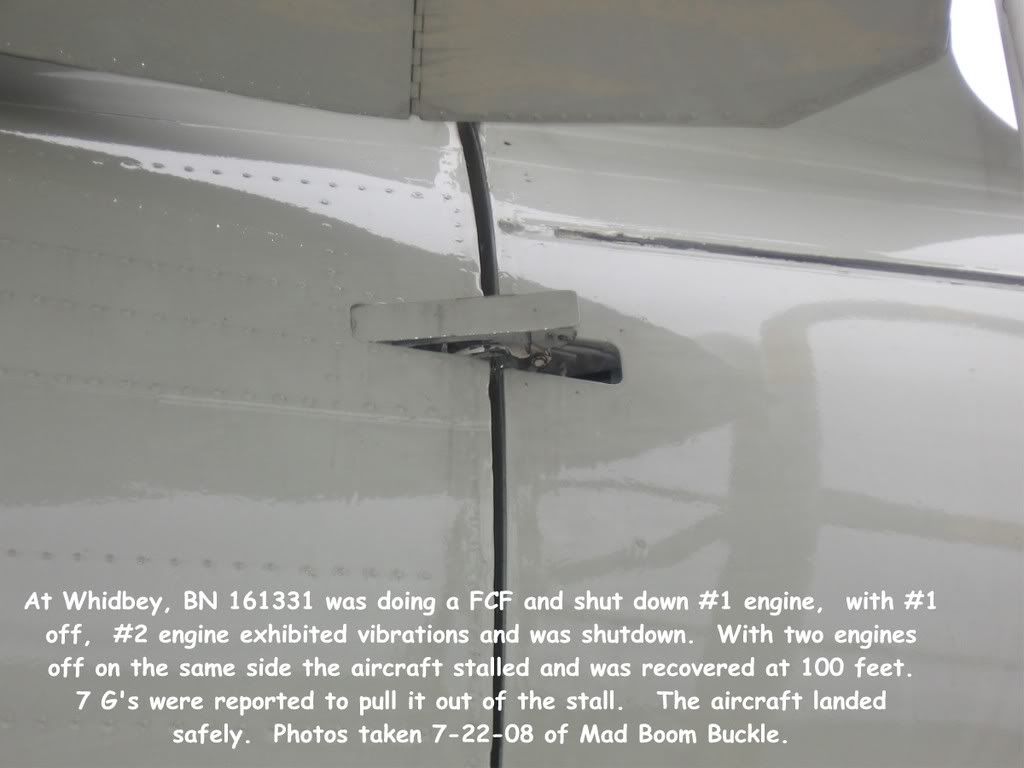
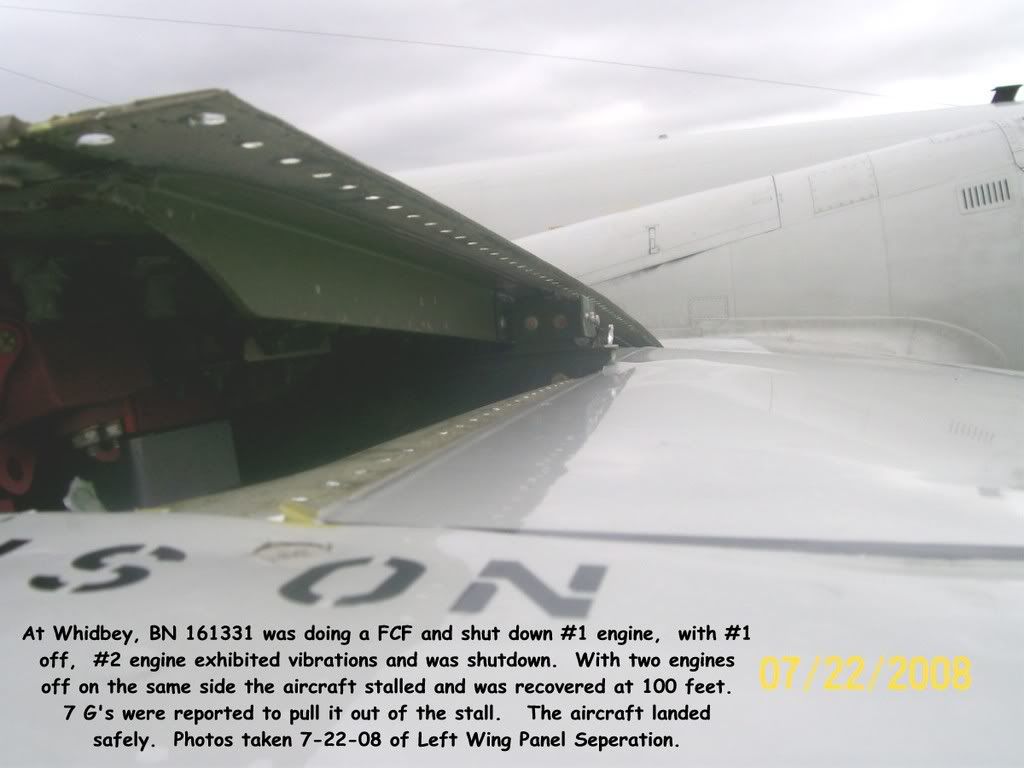
The P-3C that almost went into Puget Sound waters a few days ago was
>>> from NAS Whidbey.
>>>
>>> It was a CPW-10 aircraft being operated by VP-1.
>>>
>>> Squadrons don't own aircraft any more.
>>>
>>> The P-3 fleet has so deteriorated because of under-funding and over-use
>>> that there are less than 100 still flyable*.
>>>
>>> The P-3s belong to the wing and are "lent to the squadrons on an
>>> as-needed"
>>> basis.
>>>
>>> The mission was a NATOPS pilot check, with a CPW-10 pilot (LT) aboard, a
>>> VP-1 LT and LTJG, plus VP-1 aircrewmen that included two flight
>>> engineers.
>>>
>>> The word is that the crew finally recovered control of the aircraft
>>> about 100 feet above MSL by pulling 7 Gs.
>>>
>>> The bird was landed back at NASW.
>>>
>>> Max damage was sustained by the aircraft, including almost tearing off a
>>> wing.
>>>
>>> Aircraft BuNo 161331.
>>>
>>> My first thought is that this was a Vmc incident:
>>>
>>> At Whidbey, P-3C 161331 was doing a Functional Check Flight.
>>>
>>> They shut down #1 engine.
>>>
>>> With #1 off, #2 engine exhibited vibrations and was shutdown.
>>>
>>> With two engines off on the same side the aircraft stalled.
>>>
>>> 7 G's were reported to pull it out of the stall.
>>>
>>> 45 consecutive rivets were pulled out on the stbd wing during the 7 G
>>> pull out (rolling pull), after peaking at negative 2.4g's as well.
>>>
>>> They did five spin rotations from 5500 ft -- they bottomed out "between
>>> 50 and 200 ft."
>>>
>>> They could see the inside of the fuel tanks when they landed.
>>>
>>> They were at 160 KIAS, appr flaps during a prop fails to feather drill
>>> on #1 when #2 started surging.
>>>
>>> They bagged #2, but while doing so got to 122 KIAS.
>>>
>>> When they added power, they were way below VMC air, and departed.
>>>
>>> SDRS recorded the flaps being raised and the landing gear being cycled
>>> down and then back up.
>>>
>>> Aircraft released all the fuel in tank #3 when it appears that the seam
>>> between planks 3 and 4 split.
>>>
>>> Tank #4 also lost its fuel load when plank #1 separated from rest of the
>>> aircraft wing.
>>> from NAS Whidbey.
>>>
>>> It was a CPW-10 aircraft being operated by VP-1.
>>>
>>> Squadrons don't own aircraft any more.
>>>
>>> The P-3 fleet has so deteriorated because of under-funding and over-use
>>> that there are less than 100 still flyable*.
>>>
>>> The P-3s belong to the wing and are "lent to the squadrons on an
>>> as-needed"
>>> basis.
>>>
>>> The mission was a NATOPS pilot check, with a CPW-10 pilot (LT) aboard, a
>>> VP-1 LT and LTJG, plus VP-1 aircrewmen that included two flight
>>> engineers.
>>>
>>> The word is that the crew finally recovered control of the aircraft
>>> about 100 feet above MSL by pulling 7 Gs.
>>>
>>> The bird was landed back at NASW.
>>>
>>> Max damage was sustained by the aircraft, including almost tearing off a
>>> wing.
>>>
>>> Aircraft BuNo 161331.
>>>
>>> My first thought is that this was a Vmc incident:
>>>
>>> At Whidbey, P-3C 161331 was doing a Functional Check Flight.
>>>
>>> They shut down #1 engine.
>>>
>>> With #1 off, #2 engine exhibited vibrations and was shutdown.
>>>
>>> With two engines off on the same side the aircraft stalled.
>>>
>>> 7 G's were reported to pull it out of the stall.
>>>
>>> 45 consecutive rivets were pulled out on the stbd wing during the 7 G
>>> pull out (rolling pull), after peaking at negative 2.4g's as well.
>>>
>>> They did five spin rotations from 5500 ft -- they bottomed out "between
>>> 50 and 200 ft."
>>>
>>> They could see the inside of the fuel tanks when they landed.
>>>
>>> They were at 160 KIAS, appr flaps during a prop fails to feather drill
>>> on #1 when #2 started surging.
>>>
>>> They bagged #2, but while doing so got to 122 KIAS.
>>>
>>> When they added power, they were way below VMC air, and departed.
>>>
>>> SDRS recorded the flaps being raised and the landing gear being cycled
>>> down and then back up.
>>>
>>> Aircraft released all the fuel in tank #3 when it appears that the seam
>>> between planks 3 and 4 split.
>>>
>>> Tank #4 also lost its fuel load when plank #1 separated from rest of the
>>> aircraft wing.

 ... Blue line speed anybody?
  ... Seems like a very lucky "save"...
That info. came my way yesterday as well - suprised that a Google search didn't come up with anything further.
One imagines that it was rather a quiet flight home.......
One imagines that it was rather a quiet flight home.......
Join Date: Jul 2007
Location: North of Watford (Gap)
Age: 58
Posts: 403
Likes: 0
Received 0 Likes
on
0 Posts
I think the local congregation will have seen an increase in numbers in the last week or so! A religion-finding experience if ever there was one. I bet the local laundry saw a bit of an uptick too.
Great save - well done to the crew, but I assume the airframe will now be SOC?
Great save - well done to the crew, but I assume the airframe will now be SOC?
Join Date: Aug 2006
Location: UK
Age: 44
Posts: 24
Likes: 0
Received 0 Likes
on
0 Posts
Immediately after the incident (Well, within a few days) this was the official release from the US Naval Safety Center -
Mishap Date: 07/22/2008 Severity: A FM Time: 13:00 Evt Ser: 69798
Reference: VP-1 221300JUL08
Acft: P003C Count: Y Destroyed: N Major Command: COMNAVAIRPAC
Custodian: VP-1 Fatalities: 0 Buno: 161331
Location: WHIDBEY ISLAND
Summary: AIRCRAFT OVERSTRESSED DEPARTED CONTROLLED FLIGHT.
Mishap Date: 07/22/2008 Severity: A FM Time: 13:00 Evt Ser: 69798
Reference: VP-1 221300JUL08
Acft: P003C Count: Y Destroyed: N Major Command: COMNAVAIRPAC
Custodian: VP-1 Fatalities: 0 Buno: 161331
Location: WHIDBEY ISLAND
Summary: AIRCRAFT OVERSTRESSED DEPARTED CONTROLLED FLIGHT.


Join Date: Jul 2008
Location: Trentham Victoria Australia
Age: 54
Posts: 5
Likes: 0
Received 0 Likes
on
0 Posts
This is the most practiced sim scenario in the P3 world a problem with #2 with #1 loitered dealing with it should have been second nature.
Unless the vibrations on #2 were incredibly severe why didn't they restart #1 before shutting down #2 ?
How did they get so slow on three engines before shutting down #2?
If they were getting slow why didn't they restart #1.
What the &^%* were the Flight engineers doing ?
well done to the aeroplane for surviving being put into a situation it was not designed to be flown in.
More questions when I think of them.
Unless the vibrations on #2 were incredibly severe why didn't they restart #1 before shutting down #2 ?
How did they get so slow on three engines before shutting down #2?
If they were getting slow why didn't they restart #1.
What the &^%* were the Flight engineers doing ?
well done to the aeroplane for surviving being put into a situation it was not designed to be flown in.
More questions when I think of them.
Join Date: Feb 2006
Location: Hanging off the end of a thread
Posts: 32,892
Received 2,830 Likes
on
1,208 Posts
Glad to see they made it........ tin can be fixed or recycled...... people can't be.. 
Seem to remember a certain Tristar doing autoland when the system was off.... creaks and groans would probably be heard in Oxford when they moved that thing to base hangar AFTER it did a circuit........
Seem to remember a certain Tristar doing autoland when the system was off.... creaks and groans would probably be heard in Oxford when they moved that thing to base hangar AFTER it did a circuit........

Join Date: Jul 2006
Location: Australia
Posts: 312
Likes: 0
Received 0 Likes
on
0 Posts
Believe they pulled 7G, lost ov 5000ft and five complete rotaions.
But having pulled No 1 , why did they not set it up for air start, prior to pulling No 2.
What happened to the CRM, were two engineers on that aircraft, 4 sets of eyes and 4 mouths, should not have happened.
Regards
Col
But having pulled No 1 , why did they not set it up for air start, prior to pulling No 2.
What happened to the CRM, were two engineers on that aircraft, 4 sets of eyes and 4 mouths, should not have happened.
Regards
Col
Join Date: Sep 2007
Location: The World
Posts: 86
Likes: 0
Received 0 Likes
on
0 Posts
They were at 160 KIAS, appr flaps during a prop fails to feather drill
on #1 when #2 started surging.
on #1 when #2 started surging.
Join Date: Jul 2008
Location: Trentham Victoria Australia
Age: 54
Posts: 5
Likes: 0
Received 0 Likes
on
0 Posts
Ok so you have a prop failed to feather ,again a well practised and very common sim scenario, in that case why shut down #2 for surging if you are slow? Surging is not a mandatory shut down in a P3 , there are several things you could try to stop the surging Td system , prop govenor , mean while you have either got #1 to feather or set yourself up in a safe flight regime before you bag #2 They had at least 5000 ft so it still begs the question why they ended up slow with 2 engines shut down spinning towards the sea .
Join Date: Feb 2001
Location: UK
Posts: 150
Likes: 0
Received 0 Likes
on
0 Posts
Practise Assy!
Makes you wonder how sensible the 6 months practise assy currency rule is.
Seem to remember shutting down 4 engines in one sortie not that long ago!!! Increases the odds somewhat.
Seem to remember shutting down 4 engines in one sortie not that long ago!!! Increases the odds somewhat.
Thread Starter
One tough old Lockheed machine.........

An RAAF 707 also went down off the coast of East Sale, Victoria, Australia in 1991 after what was described as a "Sudden and extremely violent departure from controlled flight" during double assymetric training. All five crew were killed. It seems this is not a unique incident.
Join Date: Aug 2003
Location: Sale, Australia
Age: 80
Posts: 3,832
Likes: 0
Received 0 Likes
on
0 Posts
Trojan1981, the accident was caused by a combination of three factors,
namely, pilot induced overload in that the pilot exceeded the aircraft’s
operational limit of 3 g, manufacturing deficiency in that several wing leading
edge ribs were below the specified thickness, and under the conditions of the
accident, the onset of transonic compressibility effects that increased the
aerodynamic loads on the leading edges beyond the level that the sub - standard ribs could bear.
Notably, the ribs as designed had a failure point of 3.9 g and the below specification ribs had a failure point of 3.4 g. During the aircrafts design no allowance had been made for transonic compressibility effects. It was the compressibility effects that lead to the rib overload. Its ironic that a US Navy P-3 also had an identical LE failure (also at Cocos, must be some thing in the water there) 3 years previously, but landed safely. An opportunity lost to nail the problem?
Full report here
http://dspace.dsto.defence.gov.au/ds...-0008%20PR.pdf
namely, pilot induced overload in that the pilot exceeded the aircraft’s
operational limit of 3 g, manufacturing deficiency in that several wing leading
edge ribs were below the specified thickness, and under the conditions of the
accident, the onset of transonic compressibility effects that increased the
aerodynamic loads on the leading edges beyond the level that the sub - standard ribs could bear.
Notably, the ribs as designed had a failure point of 3.9 g and the below specification ribs had a failure point of 3.4 g. During the aircrafts design no allowance had been made for transonic compressibility effects. It was the compressibility effects that lead to the rib overload. Its ironic that a US Navy P-3 also had an identical LE failure (also at Cocos, must be some thing in the water there) 3 years previously, but landed safely. An opportunity lost to nail the problem?
Full report here
http://dspace.dsto.defence.gov.au/ds...-0008%20PR.pdf