


Future Carrier (Including Costs)

Join Date: Jul 2006
Location: by the Great Salt Lake, USA
Posts: 1,542
Likes: 0
Received 0 Likes
on
0 Posts
Modern Elmo... at least a year ago, there was a discussion on the MV-22's exhaust... the heating only became a problem when its engines were run at idle for more than 20 minutes or so in the same spot, or at full power for over 5 minutes in the same spot.
Initially, time restrictions for "same-spot running" were put in place, and portable "hot pads" used to protect the deck, but a permanent solution was soon developed.
The majority of the "fix" was to simply not run them for so long at the same angle (it was determined that adjusting the nacelles' angle a few degrees every few minutes greatly reduced the heating effect), and the rest was a new heat-resistant deck coating!
The MV-22 has been operationally deploying shipboard for at least a year now, with no noteworthy deck-heating issues.
Widger... "chained-down hull-power runs" on an F-35B will be conducted the same way they are for all other jet-powered aircraft on normal carriers... with the tail at (or just over) the deck-edge, pointing outboard!
The nozzle will only be directed down during these runs to verify correct functioning of the actuators, there will be no need to run them for any significant length of time while pointing down. This should be relatively simple to do with the tail extending past the flight deck... thus no worries about high-output exhaust blasting the deck coating or splashing out to injure nearby crewmen.
No worries about heat from the lift-fan... it blows unheated air!
Initially, time restrictions for "same-spot running" were put in place, and portable "hot pads" used to protect the deck, but a permanent solution was soon developed.
The majority of the "fix" was to simply not run them for so long at the same angle (it was determined that adjusting the nacelles' angle a few degrees every few minutes greatly reduced the heating effect), and the rest was a new heat-resistant deck coating!
The MV-22 has been operationally deploying shipboard for at least a year now, with no noteworthy deck-heating issues.
Widger... "chained-down hull-power runs" on an F-35B will be conducted the same way they are for all other jet-powered aircraft on normal carriers... with the tail at (or just over) the deck-edge, pointing outboard!
The nozzle will only be directed down during these runs to verify correct functioning of the actuators, there will be no need to run them for any significant length of time while pointing down. This should be relatively simple to do with the tail extending past the flight deck... thus no worries about high-output exhaust blasting the deck coating or splashing out to injure nearby crewmen.
No worries about heat from the lift-fan... it blows unheated air!

Question for knowledgable Harrier person: what is the standard procedure for a ski jump takeoff? Set jet exhaust horizontal, and mash down on the rudder pedals/brakes as the engine spins up to X percent of nominal full throttle? Do the brakes hold to 100 percent standard power?
You might want a proper pilot for SOP, but in terms of throttle/brakes after all the tailplane trim, duct pressure and IGV checks (and lots of other checks too, probably including seeing if anyone is showing you a green flag) it will be held on brakes at an above-idle but still not very high RPM with nozzles aft, watch the bows for deck motion in the unshakeable belief that ship motion is in some way predictable and that trying to time it somehow gives better results on average than just not bothering, then at an opportune moment slam to whatever full throttle gives (no dainty setting, just slam by feel to the full-throttle stop) and release the brakes when the jet starts to move as the RPM is racing through high numbers (typically in my experience after dragging the main gear for about 5ft). It may be a turbo-fan engine but it still spools-up very quickly between the previously referred to above-idle RPM and max.
Hopefully if that's too far away from the truth a Harrier pilot will be along to correct it. I can't be expected to remember everything that happened on ship trials.
Many years ago before Sharkey got his hands on a SHAR it was felt that the SHAR might want a hold-back device. The pilot could then wait until the engine got to 100+% Nf, have a leisurely check of everything and then go when happy. So way back then "my" jet was given a little button on top of the nozzle lever for commanding hold-back release (it never to my knowledge got the rest of the kit though), which lives on to this day in a certain flight simulator if anyone ever finds themselves in that sim and wonders about it. I don't know when the decision was taken to not bother with it for SHAR. Maybe someone mentioned that it would cost money so it just got overtaken by events.
That about sums it up, cant set more than about 60% without moving. Brakes will happily hold the main wheels in a fixed position but unfortunately the jet will then drag said wheels along the deck until you are off the end and airborne.
Which means beers for the maintainers who have to change your tyres, and beers for Wings who's not impressed with the 300 ft long double black stripe you've added to the deck markings.
I've watched the "trial". Mildly amusing. At least in a Harrier you can land again with shredded tyres without any tears.
Which means beers for the maintainers who have to change your tyres, and beers for Wings who's not impressed with the 300 ft long double black stripe you've added to the deck markings.
I've watched the "trial". Mildly amusing. At least in a Harrier you can land again with shredded tyres without any tears.
Elmo - I don't think A/B is an option. (1) it could be problematical as the nozzle is adjusted to let the LP turbine drive the lift-fan, and the engine fan stream is diverted to the roll posts. (2) The main nozzle gets tilted slightly down during the deck run, to offset the lift-fan's nose-up pitching moment enough to keep weight on the nosewheel. A/B would therefore result in something like this:

Join Date: Apr 2006
Location: Tullahoma TN
Posts: 482
Likes: 0
Received 0 Likes
on
0 Posts
LO, I expect that that the STOVL F-35 will NOT use its lift fan or any vectored thrust for a ship's deck departure.
//////////////////////////////////////
More questions about Harrier I or Harrier II:
Typical mission gross weight for ski jump takeoff was about how much?
For takeoff, flaps would be set to how many degrees?
True airspeed just after departing the ramp and becoming airborne would be approximately what?
What was the o-fficial appelation for the ski jump or ramp?
//////////////////////////////////////
More questions about Harrier I or Harrier II:
Typical mission gross weight for ski jump takeoff was about how much?
For takeoff, flaps would be set to how many degrees?
True airspeed just after departing the ramp and becoming airborne would be approximately what?
What was the o-fficial appelation for the ski jump or ramp?
ME - That's not what I have seen and researched.
Goes like this:
1 - STO starts with the core nozzle almost straight aft, with a little nose-down pitching moment to load the nosewheel and ensure effective steering.
2 - The pilot applies aft stick and the core nozzle and fan set the required nose-up pitch for liftoff. This can also be commanded by pushing a button on the stick, or done automatically after the pilot inputs a deck-roll distance.
3 - As soon as the weight is off the wheels the engine nozzles and aerodynamic surfaces combine to provide conventional handling responses.
4 - As the aircraft accelerates, the aerodynamic surfaces get more effective, the engine effectors become less active and the thrust points aft.
Once the jet is above stall speed, the pilot presses the conversion button. The reverse conversion takes about 10 seconds. The clutch re-engages to free the locks, which are pulled out, and the clutch backs away. The core nozzle rolls up and is locked in full-aft position, and when the lift fan has spun down the STOVL doors are closed.
Goes like this:
1 - STO starts with the core nozzle almost straight aft, with a little nose-down pitching moment to load the nosewheel and ensure effective steering.
2 - The pilot applies aft stick and the core nozzle and fan set the required nose-up pitch for liftoff. This can also be commanded by pushing a button on the stick, or done automatically after the pilot inputs a deck-roll distance.
3 - As soon as the weight is off the wheels the engine nozzles and aerodynamic surfaces combine to provide conventional handling responses.
4 - As the aircraft accelerates, the aerodynamic surfaces get more effective, the engine effectors become less active and the thrust points aft.
Once the jet is above stall speed, the pilot presses the conversion button. The reverse conversion takes about 10 seconds. The clutch re-engages to free the locks, which are pulled out, and the clutch backs away. The core nozzle rolls up and is locked in full-aft position, and when the lift fan has spun down the STOVL doors are closed.
More questions about Harrier I or Harrier II:
Typical mission gross weight for ski jump takeoff was about how much?
About 30-32000lb ish
For takeoff, flaps would be set to how many degrees?
Flaps are at 25deg then schedule with nozzle rotation in STOL mode - if say 40noz used flaps move to 40ish degrees ,if max noz - 55noz is used (when lightweight) flaps will move all the way down to 62deg.
True airspeed just after departing the ramp and becoming airborne would be approximately what?
Say 85-95 kts, but its AOA that counts - should have been 12units.
What was the o-fficial appelation for the ski jump or ramp?
If you mean angle it was 12 degrees (started with lower angles when first introduced)
For each launch there would be a maximum and minimum launch distance- minimum is closest you could be to the ramp and still achieve safe launch speed on ramp exit, maximum is furthest away the jet could be and still safely hit the ramp profile without damaging itself. If very heavy there were times when min distance reqd exceeded maximum distance allowed - here you would have to defuel to reduce launch weight, or increase wind over the deck to reduce min distance required. At least this was always possible unlike on land, just burnt lots of ship fuel and made the old girl shake a bit..
Airspeed on ramp exit was of no real interest. You just needed to know max and min distances and nozzle rotate angle and tailplane trim. On ramp exit you captured the AOA and nozzled out towards the end of the ballistic phase as IAS built to sustain wingborne flight.
The ODM would calculate launch distances based on a Datum Launch Speed. Margins below datum were then used based on temperature and fit state. Counter-intuitively if very lightweight you werent allowed to go much below datum, whereas if you were heavy with jettisonable stores or the option of using water you could launch significantly below the datum as you had lots of ways of improving performance if you had a bad go.
It really was the gentlemans way to get airborne and was not a difficult technique - however when it went wrong it could go wrong very quickly.
Typical mission gross weight for ski jump takeoff was about how much?
About 30-32000lb ish
For takeoff, flaps would be set to how many degrees?
Flaps are at 25deg then schedule with nozzle rotation in STOL mode - if say 40noz used flaps move to 40ish degrees ,if max noz - 55noz is used (when lightweight) flaps will move all the way down to 62deg.
True airspeed just after departing the ramp and becoming airborne would be approximately what?
Say 85-95 kts, but its AOA that counts - should have been 12units.
What was the o-fficial appelation for the ski jump or ramp?
If you mean angle it was 12 degrees (started with lower angles when first introduced)
For each launch there would be a maximum and minimum launch distance- minimum is closest you could be to the ramp and still achieve safe launch speed on ramp exit, maximum is furthest away the jet could be and still safely hit the ramp profile without damaging itself. If very heavy there were times when min distance reqd exceeded maximum distance allowed - here you would have to defuel to reduce launch weight, or increase wind over the deck to reduce min distance required. At least this was always possible unlike on land, just burnt lots of ship fuel and made the old girl shake a bit..
Airspeed on ramp exit was of no real interest. You just needed to know max and min distances and nozzle rotate angle and tailplane trim. On ramp exit you captured the AOA and nozzled out towards the end of the ballistic phase as IAS built to sustain wingborne flight.
The ODM would calculate launch distances based on a Datum Launch Speed. Margins below datum were then used based on temperature and fit state. Counter-intuitively if very lightweight you werent allowed to go much below datum, whereas if you were heavy with jettisonable stores or the option of using water you could launch significantly below the datum as you had lots of ways of improving performance if you had a bad go.
It really was the gentlemans way to get airborne and was not a difficult technique - however when it went wrong it could go wrong very quickly.
Join Date: Apr 2006
Location: Tullahoma TN
Posts: 482
Likes: 0
Received 0 Likes
on
0 Posts
Thank you, Sammy Su.
As to the official name of a though deck cruiser's ski jump, if the USN had one of those, NAVAIR would call it something inscrutable.
The basic purpose of the ramp, or rose by any other name-- is it to increase the aircraft's angle of attack? ... Rather similar functional effect to the old F-8 Crusader's Variable Incidence Wing. This was a high wing fighter with a jackscrew mechanism to pitch the wing's angle of incidence up from the fuselage during takeoff and landing.
Returning to the STOVL F-35, the rear exhaust nozzle probably stays horizontal during takeoff roll and rotation into flight.
Maybe the lift fan supplies just enough thrust at the appropriate angle as the aircraft departs the deck to pitch the aircraft up to a higher angle of attack, while the rear nozzle stays horizontal?
As to the official name of a though deck cruiser's ski jump, if the USN had one of those, NAVAIR would call it something inscrutable.
The basic purpose of the ramp, or rose by any other name-- is it to increase the aircraft's angle of attack? ... Rather similar functional effect to the old F-8 Crusader's Variable Incidence Wing. This was a high wing fighter with a jackscrew mechanism to pitch the wing's angle of incidence up from the fuselage during takeoff and landing.
Returning to the STOVL F-35, the rear exhaust nozzle probably stays horizontal during takeoff roll and rotation into flight.
Maybe the lift fan supplies just enough thrust at the appropriate angle as the aircraft departs the deck to pitch the aircraft up to a higher angle of attack, while the rear nozzle stays horizontal?
Last edited by Modern Elmo; 24th Jul 2011 at 02:49.
No Elmo, the basic purpose of the ramp is to effectively increase the length of the ships deck by giving you some more runway in the sky. By throwing the aircraft into the air the ramp launch involves a ballistic phase where you are still too slow to fly, whilst following the ballistic trajectory and hopefully prior to hitting the sea you are utilising this extra time to allow the aircraft to accelerate to a forward speed where the wing is generating enough lift to then stay airborne.
In a Harrier II the ballistic phase was minimal unless very heavy, and the required speed for enough winglift was low thanks to it's efficiency. Airspeeds were lower than STOBAR aircraft like Mig29K as you were also able to provide a jet lift component to the equation but the principle of ramp providing a ballistic throw to allow the aircraft extra "deck"'to accelerate to flying speed is the same to all.
In a Harrier II the ballistic phase was minimal unless very heavy, and the required speed for enough winglift was low thanks to it's efficiency. Airspeeds were lower than STOBAR aircraft like Mig29K as you were also able to provide a jet lift component to the equation but the principle of ramp providing a ballistic throw to allow the aircraft extra "deck"'to accelerate to flying speed is the same to all.
Join Date: Aug 2007
Location: Southampton
Age: 54
Posts: 144
Likes: 0
Received 0 Likes
on
0 Posts
It is worth noting that Cmdr Taylor's original thesis which lead to the ski jump ramp was called 'The Runway In The Sky' because as Sammy has just said that is exactly what it does. The aircraft isn't actually 'flying' on it's wings until it reaches for example 130+ knots, but that would require a flight deck in excess of 1500 ft in length for some types. The ramp throws the aircraft into the air long before it is truly flying and buys it time to continue accelerating to full flying speed, due to the ballistic component. It also buys the pilot time in case of an emergency such as engine failure to decide to eject, many more vital seconds than if launched from a flat deck (either by cat shot or rolling free takeoff as on a rampless USN LHA/LHD). It is giving you an extra 500+ feet of 'virtual' runway made of air, for free. Not often you get a bargain like that!
Join Date: Apr 2006
Location: Tullahoma TN
Posts: 482
Likes: 0
Received 0 Likes
on
0 Posts
"Ballistic phase" and "runway in the sky" -- I dunno about that. "Runway in the sky" sounds like public relations aimed at passengers.
A ballistic projectile is an object initially projected upward in a gravitational field which cannot develop enough lift to significantly depart from a parabolic trajectory. A Medieval catapult throws stones into a ballistic trajectory.
"Transiently developing insufficient lift" might be a more accurately describe a Harrier's state shortly after departing the ramp. All right, if you insist, we can could call that a "ballistic phase."
One's Harrier needs to take off with as much kinetic energy as possible. Climbing the ramp makes the airplane lose some kinetic energy, compared to a Harrier takeoff roll for a distance equal to same ski jump approach deck run plus ramp length lowered to horizontal.
A Medieval catapult throws stones into a ballistic trajectory by transferring kinetic energy to the stones. A ramp for Harrier takeoffs is not a catapult. The Harrier loses some k.e. as the Harrier climbs the ramp.
Pitching the aircraft up roughly ten degrees relative to any wind over deck also increases form drag and skin drag slightly. Also, the airplane's momentum increases weight on wheels and therefore rolling resistance during the climb up the ramp.
If the goal is only to have as much kinetic energy as possible just after weight is no longer on wheels, one is better off taking off from a horizontal deck with no ramp, assuming the deck is high enough above the sea to allow recovery from an almost stalled condition.
One might also say that the ski jump or ramp trades kinetic energy for potential energy. However, I don't see the point in merely trading p.e. for k.e during Harrier takeoff, if no other benefit is achieved. Following this logic, an improved Invincible class should have had the entire aviation deck raised to the height of the top of the ramp, so as to gain potential energy without sacrificing kinetic energy for a Harrier's ballistic leap onto that runway in the sky.
As far as being higher above the water giving one more time to eject, I'm not sure that that there'd be significant difference in time until water impact, if one has traded (ramp length)*sin( 10 deg) of p.e. for (ramp length )*(cos 10 deg) of k.e., assuming the aircraft is developing some lift in both cases.
Remember, a stalled aircraft does not actually drop like a stone.
Sorry, but I think the ramp helps by pitching up the Harrier's wing to a higher angle of attack and therefore a bigger lift coefficient; a higher aoa than the airplane could achieve without the ramp during takeoff rotation. This rotation to higher aoa compensates for the shorter deck roll allowed by an Invincible-class, even though the ramp takeoff trades away some kinetic energy.
//////////////////
The aircraft isn't actually 'flying' on it's wings until it reaches for example 130+ knots, but that would require a flight deck in excess of 1500 ft in length for some types.
What types are those?
How do AV-8B's operate off 844 foot long WASP-class ships? My supposition is that AV-8B's depart the deck with their wings at a lower angle of attack and therefore with a smaller lift coefficient just after departing the ramp, compared to the aoa of a Harrier II taking off from an Invincible-class. However, the AV-8B is compensated by departing a Wasp's deck after a longer roll and therefore with more kinetic energy for that "ballistic phase" and "runway in the sky."
The ski jump cleverly and smartly compensates for a shorter deck roll.
A ballistic projectile is an object initially projected upward in a gravitational field which cannot develop enough lift to significantly depart from a parabolic trajectory. A Medieval catapult throws stones into a ballistic trajectory.
"Transiently developing insufficient lift" might be a more accurately describe a Harrier's state shortly after departing the ramp. All right, if you insist, we can could call that a "ballistic phase."
One's Harrier needs to take off with as much kinetic energy as possible. Climbing the ramp makes the airplane lose some kinetic energy, compared to a Harrier takeoff roll for a distance equal to same ski jump approach deck run plus ramp length lowered to horizontal.
A Medieval catapult throws stones into a ballistic trajectory by transferring kinetic energy to the stones. A ramp for Harrier takeoffs is not a catapult. The Harrier loses some k.e. as the Harrier climbs the ramp.
Pitching the aircraft up roughly ten degrees relative to any wind over deck also increases form drag and skin drag slightly. Also, the airplane's momentum increases weight on wheels and therefore rolling resistance during the climb up the ramp.
If the goal is only to have as much kinetic energy as possible just after weight is no longer on wheels, one is better off taking off from a horizontal deck with no ramp, assuming the deck is high enough above the sea to allow recovery from an almost stalled condition.
One might also say that the ski jump or ramp trades kinetic energy for potential energy. However, I don't see the point in merely trading p.e. for k.e during Harrier takeoff, if no other benefit is achieved. Following this logic, an improved Invincible class should have had the entire aviation deck raised to the height of the top of the ramp, so as to gain potential energy without sacrificing kinetic energy for a Harrier's ballistic leap onto that runway in the sky.
As far as being higher above the water giving one more time to eject, I'm not sure that that there'd be significant difference in time until water impact, if one has traded (ramp length)*sin( 10 deg) of p.e. for (ramp length )*(cos 10 deg) of k.e., assuming the aircraft is developing some lift in both cases.
Remember, a stalled aircraft does not actually drop like a stone.
Sorry, but I think the ramp helps by pitching up the Harrier's wing to a higher angle of attack and therefore a bigger lift coefficient; a higher aoa than the airplane could achieve without the ramp during takeoff rotation. This rotation to higher aoa compensates for the shorter deck roll allowed by an Invincible-class, even though the ramp takeoff trades away some kinetic energy.
//////////////////
The aircraft isn't actually 'flying' on it's wings until it reaches for example 130+ knots, but that would require a flight deck in excess of 1500 ft in length for some types.
What types are those?
How do AV-8B's operate off 844 foot long WASP-class ships? My supposition is that AV-8B's depart the deck with their wings at a lower angle of attack and therefore with a smaller lift coefficient just after departing the ramp, compared to the aoa of a Harrier II taking off from an Invincible-class. However, the AV-8B is compensated by departing a Wasp's deck after a longer roll and therefore with more kinetic energy for that "ballistic phase" and "runway in the sky."
The ski jump cleverly and smartly compensates for a shorter deck roll.
Last edited by Modern Elmo; 25th Jul 2011 at 04:35.
Elmo:
It kinda looks like you are arguing against a bunch of Harrier dudes who rarely take their eye off the alpha indication in the HUD during a ski-jump assisted departure...
Sorry, but I think the ramp helps by pitching up the Harrier's wing to a higher angle of attack and therefore a bigger lift coefficient; a higher aoa than the airplane could achieve without the ramp during takeoff rotation.
Join Date: Apr 2006
Location: Tullahoma TN
Posts: 482
Likes: 0
Received 0 Likes
on
0 Posts
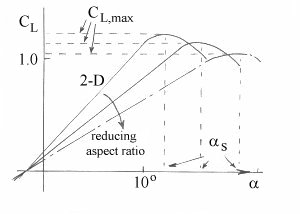
Source: aerodynamic lift
I was long-winded last night. Too wordy.
Check this graph. Notice that CsubL is at or near its maximum at alpha = 10 degrees. The three different curves are for different aspect ratios.
Harrier ramps are inclined at a ten degree angle, I think. And the Admiral Kuznetsov had a twelve degree ramp(?). The idea is to rotate the wing to its maximum CsubL.
....
I believe that there's a movie from the early 1950's titled Highway in the Sky, starring John Wayne as an heroic DC-3 pilot.
Last edited by Modern Elmo; 25th Jul 2011 at 19:04.
Harrier ramps are inclined at a ten degree angle, I think
Whether you like it or not, the ski-jump principle is basically about partially-ballistic trajectories giving "runway in the sky" to use to accelerate to a speeds where >+1g Nz is available. Your basic sums are wrong, as the ramps are curved in profile rather than straight as suggested by your simple trigonometry. I've walked up more than one, but find some pictures on the internet if you want evidence. Some KE is traded off on the way up the ramp, but nowhere near as much as you think bearing in mind the ramp length and *exit* angle (entry angle is zero). You are correct that rolling resistance increases on the ramp, but that is trivial and I can't remember it ever being accounted for in any performance calculations I've seen. What matters far more is the upward component of velocity at ramp exit. As an additional benefit, this also means that even if the engine misbehaved when leaving the ramp, the aircraft would have signficantly more time in the air than the equivalent situation with a flat-deck launch. Significant in terms of time for stores-jettison, engine limiter-tripping and/or ejection anyway)
You should probably have a look at how flightpath angle, pitch angle and angle of attack are related, as you seem to be confused about that too. Ever wondered why Harriers on the ground have a marked nose-up attitude (assuming the nose-gear oleo is correctly pressurised, which in many static museum examples is not the case)?
What types are those?
Join Date: Apr 2006
Location: Tullahoma TN
Posts: 482
Likes: 0
Received 0 Likes
on
0 Posts
OK, I'm not that good at old movies. The John Wayne film is *Island in the Sky.* *No Island in the Sky* stars Jimmy Stewart. The Labrador overlap in these movies got me confused.
Island in the Sky (1953)
With John Wayne, Lloyd Nolan, Walter Abel, James Arness. A transport plane crash-lands in the frozen wastes of Labrador, and the plane's pilot, Dooley, must …
No Highway in the Sky
From Wikipedia, the free encyclopedia
No Highway in the Sky
...
Distributed by 20th Century Fox
Release date(s) 28 June 1951
September 21, 1951
Country UK
Language English
No Highway in the Sky is a 1951 British disaster film (aka: No Highway) directed by Henry Koster and starring James Stewart and Marlene Dietrich. ...
The film follows Theodore Honey (James Stewart), a highly eccentric "boffin" with the Royal Aircraft Establishment. A widower with a precocious young daughter, Elspeth (Janette Scott), Honey is sent from Farnborough to investigate the crash of a "Reindeer" airliner in Labrador, which he theorizes occurred because of a structural failure in the tail caused by sudden metal fatigue. ...
Island in the Sky (1953)
With John Wayne, Lloyd Nolan, Walter Abel, James Arness. A transport plane crash-lands in the frozen wastes of Labrador, and the plane's pilot, Dooley, must …
No Highway in the Sky
From Wikipedia, the free encyclopedia
No Highway in the Sky
...
Distributed by 20th Century Fox
Release date(s) 28 June 1951
September 21, 1951
Country UK
Language English
No Highway in the Sky is a 1951 British disaster film (aka: No Highway) directed by Henry Koster and starring James Stewart and Marlene Dietrich. ...
The film follows Theodore Honey (James Stewart), a highly eccentric "boffin" with the Royal Aircraft Establishment. A widower with a precocious young daughter, Elspeth (Janette Scott), Honey is sent from Farnborough to investigate the crash of a "Reindeer" airliner in Labrador, which he theorizes occurred because of a structural failure in the tail caused by sudden metal fatigue. ...
Thread Starter
Progress is been made with construction - the first(?) super block has been safely transported to Rosyth.
This 8,000-tonne segment – Lower Block 03 to give it its official title – of the ship was towed 600 miles around the Scottish coast from one great artery, the Clyde, to another, the Forth, during a five-day operation. It safely arrived early on Saturday evening.
It took shipwrights at BAE Systems’ Govan yard two years to complete the section, which is more than 20 metres (65ft) high, 60 metres (196ft) long and 40 metres (131ft) wide. In addition to machinery spaces, it contains cabins for more than 150 members of the ship’s company and part of the vast hangar.
Lower Block 03 is the latest section of the 65,000-tonne warship to be built in six shipyards around the UK and transported to the Forth.
One of the largest cranes in the UK – its span is 120m (393ft) and it’s 68m (223ft) to the underside of the main beam – Goliath has been assembled in Rosyth to move sections of Queen Elizabeth and Prince of Wales weighing up to 1,000 tonnes each. It’s due to be ready to start work next month.
And here is another one, built on the Tyne.
YOU wait three years for Britain’s next generation aircraft carrier to take shape and then two massive sections are finished in a week…
Just days after the largest segment yet of HMS Queen Elizabeth was towed up the Forth, another huge section of the ship has been unveiled down the East Coast on Tyneside.
The carrier’s hangar was turned into a function room for an official reception to celebrate the completion of Centre Block 03, a 3,000-tonne piece of the carrier which comprises some of its flight deck and cavernous hangar among other compartments.
The 63-metre-long (206ft) block stands six metres (20ft) tall and is 40 metres (131ft) wide. It’s taken 18 months and half a million man hours to complete – and was finished five weeks ahead of schedule by shipwrights at A&P in Hebburn, the last yard on the Tyne building warships.
A&P won a £55m order to build segments of Queen Elizabeth and her sister Prince of Wales – it’s one of six yards involved in the mammoth shipbuilding programme.
Meanwhile: Ministers reconsider mothballing carrier

This 8,000-tonne segment – Lower Block 03 to give it its official title – of the ship was towed 600 miles around the Scottish coast from one great artery, the Clyde, to another, the Forth, during a five-day operation. It safely arrived early on Saturday evening.
It took shipwrights at BAE Systems’ Govan yard two years to complete the section, which is more than 20 metres (65ft) high, 60 metres (196ft) long and 40 metres (131ft) wide. In addition to machinery spaces, it contains cabins for more than 150 members of the ship’s company and part of the vast hangar.
Lower Block 03 is the latest section of the 65,000-tonne warship to be built in six shipyards around the UK and transported to the Forth.
One of the largest cranes in the UK – its span is 120m (393ft) and it’s 68m (223ft) to the underside of the main beam – Goliath has been assembled in Rosyth to move sections of Queen Elizabeth and Prince of Wales weighing up to 1,000 tonnes each. It’s due to be ready to start work next month.
And here is another one, built on the Tyne.
YOU wait three years for Britain’s next generation aircraft carrier to take shape and then two massive sections are finished in a week…
Just days after the largest segment yet of HMS Queen Elizabeth was towed up the Forth, another huge section of the ship has been unveiled down the East Coast on Tyneside.
The carrier’s hangar was turned into a function room for an official reception to celebrate the completion of Centre Block 03, a 3,000-tonne piece of the carrier which comprises some of its flight deck and cavernous hangar among other compartments.
The 63-metre-long (206ft) block stands six metres (20ft) tall and is 40 metres (131ft) wide. It’s taken 18 months and half a million man hours to complete – and was finished five weeks ahead of schedule by shipwrights at A&P in Hebburn, the last yard on the Tyne building warships.
A&P won a £55m order to build segments of Queen Elizabeth and her sister Prince of Wales – it’s one of six yards involved in the mammoth shipbuilding programme.
Meanwhile: Ministers reconsider mothballing carrier
Last edited by WE Branch Fanatic; 28th Aug 2011 at 18:28.
In other news:
Navy Official Questions Need For JSF Variants | AVIATION WEEK
The problem is that the three US customers have different views of the JSF.
For the Marines, it is existential: they desperately do not want to rely on carrier support, and their current doctrine calls for their amphibious fleet to be autonomous and self-supporting. They are also very powerful politically.
Of all the US services, the Navy gains least from JSF. They have a pretty capable aircraft in production, with some development potential.
The USAF wants the F-35, but has so many on the books that it could afford to trim back if it had to and buy a few F-15s and F-16s.
The run-up to the Defense Acquisition Board review will be interesting.
Navy Official Questions Need For JSF Variants | AVIATION WEEK
The problem is that the three US customers have different views of the JSF.
For the Marines, it is existential: they desperately do not want to rely on carrier support, and their current doctrine calls for their amphibious fleet to be autonomous and self-supporting. They are also very powerful politically.
Of all the US services, the Navy gains least from JSF. They have a pretty capable aircraft in production, with some development potential.
The USAF wants the F-35, but has so many on the books that it could afford to trim back if it had to and buy a few F-15s and F-16s.
The run-up to the Defense Acquisition Board review will be interesting.
Join Date: Jan 2011
Location: uk
Posts: 91
Likes: 0
Received 0 Likes
on
0 Posts
Sailors should stick to buying ships
And that is the problem when one Service becomes blinded by the desire to own a Carrier at any cost. This is not just MoD officials; there are many RN retirees who are pushing this mantra (Sharkey for one). The (Portsmouth) News always seems to have an RN slant on any story and the local MP won’t be far behind.
There are two very important issues at stake here rather than just having a stealthy day one entry aircraft (although any change of heart in the US will obviously impact on all other customers):
If we didn’t buy it, three things would happen as a consequence:
I urge anyone to think this through, the consequences are far worse than just some tactical disadvantage or cost cutting for the MoD budget – it will completely affect our strategic relationships and our tax receipts.
Now that will make the politicians sit up!
There are two very important issues at stake here rather than just having a stealthy day one entry aircraft (although any change of heart in the US will obviously impact on all other customers):
If we didn’t buy it, three things would happen as a consequence:
- The UK work share would be under huge threat and the revenue that is currently being banked by HMT could be lost – there are many 10s of Billions at stake here in inward UK investment.
- We will be consigned to the second division if all other customers purchase. We will break away with our new French chums and sit firmly nt eh 4th Generation 2nd Division.
- You can kiss buy to any pretence of the “Special relationship”.
- The valid reason is the real problem of a lack of airborne refuelling capability – you might be able to take risk with STOVL but conventional aircraft need the option. A F35 tanker looks prohibitive and a mini fleet of Hornet tankers will be a disproportionate, additional cost.
- The dodgy one is that they believe that they can revitalise their claim to own the capability through their attempts at a large US exchange programme for their FAA aircrew over the coming years (although this has come under scrutiny now).
I urge anyone to think this through, the consequences are far worse than just some tactical disadvantage or cost cutting for the MoD budget – it will completely affect our strategic relationships and our tax receipts.
Now that will make the politicians sit up!