


Crash Witering Woods sometime 1950s/60s

Thread Starter
Join Date: Dec 2003
Location: North East England
Posts: 172
Likes: 0
Received 0 Likes
on
0 Posts
Crash Wittering Woods sometime 1950s/60s
Hello, I can't find anything on Google about this, so wonder if anyone here can help.
As a child I used to visit family in Wittering village during the 1970s. From their back window which faced what I called Wittering Woods, you could see a clearing in the tree line where i was told a jet crashed sometime before I was born.
I have a memory of being out walking and shown a clearing in woodland where the accident happened.
Bear in mind I was very small at the time, and my unlce who told me about it has been dead many years.
The only crash I can find is a Valiant in 1960 at a disused air strip near Harrington. Its the right direction, but Google suggests it didn't crash into woodland. I have had a look at Google earth and if there is evidence of a crash there, I can't see it. Looks like the airfield was turned back to agriculture.
What I do remember was a gap in the tree line and a clearing. Is it my mind playing tricks perhaps?
Does anyone have info on the Wittering Woods crash?
As a child I used to visit family in Wittering village during the 1970s. From their back window which faced what I called Wittering Woods, you could see a clearing in the tree line where i was told a jet crashed sometime before I was born.
I have a memory of being out walking and shown a clearing in woodland where the accident happened.
Bear in mind I was very small at the time, and my unlce who told me about it has been dead many years.
The only crash I can find is a Valiant in 1960 at a disused air strip near Harrington. Its the right direction, but Google suggests it didn't crash into woodland. I have had a look at Google earth and if there is evidence of a crash there, I can't see it. Looks like the airfield was turned back to agriculture.
What I do remember was a gap in the tree line and a clearing. Is it my mind playing tricks perhaps?
Does anyone have info on the Wittering Woods crash?
Last edited by tyne; 2nd Sep 2012 at 14:28.

The Valiant crash to which you refer was probably the one at Spanhoe, which is documented elsewhere on this site.
There was a brand new Victor that went in after take-off about 3 1/2 miles east north east of Wittering on 20 Mar 63 but there were other aircraft as well. I guess this crash is 180 degrees out from your recollection
Please can you refine the timescale here. What year were you born and hence what is the likely timescale for this accident, if you were visiting in the '70s. The Victor at Cottesmore on 14 Jun 62 is also not a contender but we could be looking at a completely different era. For example, the USAAF had bases in this area and my maps show clearings in Collyweston Great Wood but nothing in Bedford Purlieus. Kings Cliffe, Ketton and North Luffenham could all have contributed to an accident in this area, so are you certain it was a Wittering aircraft, rther than somebody elses?
Old Duffer
There was a brand new Victor that went in after take-off about 3 1/2 miles east north east of Wittering on 20 Mar 63 but there were other aircraft as well. I guess this crash is 180 degrees out from your recollection
Please can you refine the timescale here. What year were you born and hence what is the likely timescale for this accident, if you were visiting in the '70s. The Victor at Cottesmore on 14 Jun 62 is also not a contender but we could be looking at a completely different era. For example, the USAAF had bases in this area and my maps show clearings in Collyweston Great Wood but nothing in Bedford Purlieus. Kings Cliffe, Ketton and North Luffenham could all have contributed to an accident in this area, so are you certain it was a Wittering aircraft, rther than somebody elses?
Old Duffer
Thread Starter
Join Date: Dec 2003
Location: North East England
Posts: 172
Likes: 0
Received 0 Likes
on
0 Posts
Hello Old Duffer, thanks for your reply.
I was born in 1970, and visited my aunt and uncle in Wittering up to the age of 9, when they moved to Stamford.
The house was on Church Road - I think it may have been called Church Lane at the time. From memory the back of the house faced West and you could see woods in the distance beyond a near row of houses. I recall at "V" sort of break in trees which is what I was told was a crash site.
Bearing in mind, by family had lived in the house since I guess the late 1940s, it could have been any time then. I am fairly sure the aircraft was a jet, and recall my uncle showing me a picture of a similar aircraft in one of his books. The impression I got was that the crash happened before i was born but after the war.
Sadly I am not in close touch with my uncle's Son's so can't easily get more information. I do however remember my cousin (He was born in 1950) telling me of some sort of crash in the area during the late 50's where there was some sort of big panic. They were given a talk at school about the crash and told not to touch any debris or anything they found on the ground in the area and to go straight to the police, or someone in the RAF.
This may be a completely unrelated incident, but by the level of security displayed, the incident my cousin describes suggests an aircraft carrying something sensitive may have gone in somewhere near the village.
Sorry I can't be more specific. There must have been many sad and tragic accidents at or near Wittering over the years.
*I met a chap who later lost his life there in a Harrier about 10 years ago.
I was born in 1970, and visited my aunt and uncle in Wittering up to the age of 9, when they moved to Stamford.
The house was on Church Road - I think it may have been called Church Lane at the time. From memory the back of the house faced West and you could see woods in the distance beyond a near row of houses. I recall at "V" sort of break in trees which is what I was told was a crash site.
Bearing in mind, by family had lived in the house since I guess the late 1940s, it could have been any time then. I am fairly sure the aircraft was a jet, and recall my uncle showing me a picture of a similar aircraft in one of his books. The impression I got was that the crash happened before i was born but after the war.
Sadly I am not in close touch with my uncle's Son's so can't easily get more information. I do however remember my cousin (He was born in 1950) telling me of some sort of crash in the area during the late 50's where there was some sort of big panic. They were given a talk at school about the crash and told not to touch any debris or anything they found on the ground in the area and to go straight to the police, or someone in the RAF.
This may be a completely unrelated incident, but by the level of security displayed, the incident my cousin describes suggests an aircraft carrying something sensitive may have gone in somewhere near the village.
Sorry I can't be more specific. There must have been many sad and tragic accidents at or near Wittering over the years.
*I met a chap who later lost his life there in a Harrier about 10 years ago.
Join Date: Aug 2007
Location: Bedford
Posts: 412
Likes: 0
Received 0 Likes
on
0 Posts
Tyne,
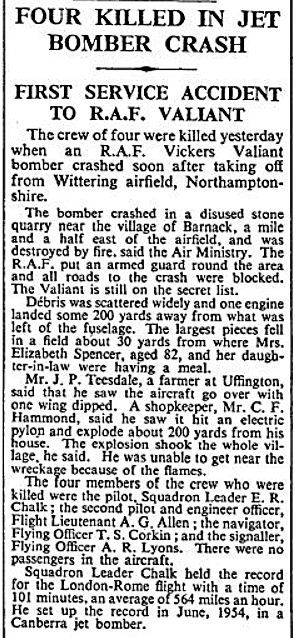
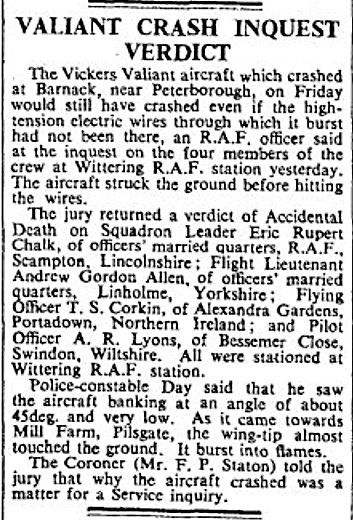
I think I can help here. There were 3 accidents at Barnack near Stamford . 16.8.54 Canberra WH873 of 76 Sqdn Hit trees bordering Burghley Park 500 yds from the approach path. 29.7.55 Valiant WP222 of 138 Sqdn crashed after take off Barnack.
"Apart from the aforementioned display flying, the main thrust of the early flying programme was engine trials of the Avon engines. Toward the end of July in particular, the ORB notes that flying was concentrated on WP222, with it being flown by all the crews. However, as is now well documented, on the morning of 29th July, WP 222 crashed at Barnock, shortly after take off in an easterly direction. The accident enquiry concluded that a runaway aileron trim tab actuator caused the accident. The aircraft banked to port at 60 degrees before it struck the ground and exploded. It has been said that on early Valiants the trim switch was very close to the ‘press to talk’ VHF button and it might have been inadvertently actuated by one of the pilots. However, the court of enquiry concluded that the runaway was caused by a short circuit in the electrical supply to the trim tab actuator. Subsequently, steps were taken to ensure that the trim tab travel was limited on all aircraft. S/Ldr Chalk and his crew were buried with due ceremony in the Wittering Village Church".
On 20.3.63 Victor XM714 of 100 Squadron stalled on take off. Came down 3.5 miles ENE of RAF Wittering. Barnack.
I think I can help here. There were 3 accidents at Barnack near Stamford . 16.8.54 Canberra WH873 of 76 Sqdn Hit trees bordering Burghley Park 500 yds from the approach path. 29.7.55 Valiant WP222 of 138 Sqdn crashed after take off Barnack.
"Apart from the aforementioned display flying, the main thrust of the early flying programme was engine trials of the Avon engines. Toward the end of July in particular, the ORB notes that flying was concentrated on WP222, with it being flown by all the crews. However, as is now well documented, on the morning of 29th July, WP 222 crashed at Barnock, shortly after take off in an easterly direction. The accident enquiry concluded that a runaway aileron trim tab actuator caused the accident. The aircraft banked to port at 60 degrees before it struck the ground and exploded. It has been said that on early Valiants the trim switch was very close to the ‘press to talk’ VHF button and it might have been inadvertently actuated by one of the pilots. However, the court of enquiry concluded that the runaway was caused by a short circuit in the electrical supply to the trim tab actuator. Subsequently, steps were taken to ensure that the trim tab travel was limited on all aircraft. S/Ldr Chalk and his crew were buried with due ceremony in the Wittering Village Church".
On 20.3.63 Victor XM714 of 100 Squadron stalled on take off. Came down 3.5 miles ENE of RAF Wittering. Barnack.
Last edited by T-21; 2nd Sep 2012 at 21:08.
Thread Starter
Join Date: Dec 2003
Location: North East England
Posts: 172
Likes: 0
Received 0 Likes
on
0 Posts
Hi T21 I have seen those lad's graves. Very sad
That crash s another one I remember hearing about and remember talk of a Canberra. I used to draw them with my uncles help as a nipper.
The woods I refer to are west or NW of Wittering. As I stood looking at the clearing in the woods, Barnack would be over my left shoulder so to speak.
Having given it some thought I think this must have been the Valliant crash I was told about Its kind ofin the right direction, though I do remember the clearing in the woods.
Any thoughts about my cousin's story regarding wreckage? Did an aircraft crash while carrying instant sunshine?
That crash s another one I remember hearing about and remember talk of a Canberra. I used to draw them with my uncles help as a nipper.
The woods I refer to are west or NW of Wittering. As I stood looking at the clearing in the woods, Barnack would be over my left shoulder so to speak.
Having given it some thought I think this must have been the Valliant crash I was told about Its kind ofin the right direction, though I do remember the clearing in the woods.
Any thoughts about my cousin's story regarding wreckage? Did an aircraft crash while carrying instant sunshine?
Thread Starter
Join Date: Dec 2003
Location: North East England
Posts: 172
Likes: 0
Received 0 Likes
on
0 Posts
Off topic, but I have an anecdote from 1950s Wittering.
My aunt had worked at Wittering as a driver when she was in the WAAF during World War Two. The age of piston engined aircraft.
A decade or so later, as a civvy she was back there driving a NAAFI van.
I think that at that time Vulcans operated there with nuclear weapons.
The story goes like this.....
There was a Vulcan on the start of its take off roll. My aunt, used to the speeds but in the age of piston planes saw it at some distance and proceeded to drive the NAAFI van across the active runway. She thought there would be plenty of time. The Vulcan crew disagreed, and aborted take off. My aunt then, oblivious to the trouble she had caused drove behind another Vulcan clearly not aware what two brace of Olympus would be pushing out the back.
She got a shouting at from an NCO which if you knew my aunt was a pretty brave thing to do!
At no point she told me had anyone given hear any training in driving round an aerodrome filled with jets. She new nithing of taie off speeds, jet efflux, FOD, etc. She'd worked around Lancs, Liberators, DC3s and fighters in the war. Whoever made the rules then, they were lacking.
My aunt had worked at Wittering as a driver when she was in the WAAF during World War Two. The age of piston engined aircraft.
A decade or so later, as a civvy she was back there driving a NAAFI van.
I think that at that time Vulcans operated there with nuclear weapons.
The story goes like this.....
There was a Vulcan on the start of its take off roll. My aunt, used to the speeds but in the age of piston planes saw it at some distance and proceeded to drive the NAAFI van across the active runway. She thought there would be plenty of time. The Vulcan crew disagreed, and aborted take off. My aunt then, oblivious to the trouble she had caused drove behind another Vulcan clearly not aware what two brace of Olympus would be pushing out the back.
She got a shouting at from an NCO which if you knew my aunt was a pretty brave thing to do!
At no point she told me had anyone given hear any training in driving round an aerodrome filled with jets. She new nithing of taie off speeds, jet efflux, FOD, etc. She'd worked around Lancs, Liberators, DC3s and fighters in the war. Whoever made the rules then, they were lacking.
Last edited by tyne; 2nd Sep 2012 at 22:14.
Right guys and gals, let's get back on Thread!
If Tyne is in Wittering village and is looking west or north west, that actually takes one across the airfield itself (The A1 now runs approximately south east/north west at this point). Collyweston is due west on the maps and Easton on the Hill is between it and the A1. Ketton is beyond Easton and Rutland Water and North Luffenham beyond. In that quadrant there aren't too many woods but many to the south west.
There's nothing for it, Tyne old chap, get on your bike and have a quick pedal round the village and get the six figure map ref!!!!!!!
Old Duffer
If Tyne is in Wittering village and is looking west or north west, that actually takes one across the airfield itself (The A1 now runs approximately south east/north west at this point). Collyweston is due west on the maps and Easton on the Hill is between it and the A1. Ketton is beyond Easton and Rutland Water and North Luffenham beyond. In that quadrant there aren't too many woods but many to the south west.
There's nothing for it, Tyne old chap, get on your bike and have a quick pedal round the village and get the six figure map ref!!!!!!!
Old Duffer
As part of UAS summer camp we were based at RAF Wittering in July 55. I recall the sobering sight of the ominous black cloud on the horizon when we were told that a Valiant had crashed.
However, it was my impression that it was one of those based at Wittering.
However, it was my impression that it was one of those based at Wittering.
If this was scotbill's 'accident', it was WP222, a 138 Sqn aircraft.
The accident report says it began a turn to port rather than the right hand turn expected and this turn, coupled with a sideslip continued until it hit the ground.
If the aircraft was using taking off to the west - don't know the r/w headings at Wittering - this could well explain tyne's recollections because it would have crashed in the general area of the woods to the west/south west of Wittering.
For the record, the crew were:
S/L Eric Rupert CHALK AFC 33
F/L Andrew Gordon ALLEN 31 engineer officer flying in co-pilot's seat
F/O Theodore Samuel CORKIN 30 Navigator
P/O Arthur Robert LYONS 33 Air Sig
Lyons bailed out but his parachute did not deploy. The accident is believed to have been caused by a failure of an aileron actuator.
Old Duffer
The accident report says it began a turn to port rather than the right hand turn expected and this turn, coupled with a sideslip continued until it hit the ground.
If the aircraft was using taking off to the west - don't know the r/w headings at Wittering - this could well explain tyne's recollections because it would have crashed in the general area of the woods to the west/south west of Wittering.
For the record, the crew were:
S/L Eric Rupert CHALK AFC 33
F/L Andrew Gordon ALLEN 31 engineer officer flying in co-pilot's seat
F/O Theodore Samuel CORKIN 30 Navigator
P/O Arthur Robert LYONS 33 Air Sig
Lyons bailed out but his parachute did not deploy. The accident is believed to have been caused by a failure of an aileron actuator.
Old Duffer
I would go with a problem with the trim actuator.
On the Valiant the normal power control trim, a 4 way joystck, was on the centre consol. The similar manual trim was on the port consol and only reachable by the captain. The power controls were developed from the Frazer Nash gun turret actuator and were electro/hyraulic. The trims were Q feel with big pnumatic cans in the fuselage. The controls, however, had a limit to their effectiveness and if they were overloaded they would stall. The Valiant could revert to manual control and for this the manual trims were electric.
The pitch trim was primarily by adjusting the tailplane incidence. There was a indictor that showed the loading on the elevator and the would be neutralised by use of the power trim. After experience with a similar arrangement on the Canberra the TPI switch was doubled, one power and one operating, to reduce the chance of a runaway. This is what was believed to have happened to WZ 363 at Market Rasen in 1964.
With a practice power control failure, a real one was something that had never been heard of, a Very Heavy aircraft would be flown with assistance from the manual trims. Fortunately down at about 150knots it was manageable enough to land it.
The big problem came if a manual electrically operated actuator ran away or an aileron trim tab was fully over. The power controls could not cope with this and would stall. The captain would then be presented with a hardover on his control spectacles that was outside both pilots strength to correct. Full opposite rudder would only delay the crash and that is what happened to WP222.
Did the actuator run away or was it selected before takeoff? During the pre-start check the manual trims are checked throughout their range and it is just possible that they were left in a full-over position as they cannot be seen from the cockpit. During the take off and the initial climb the power controls would have been able to cope with the out-of-trim forces until the aerodynamic loading became excessive and then it would have stalled.
We will never know because there is no way they would have positivily found out whether human or mechanical failure could have caused the accident. What did happen was that the operating range of the manual trim tabs was reduced from 4.45 ins to 1,39 ins so that with a full runaway the aircraft was still controllable.
On the Valiant the normal power control trim, a 4 way joystck, was on the centre consol. The similar manual trim was on the port consol and only reachable by the captain. The power controls were developed from the Frazer Nash gun turret actuator and were electro/hyraulic. The trims were Q feel with big pnumatic cans in the fuselage. The controls, however, had a limit to their effectiveness and if they were overloaded they would stall. The Valiant could revert to manual control and for this the manual trims were electric.
The pitch trim was primarily by adjusting the tailplane incidence. There was a indictor that showed the loading on the elevator and the would be neutralised by use of the power trim. After experience with a similar arrangement on the Canberra the TPI switch was doubled, one power and one operating, to reduce the chance of a runaway. This is what was believed to have happened to WZ 363 at Market Rasen in 1964.
With a practice power control failure, a real one was something that had never been heard of, a Very Heavy aircraft would be flown with assistance from the manual trims. Fortunately down at about 150knots it was manageable enough to land it.
The big problem came if a manual electrically operated actuator ran away or an aileron trim tab was fully over. The power controls could not cope with this and would stall. The captain would then be presented with a hardover on his control spectacles that was outside both pilots strength to correct. Full opposite rudder would only delay the crash and that is what happened to WP222.
Did the actuator run away or was it selected before takeoff? During the pre-start check the manual trims are checked throughout their range and it is just possible that they were left in a full-over position as they cannot be seen from the cockpit. During the take off and the initial climb the power controls would have been able to cope with the out-of-trim forces until the aerodynamic loading became excessive and then it would have stalled.
We will never know because there is no way they would have positivily found out whether human or mechanical failure could have caused the accident. What did happen was that the operating range of the manual trim tabs was reduced from 4.45 ins to 1,39 ins so that with a full runaway the aircraft was still controllable.
Last edited by Fareastdriver; 6th Sep 2012 at 07:37.
Join Date: Jun 2013
Location: Helston
Posts: 1
Likes: 0
Received 0 Likes
on
0 Posts
Hello Tyne
If the incident you refer to is the one at the edge of Barnack on 29th July 1955, my father was a crew member of the Valiant, A.G. Allen. My understanding is that when the crew realised that there was a problem they took action to avoid crashing into the village, thus hitting power lines. The four crew are buried side by side in Wittering churchyard. In 2005, I was given a 'tour' of the crash site at the edge of a field, by a woman who remembered the incident and was still living in the village.
I would be interested in any further information about this, or from anyone who knew my father.
If the incident you refer to is the one at the edge of Barnack on 29th July 1955, my father was a crew member of the Valiant, A.G. Allen. My understanding is that when the crew realised that there was a problem they took action to avoid crashing into the village, thus hitting power lines. The four crew are buried side by side in Wittering churchyard. In 2005, I was given a 'tour' of the crash site at the edge of a field, by a woman who remembered the incident and was still living in the village.
I would be interested in any further information about this, or from anyone who knew my father.

Join Date: Aug 2014
Location: Essex
Posts: 1
Likes: 0
Received 0 Likes
on
0 Posts
Crash near Barnack
Hi Hellys,
My uncle was S/L Eric Rupert Chalk (My father's brother) and I do have a cutting of the Daily Mail of 30th July 1955 which mentions the crash. I too was told that the crew realised there was a problem and glided the plane away from the village in order to avoid crashing in the village. I was born in 1958 so never knew my uncle but am planning to go and visit his grave in Wittering church (Thanks T-21)
My uncle was S/L Eric Rupert Chalk (My father's brother) and I do have a cutting of the Daily Mail of 30th July 1955 which mentions the crash. I too was told that the crew realised there was a problem and glided the plane away from the village in order to avoid crashing in the village. I was born in 1958 so never knew my uncle but am planning to go and visit his grave in Wittering church (Thanks T-21)
Join Date: Mar 2007
Location: Hertfordshire
Age: 70
Posts: 292
Likes: 0
Received 0 Likes
on
0 Posts
Tyne said 'Sadly I am not in close touch with my uncle's Son's so can't easily get more information. I do however remember my cousin (He was born in 1950) telling me of some sort of crash in the area during the late 50's where there was some sort of big panic. They were given a talk at school about the crash and told not to touch any debris or anything they found on the ground in the area and to go straight to the police, or someone in the RAF.'.
The Valiant crash in 1960 was the 12th August, definitely school holidays.
The one on the 29th July 1955 may possibly also be school holidays - I wasn't at school then.
The Valiant crash in 1960 was the 12th August, definitely school holidays.
The one on the 29th July 1955 may possibly also be school holidays - I wasn't at school then.
Join Date: Feb 2015
Location: Isle of Lewis
Posts: 1
Likes: 0
Received 0 Likes
on
0 Posts
Crash Wittering Woods sometime 1950s/60s
In 1955 I was 7 years old and living in Bainton a couple of miles ENE of Barnack where I was at school, but not that day (Holidays?). To the rear of our property (roughly north and approximately 300yds away) my elder brother and I saw the unfortunate Valiant flying low and bellowing out smoke to such an extent a crash was almost inevitable. It was flying towards Barnock and possibly our school.
Nothing for it, we ran and jumped on our bikes and rode the two miles or so to Barnack. On arrival we took the road between the village and the "Hills and Holes". Because of the terrain of the Hills and Holes and smoke there was little that could be seen by a 7 year old in that direction, but it was clear that that was where the main part of the wreckage was, although I seem to remember an engine in the music teacher's garden, to the village side of the road. 400 yards further on, SE, beside the road was something hanging in a tree, at which even a 7 year old realised the horror and deceased investigating and just watched the emergency services. Later we were ushered away. More recently, living in the Outer Hebrides, I discussed the event with my next door neighbour, who happened to be doing National Service, based at Wittering, at the time and was probably the person who ushered us away, as he was called out to the crash site. We visited the site together some 10 years ago and he confirmed my recollections. Unfortunately, he has since died so cannot add to the story.
Yes, avoiding Barnack was heroic, as the straight route home would take the plane right over Barnack, but why the black smoke 2 to 3 miles before the crash - perhaps maximum thrust to try and keep height, or an engine fire not recorded. Also how did the engine get in the garden of the music teacher on the edge of the village - was the plane breaking up before hitting the hills and holes? are the questions I was left with. I suspect the plane did cross parts of Barnack, but the Pilot and crew did everything they could to maintain height until they crossed it, including giving up their lives, when all seemed lost 3 miles back and ejection then, perhaps, was their best option - if not Barnack's.
Mungold
Nothing for it, we ran and jumped on our bikes and rode the two miles or so to Barnack. On arrival we took the road between the village and the "Hills and Holes". Because of the terrain of the Hills and Holes and smoke there was little that could be seen by a 7 year old in that direction, but it was clear that that was where the main part of the wreckage was, although I seem to remember an engine in the music teacher's garden, to the village side of the road. 400 yards further on, SE, beside the road was something hanging in a tree, at which even a 7 year old realised the horror and deceased investigating and just watched the emergency services. Later we were ushered away. More recently, living in the Outer Hebrides, I discussed the event with my next door neighbour, who happened to be doing National Service, based at Wittering, at the time and was probably the person who ushered us away, as he was called out to the crash site. We visited the site together some 10 years ago and he confirmed my recollections. Unfortunately, he has since died so cannot add to the story.
Yes, avoiding Barnack was heroic, as the straight route home would take the plane right over Barnack, but why the black smoke 2 to 3 miles before the crash - perhaps maximum thrust to try and keep height, or an engine fire not recorded. Also how did the engine get in the garden of the music teacher on the edge of the village - was the plane breaking up before hitting the hills and holes? are the questions I was left with. I suspect the plane did cross parts of Barnack, but the Pilot and crew did everything they could to maintain height until they crossed it, including giving up their lives, when all seemed lost 3 miles back and ejection then, perhaps, was their best option - if not Barnack's.
Mungold
Join Date: Aug 2021
Location: peak district
Posts: 1
Likes: 0
Received 0 Likes
on
0 Posts
I was about 4/5 years old when a V bomber came screaming over the married quarters. I was in the garden and saw it vividly. This would be about 1956 The plane crashed about 2 miles away. I think all the crew were killed. There were reports in the papers which could be accessed on the internet, but these appear to have disappeared. I remember the whole house shuddering and my mother screaming and taking me inside. It was shocking as the explosion was very loud. My mother had lived through the blitz in London and knew about bombings. My father was a navigator but was not up at the time. He did not fly V bombers I don’t think. But he never said.
